


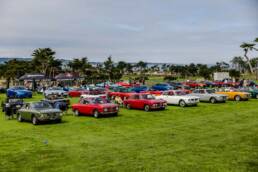
The Concorso Italiano is one of the main events not to miss during Monterey Car Week. It has become throughout the years the reference event for Italian cars, with a huge presence from all the clubs, from Alfa Romeo, Maserati, Ferrari and Lamborghini to smaller brands such as Cisitalia, Iso, Siata and De Tomaso. Always held on the Saturday just before the Pebble Beach Concours d’Elegance, it is one of my favorite events because the atmosphere is very chill, and everyone is there first and foremost to enjoy themselves.
Since we had already been to the Paddock at the same location the evening before, you might notice in the pictures some of the same cars. We will not talk again about the 1952 Siata 208 CS, the Aston Martin DB5 James Bond tribute, the BMW M1, the pink Spyker or the Ford Mustang GTD in this report. You can read our Paddock Monterey 2025 report if you want to know more about them here.
The 2025 edition, held on Saturday 16 August, was an important one. It marked the 40th anniversary of Concorso Italiano, while Cisitalia celebrated its 80th anniversary and the Lamborghini Diablo its 35th. The Iso Grifo also turned 60 and the Ferrari 308 family 50. It gave the organizers several very different themes: the delicate engineering of a small post-war Italian manufacturer, the excess of a V12 supercar from the nineties, and four decades of a show that has grown into one of the largest gatherings of Italian cars anywhere in the world.
Text & Pictures: Mickael B., Florent P. ©
I arrived at the Bayonet Black Horse Golf Course just after the official opening time, around 10:30 AM. I had already been to WeatherTech Raceway Laguna Seca early in the morning to see the Juan Manuel Fangio Cup Race and the Ken Miles Sixties GT Trophy Race. This is the normal problem during Car Week: even when you wake up early, you are already late for something else.
The golf course was already full, but Concorso Italiano remains easier to enjoy than many of the most formal events of the week. The cars are arranged by marque and club, owners stay close to them, people actually talk, and nobody seems excessively worried that a blade of grass might be pointing in the wrong direction. It is a concours, but one where the social part remains at least as important as the judging.
A pair of completely unreasonable Ferraris
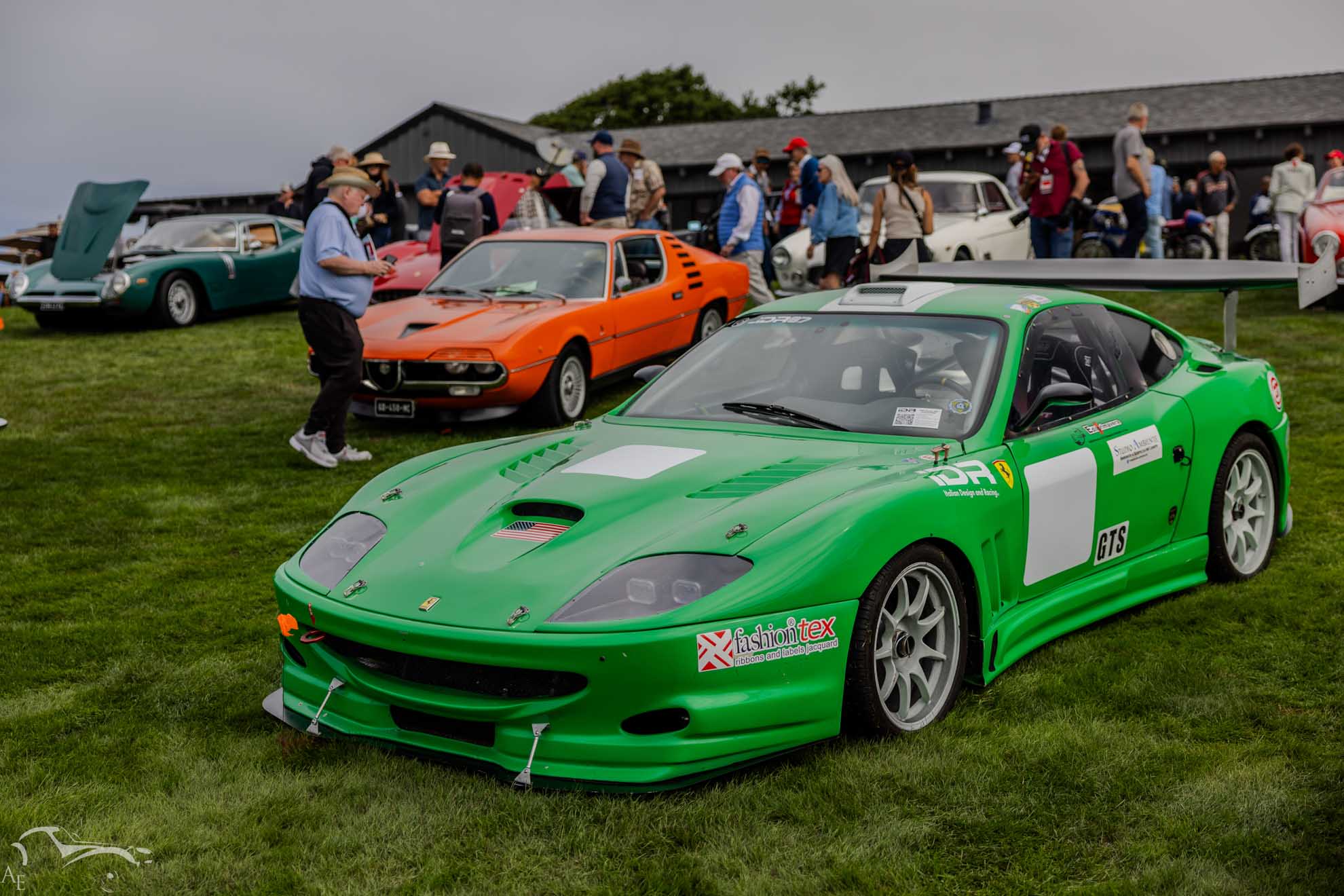
We started with a heavily modified track version of a Ferrari 550 Maranello, inspired by the famous Prodrive-built 550 GTS cars that became some of the most successful GT racers of their period. This car, chassis 107301, began life as a road-going 1997 Ferrari 550 before ENRO Competition in Italy converted it in 2016.
The transformation is quite extensive. The car received widened composite bodywork, centre-lock wheels, air jacks, a full roll cage and F40 LM-derived braking hardware. It does not pretend to be an original Prodrive chassis, which is important, but visually it captures the brutal stance of those Le Mans-era cars rather well. It was later offered through Sotheby’s Motorsport in 2024.
The green and yellow color choice was rather interesting, although certainly not one I would make specially for such an elegant car. Being a very lucky owner of a 550 myself, it is a car with which I have a very interesting love-hate relationship. You can read more about my experience with the model here. They might be easier to maintain than Testarossas, but one shall not forget that they are now old Italian supercars, built in a period where Ferrari was still using many inexpensive components shared with the Fiat group.
When everything clicks together though—the gearbox, the engine, the steering and the chassis—it is an amazing piece of machinery. The standard 550 is not a race car and never tries to be one. That is precisely why this ENRO conversion is so fascinating: it takes one of the most elegant and usable front-engined Ferraris and removes almost everything that made it civilized.
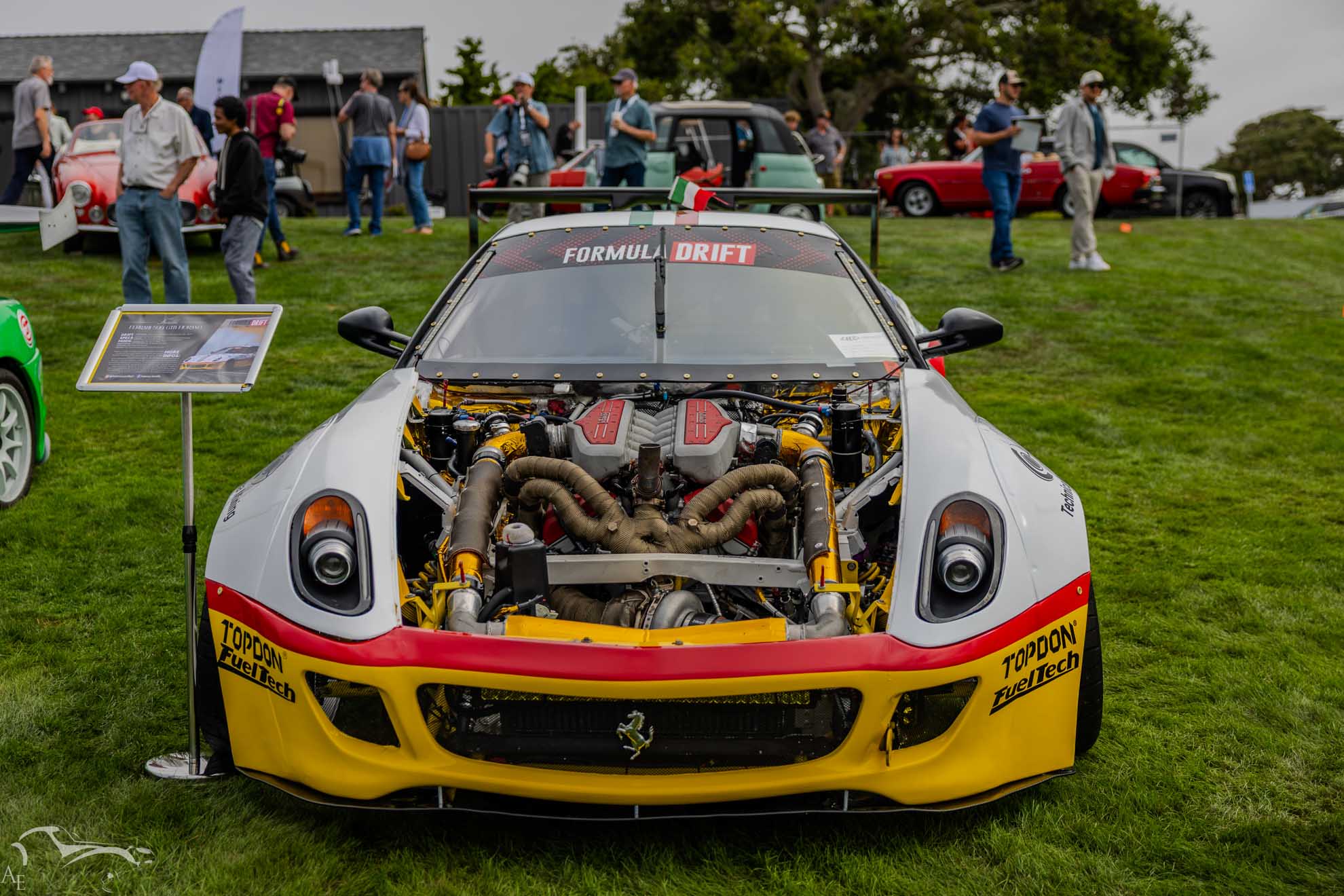
Next to it was another heavily modified Italian thoroughbred, the 550’s successor, a Ferrari 599 GTB Fiorano nicknamed “Fiorella”. It was prepared for Formula Drift by Italian driver Federico Sceriffo and his team, and has evolved considerably since its first competition outings.
The car debuted with twin Rotrex superchargers, but its later specification has been described with a turbocharged V12 producing roughly 1,100 to 1,150 horsepower and more than 1,000 Nm of torque. Whatever the exact configuration at a given event, it is far in excess of the original 599 GTB’s 620 horsepower output.
With its wider arches, custom suspension, huge steering angle, lightened body and an engine trying to send four-figure power numbers to the rear wheels, it has everything necessary for professional drifting. The car had notable reliability issues when it first entered the series in 2018, which was not exactly surprising. A 599 is a heavy grand tourer with a large V12 placed ahead of the driver, not the obvious base for a drift competition car.
That is what makes Fiorella more interesting than a technically easier build. It is tricky, expensive and probably absurdly demanding to keep alive, but watching somebody use a Ferrari V12 GT in a discipline dominated by much more conventional platforms is precisely the kind of madness I like seeing at Concorso Italiano. I can only take my hat off to Federico’s achievements.
Cisitalia at 80: small manufacturer, enormous legacy
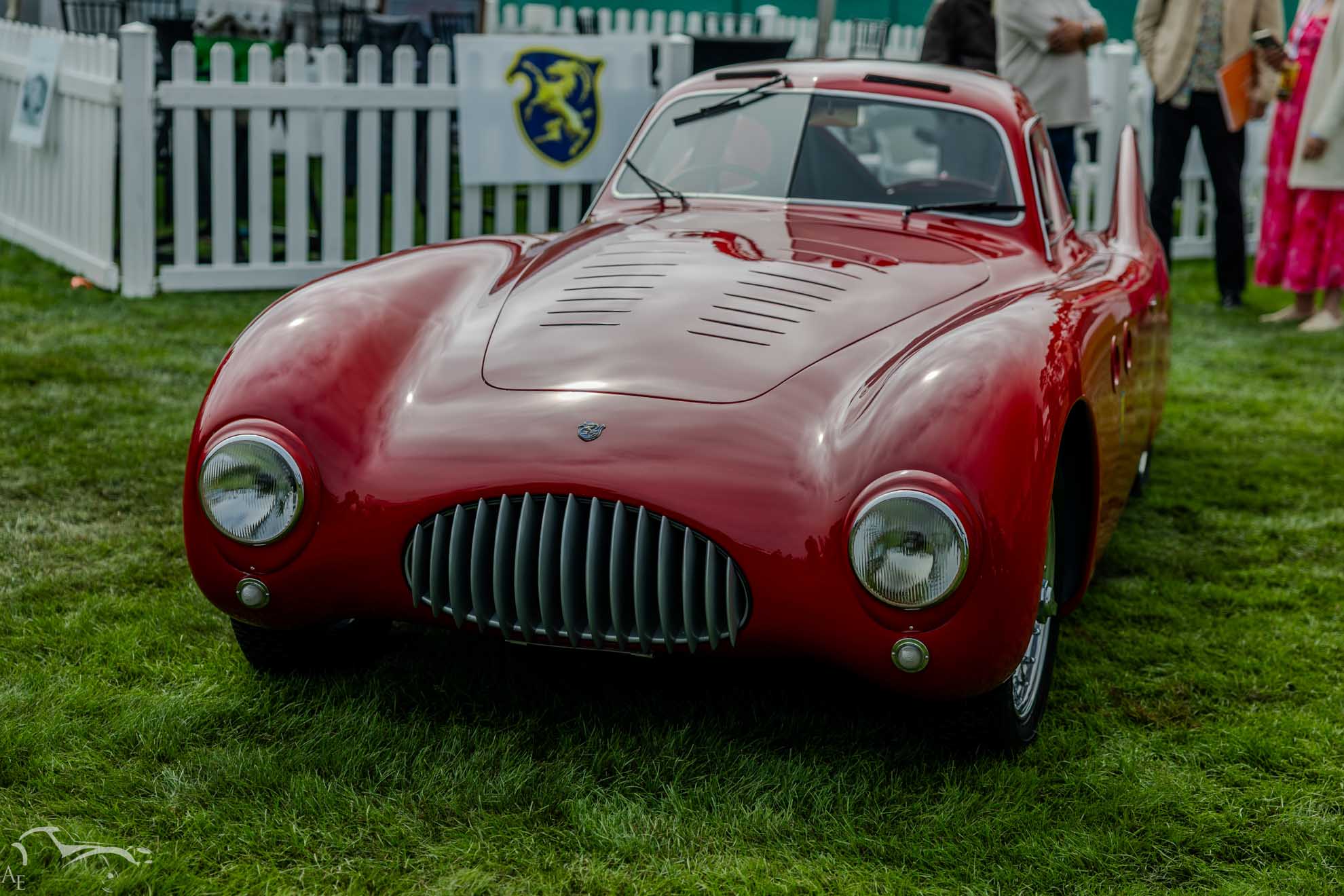
This year’s main featured marque was Cisitalia, celebrating its 80th anniversary. The star of the display was this 1947 Cisitalia 202 CMM Aerodinamica Coupé from the Lawrence Auriana Collection, which was later selected as the overall Best of Show.
The exact chassis and engine numbers quoted in some informal descriptions could not be independently confirmed from the photographs or from an authoritative public record, so I prefer not to repeat them as facts. What can be established is already more than interesting enough: this was an ex-factory competition Cisitalia, one of the extremely rare aerodynamic coupés developed around the 202 CMM programme, and it participated in the 1947 Mille Miglia.
Its streamlined form was shaped under Giovanni Savonuzzi’s direction and executed with lightweight coachwork by Vignale. It looks narrow, delicate and almost fragile compared with a modern racing car, yet its entire shape is dictated by the same obsession that still drives engineers today: reducing drag and mass while extracting the most from limited power.
Cisitalia did not have the resources of Alfa Romeo or Ferrari. It worked largely with Fiat-derived mechanical components, but used them with remarkable ingenuity. The company’s influence was much larger than its production numbers. The better-known road-going 202 Gran Sport, designed by Pinin Farina, became one of the first cars acquired by the Museum of Modern Art for its permanent collection. The 202 MM Aerodinamica tells the more competitive side of that same story.
The anniversary display included two D46 single-seaters, a Nuvolari Spyder and the later Cisitalia-OSCA DF85. One of the D46s had finished fifth in the 1946 Coppa Brezzi and later won the 1947 Mont Ventoux hill climb, while the other was the Coppa Brezzi winner. The small “Alleggerita” Spyder recalled Piero Dusio’s own participation in the 1947 Mille Miglia, and the 1960 DF85 showed how the Cisitalia name survived through a final mix of Fiat chassis, custom bodywork and an OSCA engine.
Seeing all of them together made the Best of Show decision rather logical. The Aerodinamica might not have the visual drama of a Miura or a Daytona, but it represented exactly what a special-feature class should do: show visitors a chapter of automotive history that most people know only through books.
De Tomaso before and after the Pantera
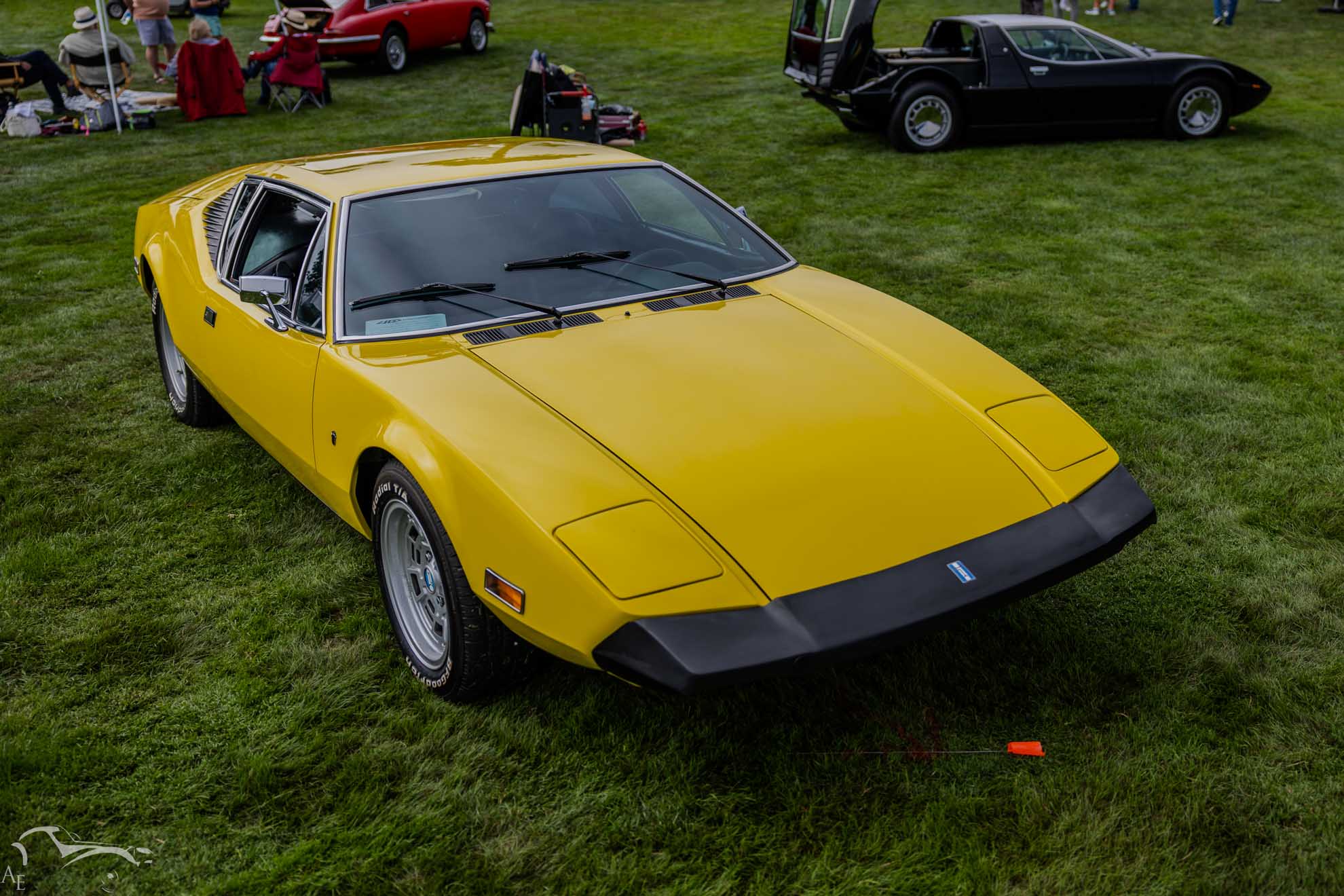
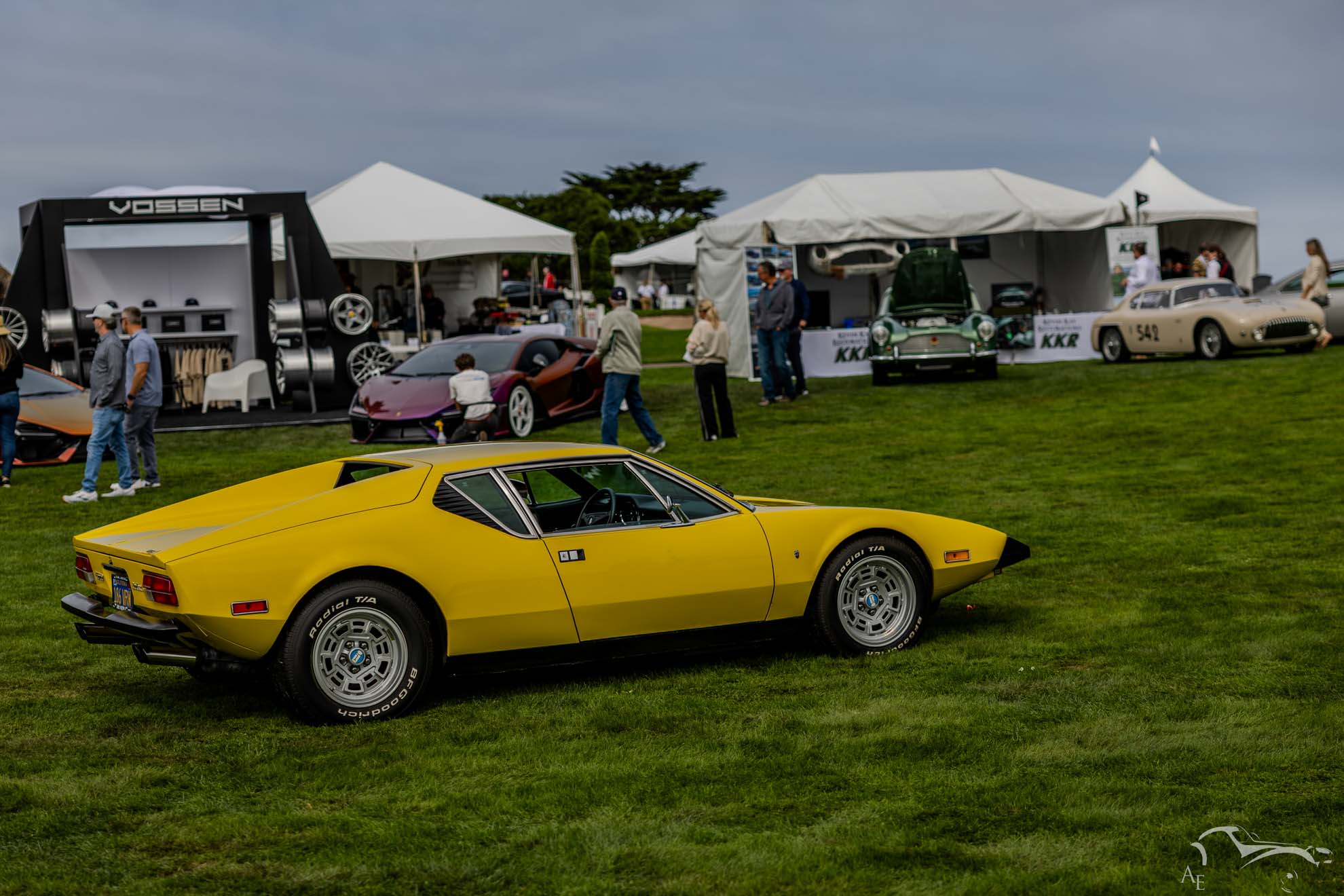
A bright yellow De Tomaso Pantera was one of the first cars to pull me away from the Cisitalia display. Designed by Giorgetto Giugiaro while he was at Ghia, the Pantera was one of the most dramatic shapes of the late sixties. Its very low nose, sharp waistline and rear engine covers make almost every modern supercar look excessively complicated.
This first generation, was built with big american V8 power. It had all the ingredients people now romanticize: an Italian body, an American engine, a central backbone chassis and proportions which give practicality absolutely no priority. It also had the faults people conveniently forget, including a reputation for nervous handling and limited rear visibility.
Would I still want one? Clearly yes. The Pantera is not compelling because it is objectively perfect. It is compelling because it looks as if the designer refused every sensible compromise.
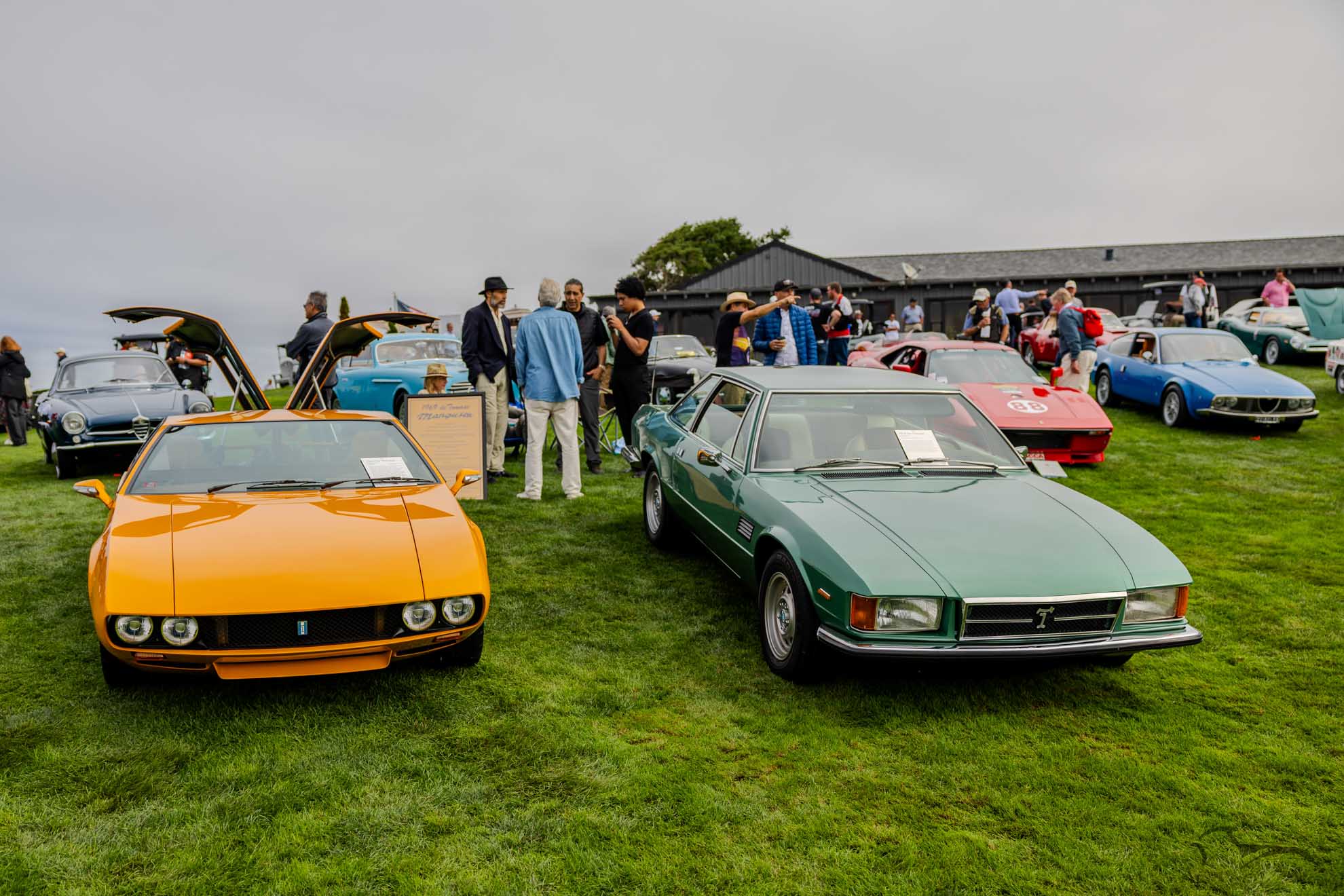
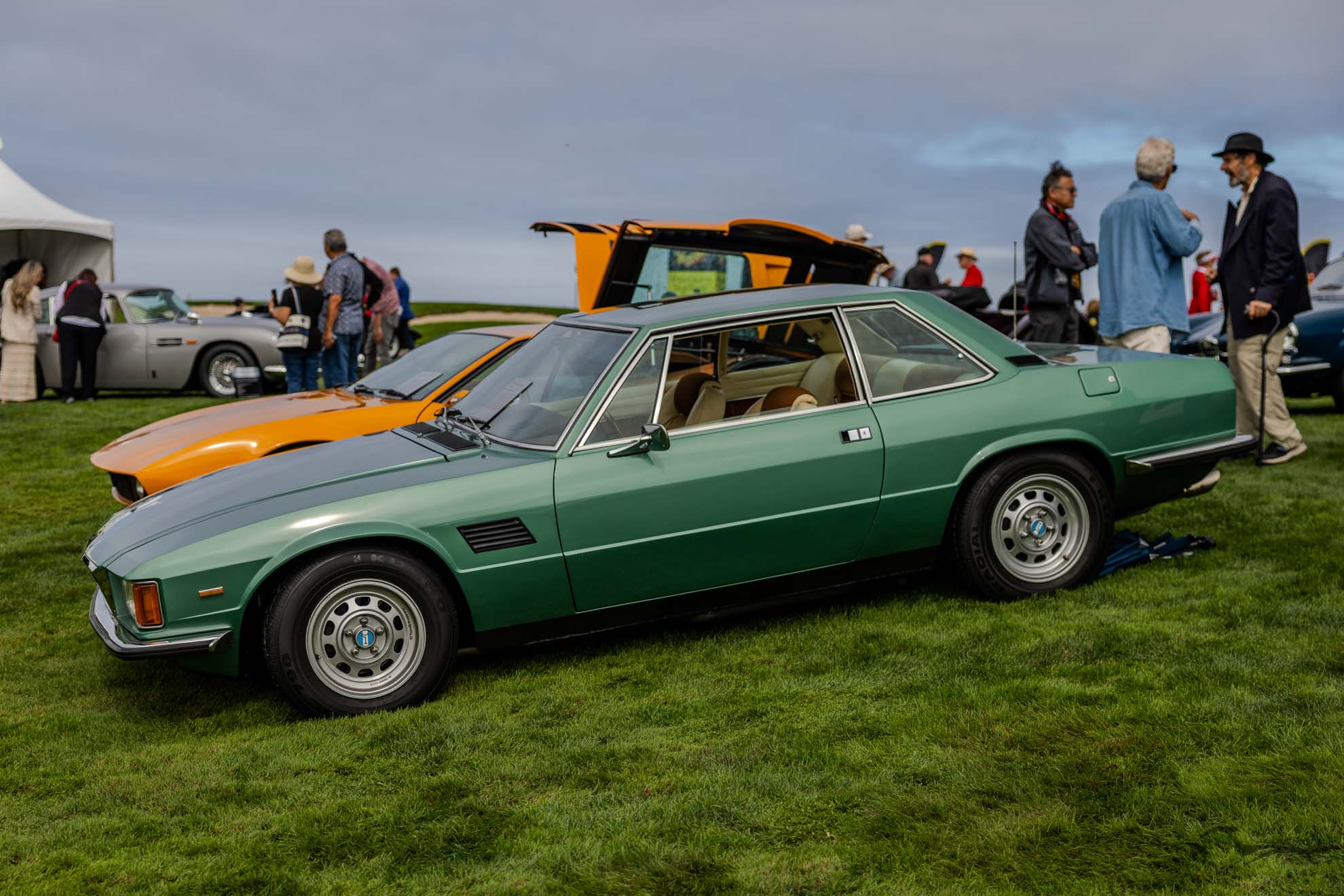
The dark green Longchamp parked nearby showed another side of De Tomaso. Introduced in the early seventies, it was a front-engined luxury GT rather than a mid-engined exotic. Tom Tjaarda designed a restrained, angular body around a Ford V8 and much of the same basic platform used by the De Tomaso Deauville saloon.
The Longchamp is much less famous than the Pantera or Mangusta, but that is precisely why it deserved a place here. It sits somewhere between a Maserati Kyalami, an Iso Lele and an American personal luxury coupé. Production remained very low, with only a few hundred cars built across the coupé and later GTS or Spyder variants.
It is not as immediately beautiful as the Mangusta, but its dark green paint helped. The car has the kind of discreet menace that would make it a very good long-distance companion. The Mangusta is the one you put on a poster; the Longchamp might actually be the one you use.
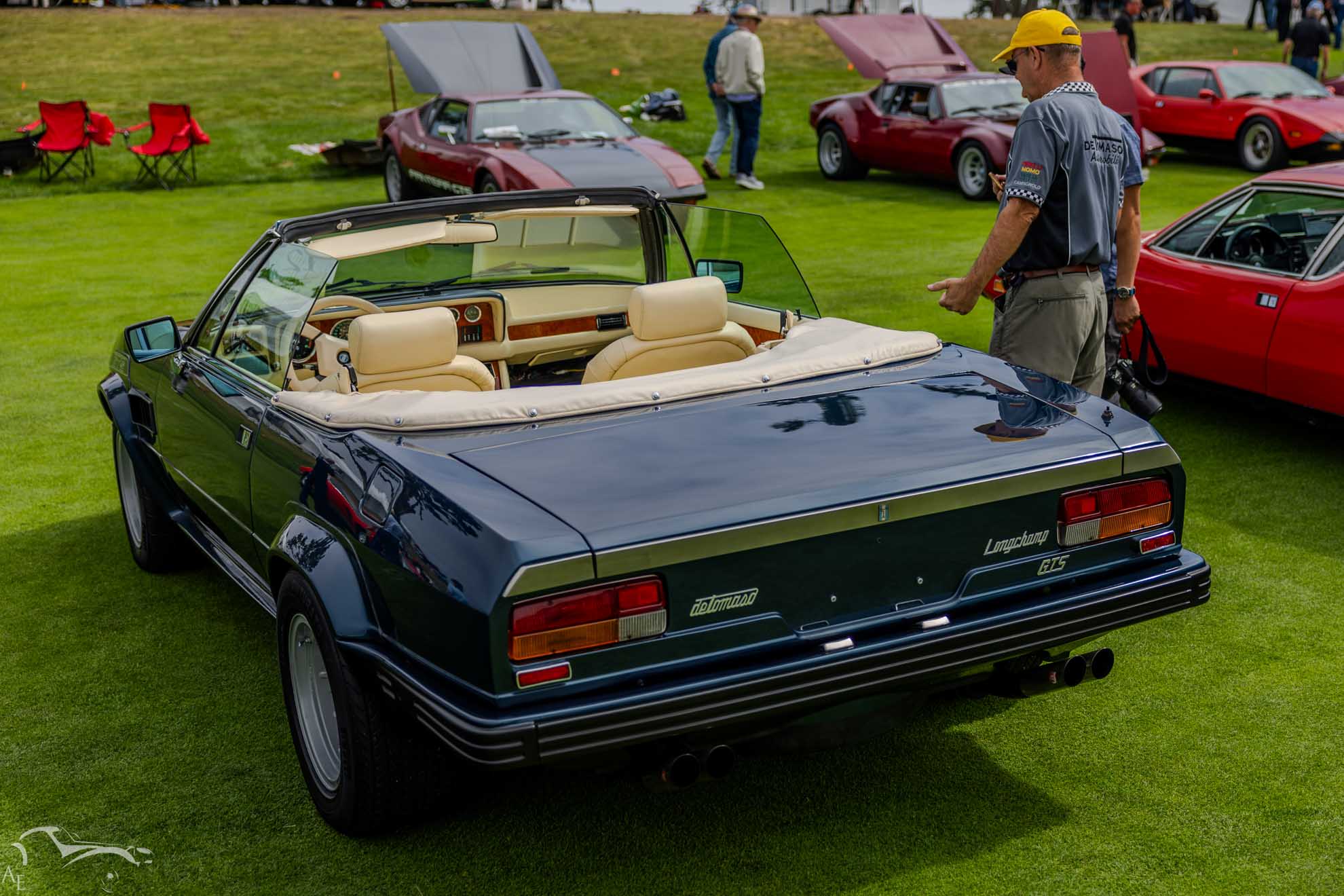
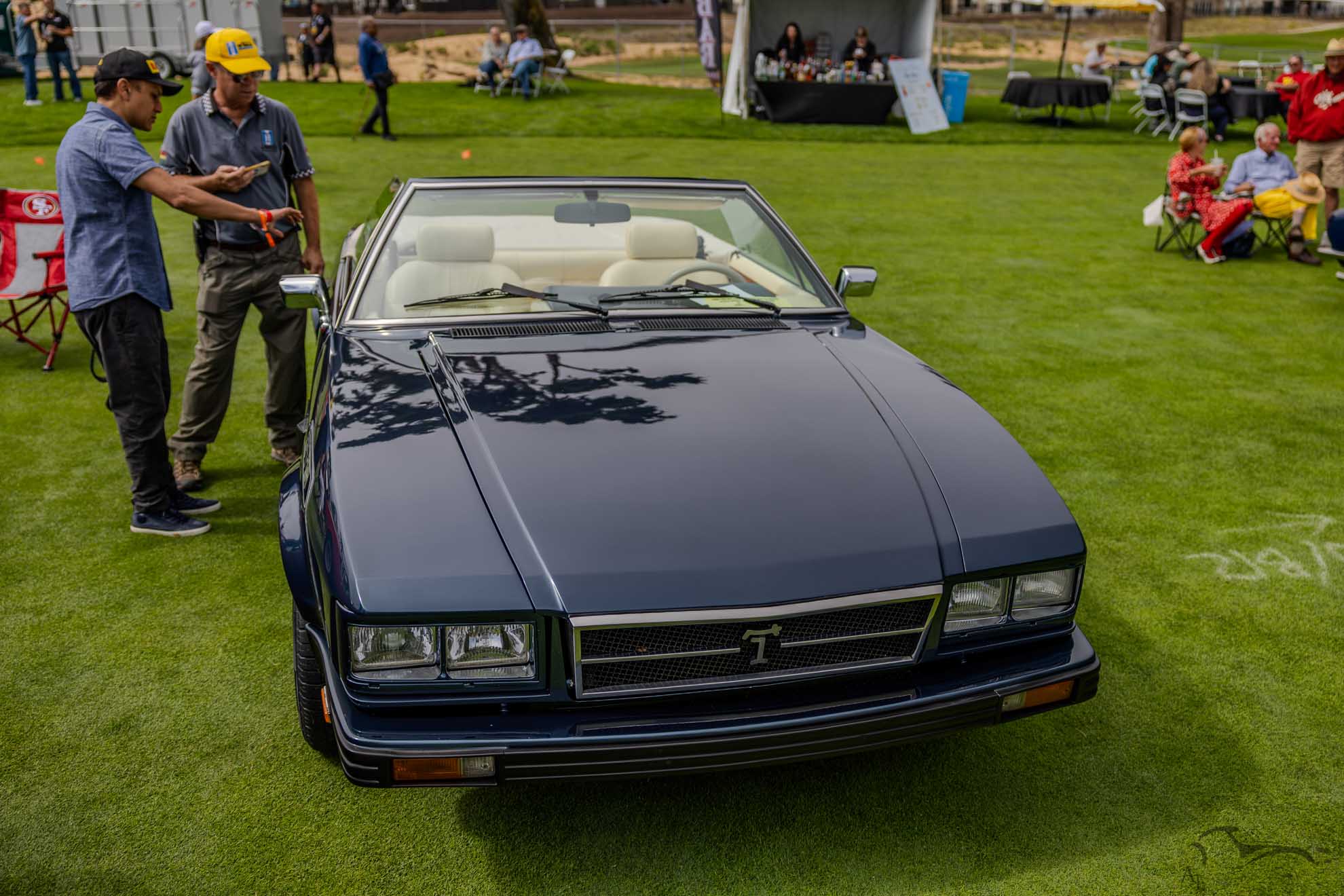
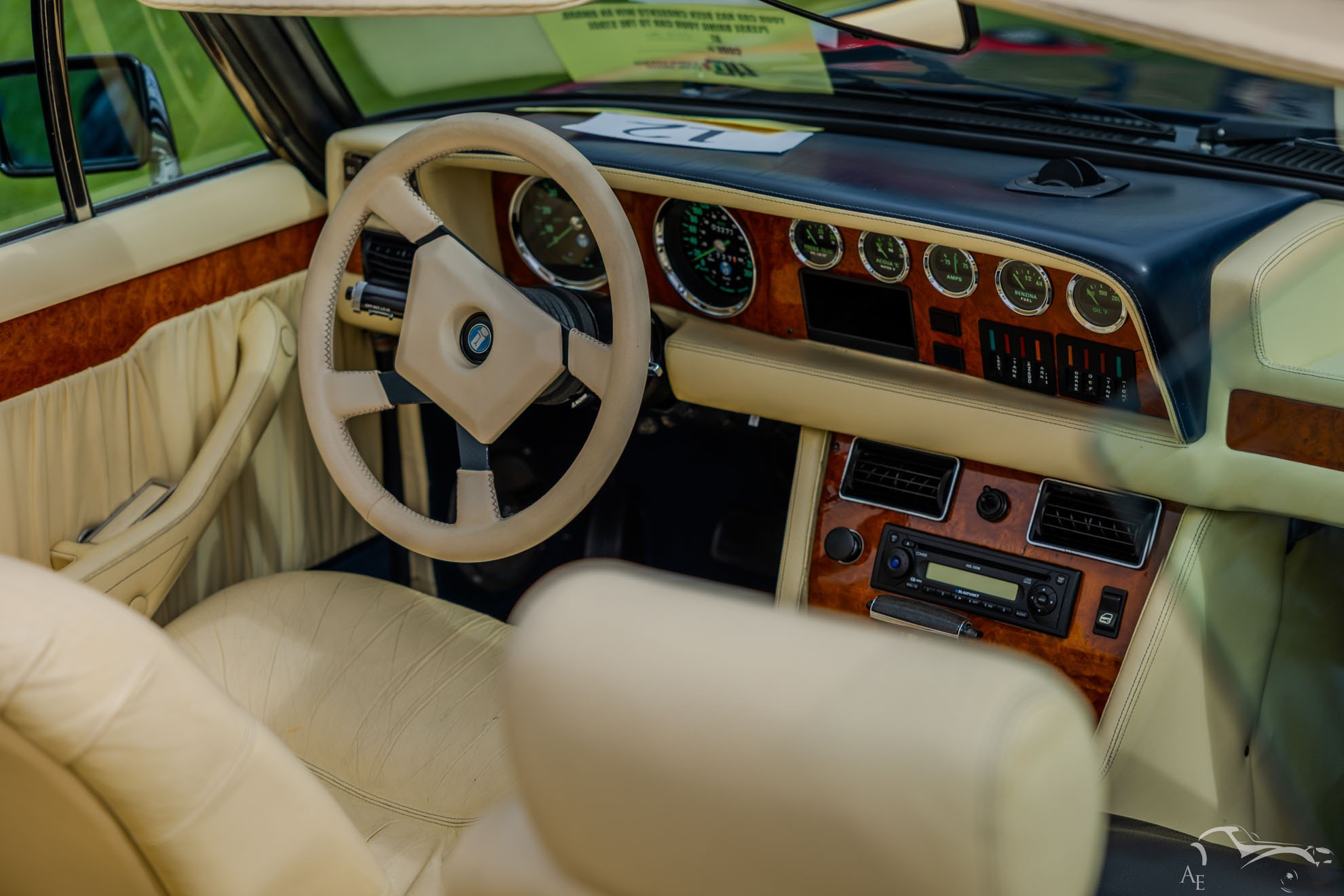
The dark blue Longchamp GTS Spyder later in the field was considerably rarer than the coupé. Carrozzeria Pavesi converted the open cars, and only 14 Spyders are generally reported among roughly 409 Longchamps produced.
The widened GTS arches, broad rear deck and four exhaust tips make it considerably less discreet than the green coupé. It still uses the same basic formula: Tom Tjaarda’s front-engined 2+2 shape, a Ford 351 Cleveland V8 and a cabin saturated in leather and period switchgear.
Convertibles often weaken the proportions of angular coupés, but the Longchamp survives the operation better than expected. The coupé is cleaner; the Spyder is rarer and stranger. At Concorso Italiano, rarity and strangeness usually win my attention.
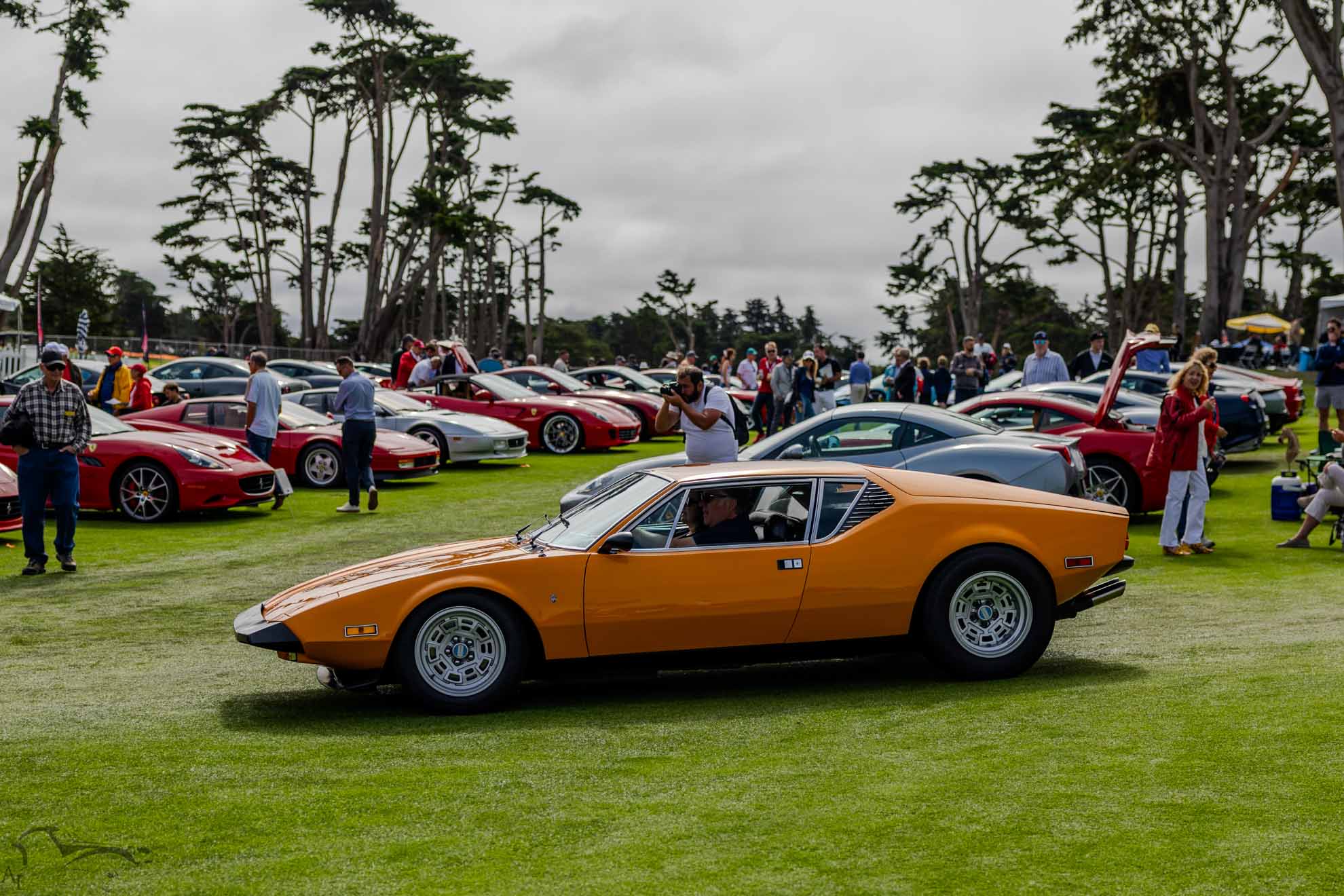
The Pantera was of course much better represented. It was the car that finally made the De Tomaso formula commercially significant: Italian design and construction, Ford Cleveland V8 power, and official distribution through Lincoln-Mercury dealers in the United States.
This orange example was close to the clean, classic Pantera shape. Compared with the later wide-bodied cars, the early design is almost delicate. The flying-buttress rear quarters, black engine cover and low nose already give it enough presence without needing enormous wings or modern wheels.
The Pantera International Best of Show award went to Gary and Sue Choate’s 1973 Pantera L. It remains one of the central pillars of Concorso Italiano.
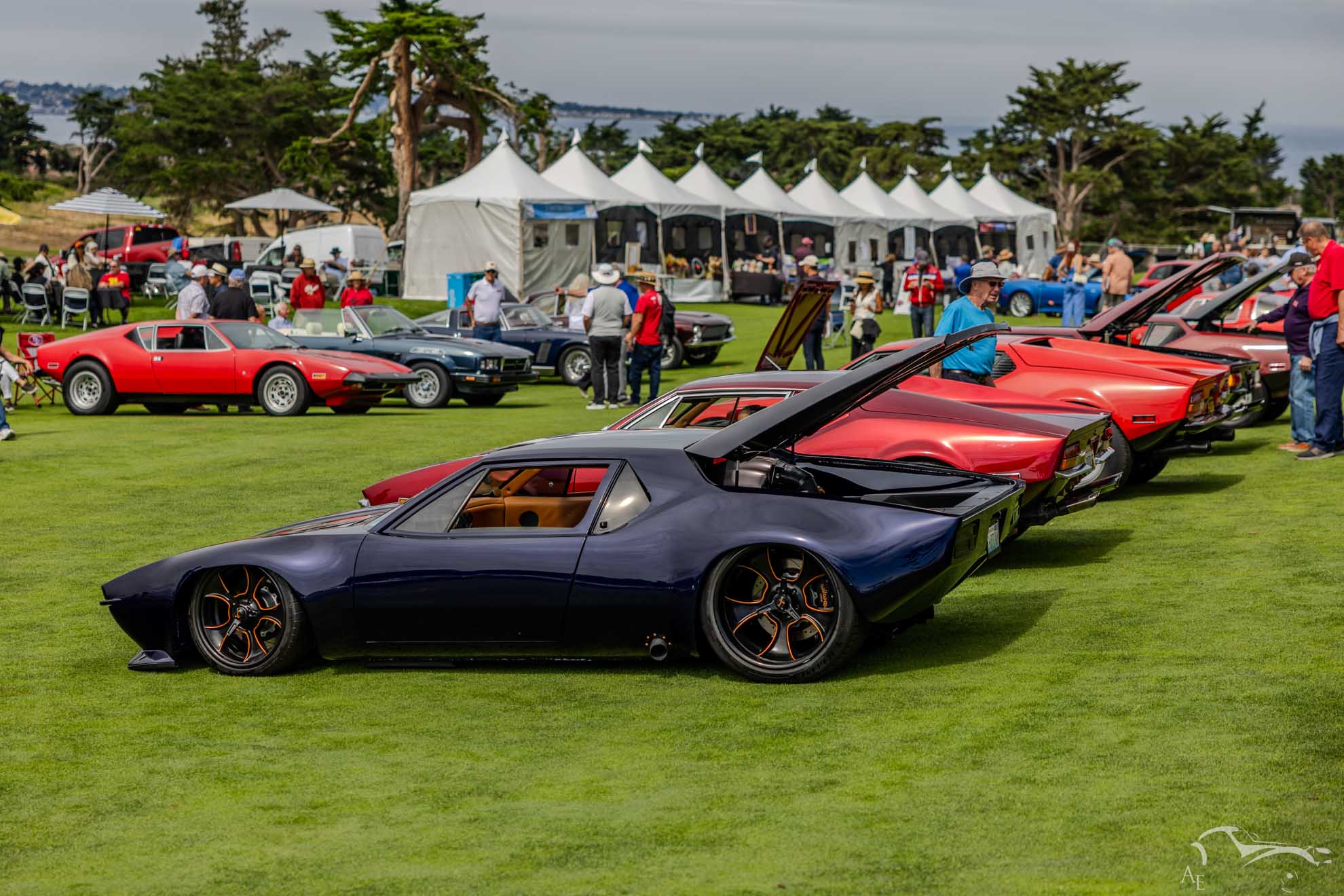
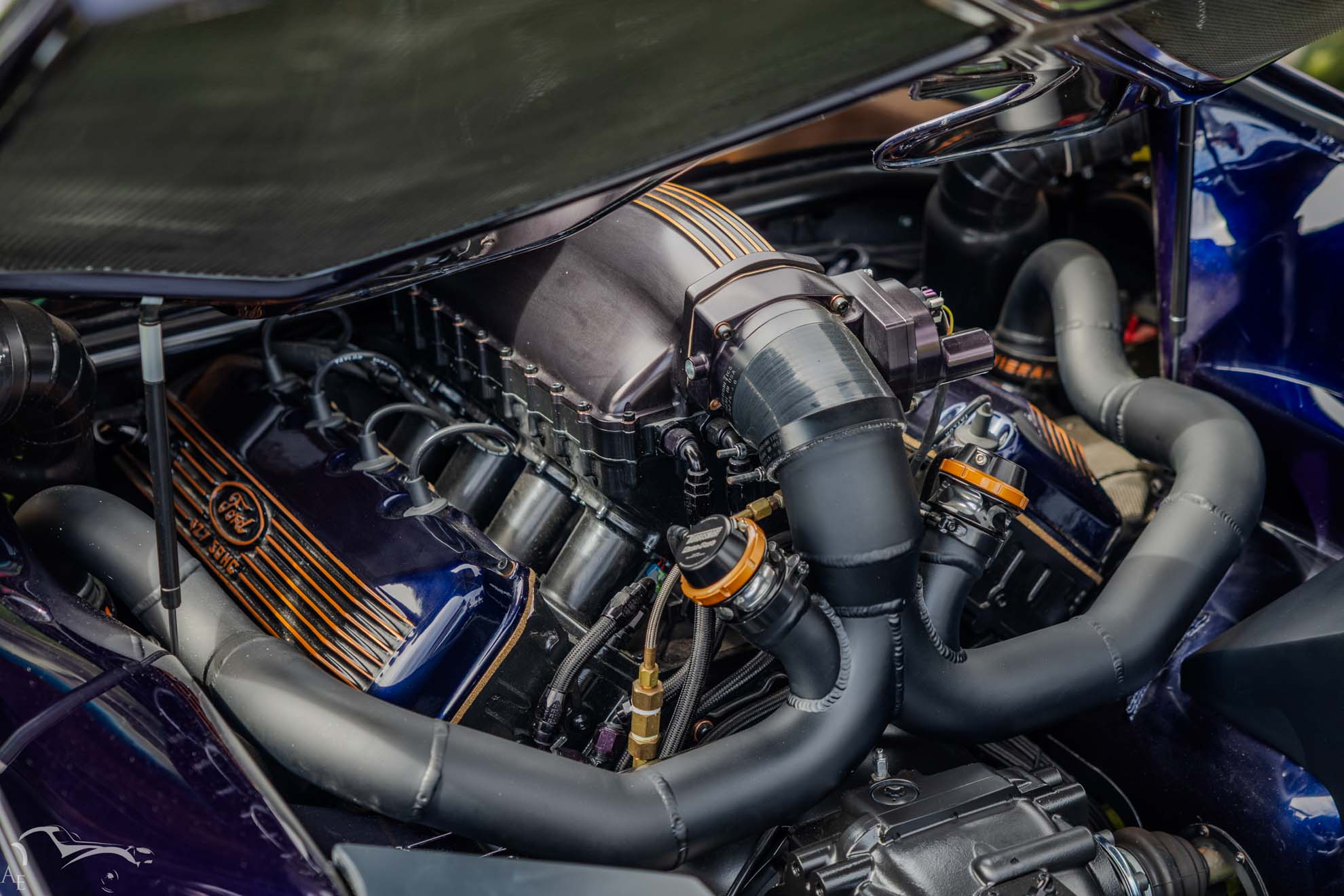
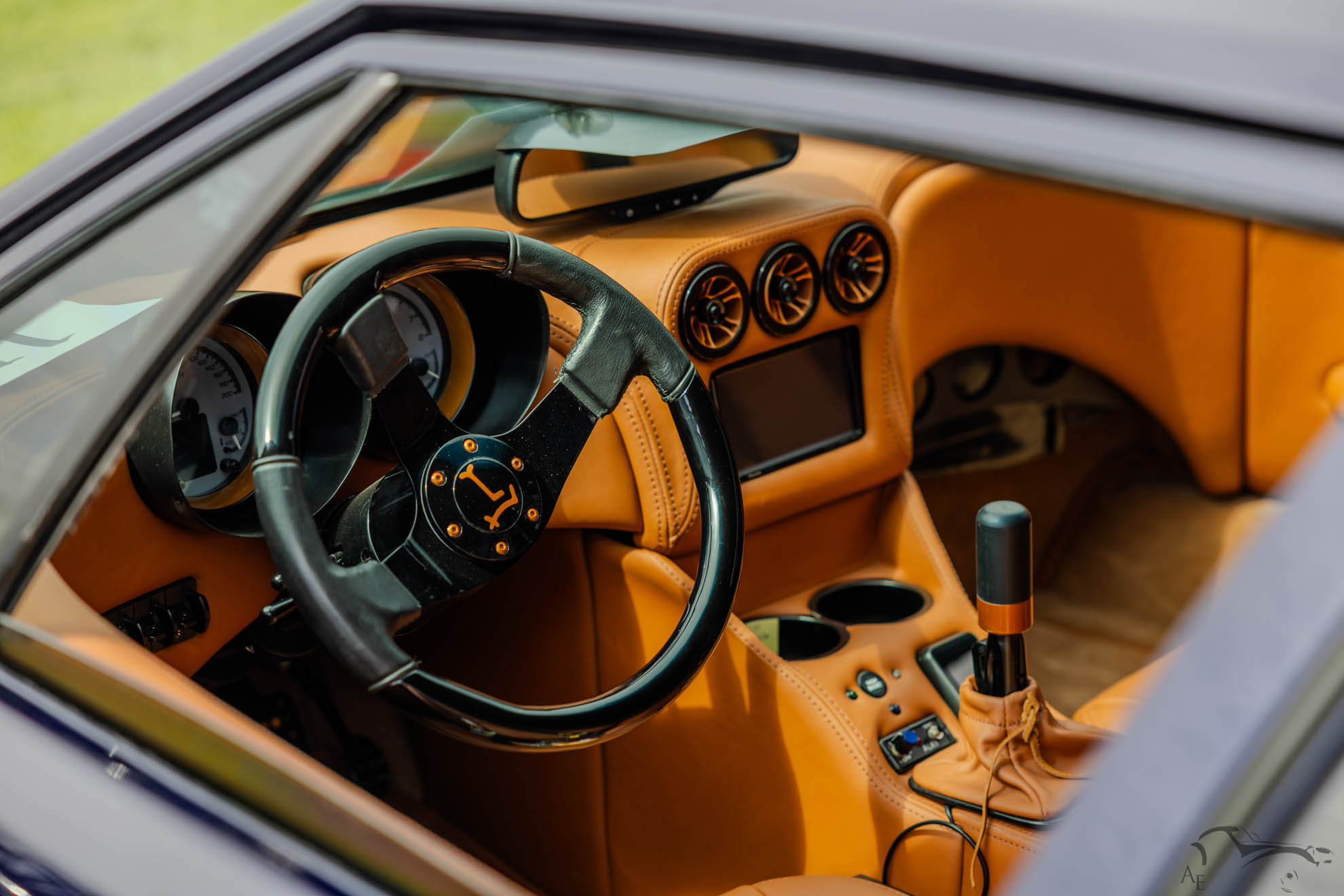
At the other extreme was Greg and Robin Paboojian’s extensively modified 1973 Pantera, finished in a deep metallic shade which moved between midnight blue and wine-purple under the California sun. It sat extremely low over modern wheels and hid a Ford 427 Cammer under its rear deck. The personal plate, SHODOWN, was appropriate.
Restomods divide people, and I understand both sides. A standard Pantera has become valuable enough that irreversible modifications can destroy originality. On the other hand, Panteras were modified from almost new, and the car’s American V8 makes it one of the most natural Italian exotics to personalize.
The risk is always going too far. Here the color and stance were certainly not subtle, but the underlying Tom Tjaarda-designed wedge shape still came through. I would not trade a perfect early Pantera for it, but I would much rather see a controversial custom car used and debated than another red example hidden permanently in a collection.
Italian-American grand touring: Apollo GT
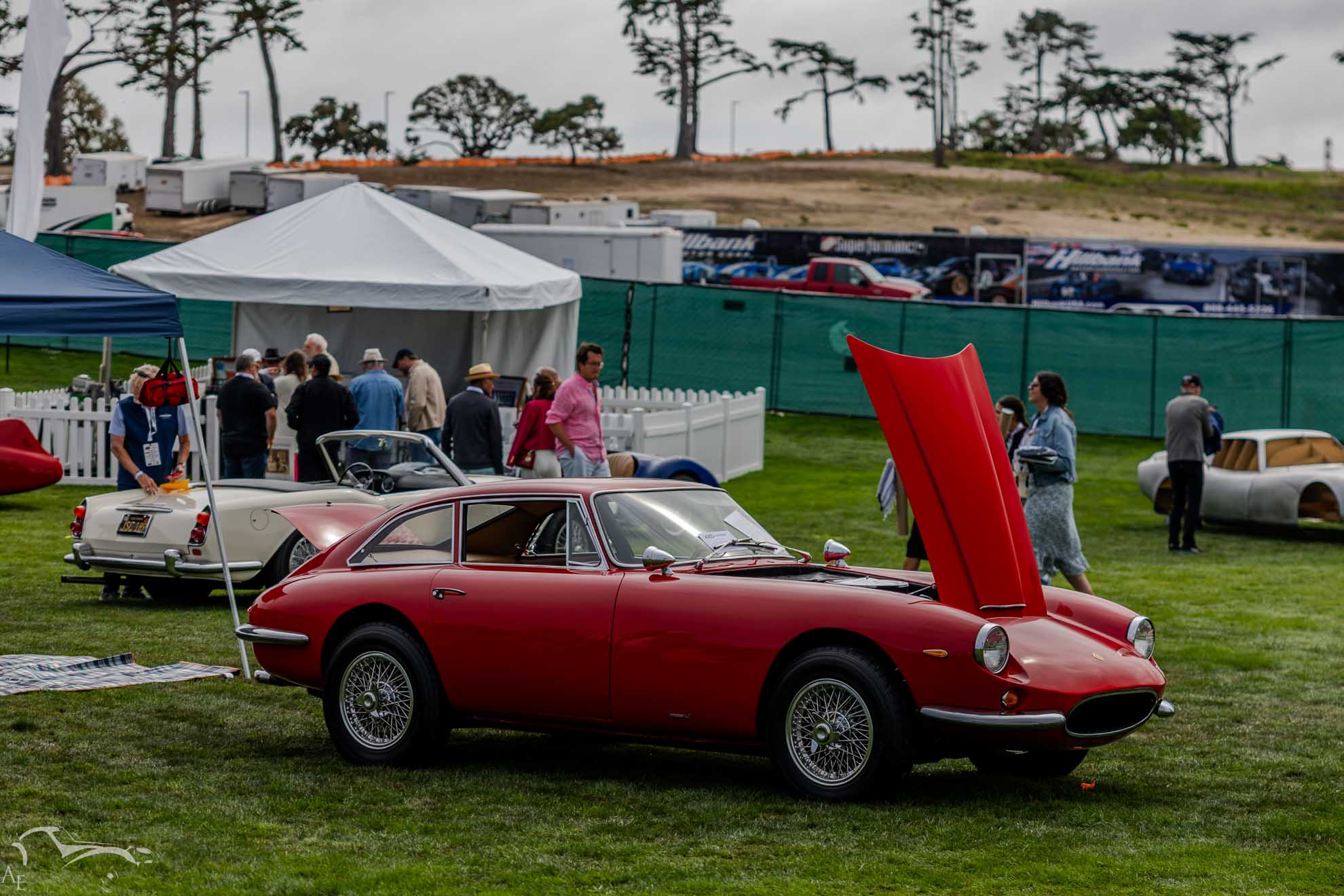
The red 1967 Apollo GT was rarer still. The Apollo project began with American engineer Milt Brown, who wanted to create a home-grown rival to Ferrari using a lightweight American V8 and Italian coachwork. The bodies were constructed by Intermeccanica in Italy before the cars were completed in the United States.
Most Apollo GTs used the compact Buick aluminium V8, but event coverage identified this particular Denny K. Paul-owned car as using a Chevrolet Corvette 327-cubic-inch V8. Fewer than 100 Apollos were produced in total, and their exact histories can be complicated because the project changed corporate structures and names several times.
The Apollo is not as visually aggressive as the Grifo. It is smaller, rounder and perhaps more obviously early-sixties in proportion. Yet it may be historically more interesting because it represents an American attempt to create a genuine transatlantic GT company from scratch, not merely to buy an Italian body for an existing chassis.
The elegant obscurity of Fiat-OSCA
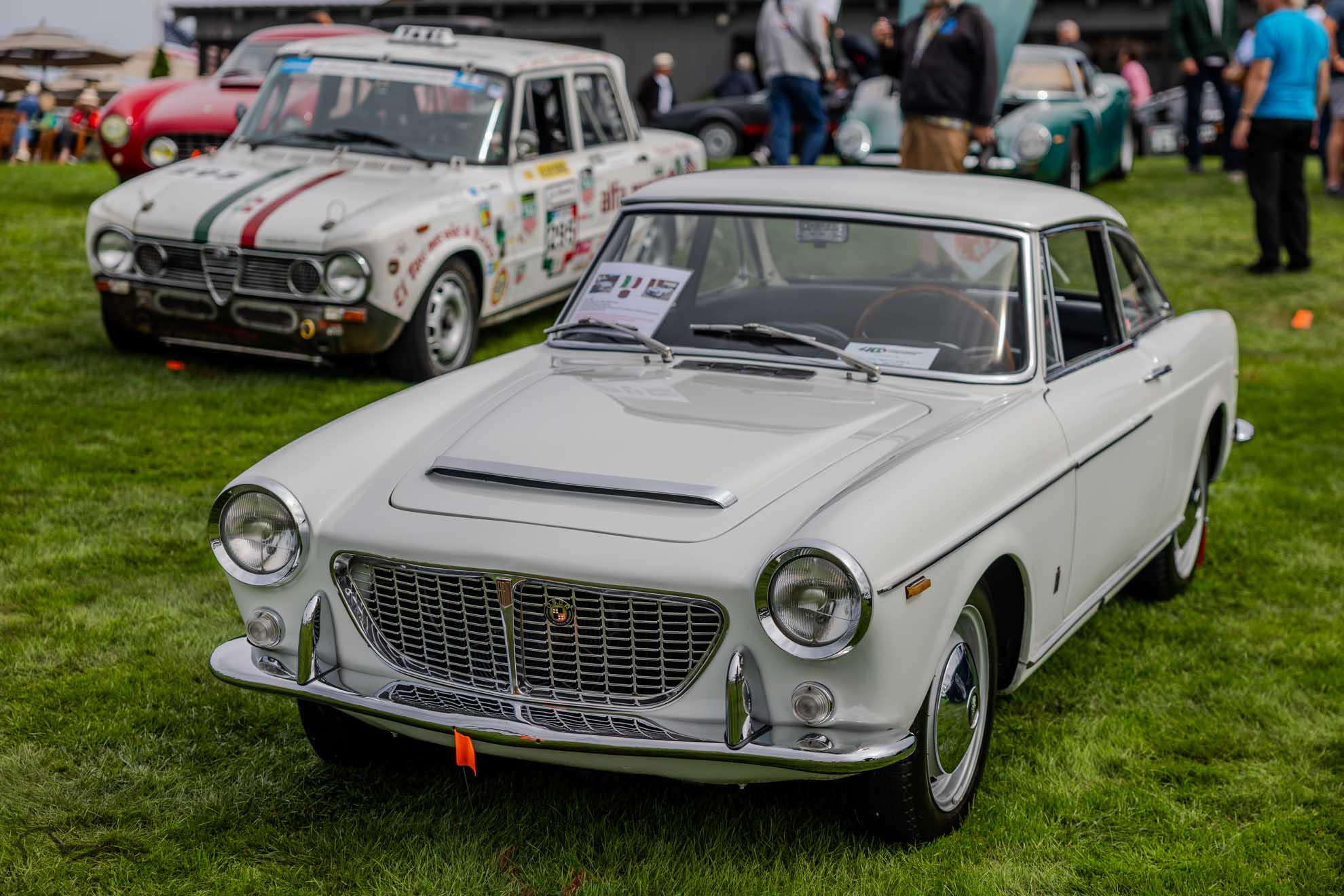
The white Fiat-OSCA 1600 S Cabriolet looked almost modest next to the Grifo and Mangusta. That is deceptive. Under its Pininfarina body sits an OSCA twin-cam engine, connecting the car directly to the Maserati brothers’ post-Maserati company.
Fiat offered the 1500 S and later 1600 S as higher-performance versions of its Pininfarina cabriolet. The later 1600 used a 1,568 cc twin-cam four-cylinder and could be identified by details including the more pronounced bonnet intake. This example also wore its removable hardtop, which gives the elegant open car a surprisingly formal appearance.
It is the kind of car many people walk past because it does not shout. Yet it combines three of the most important names in Italian motoring—Fiat, OSCA and Pininfarina—in one compact object. I would argue that this is exactly the sort of car Concorso Italiano is best at revealing.
Maserati: from Vignale prototypes to brutal Biturbo wedges
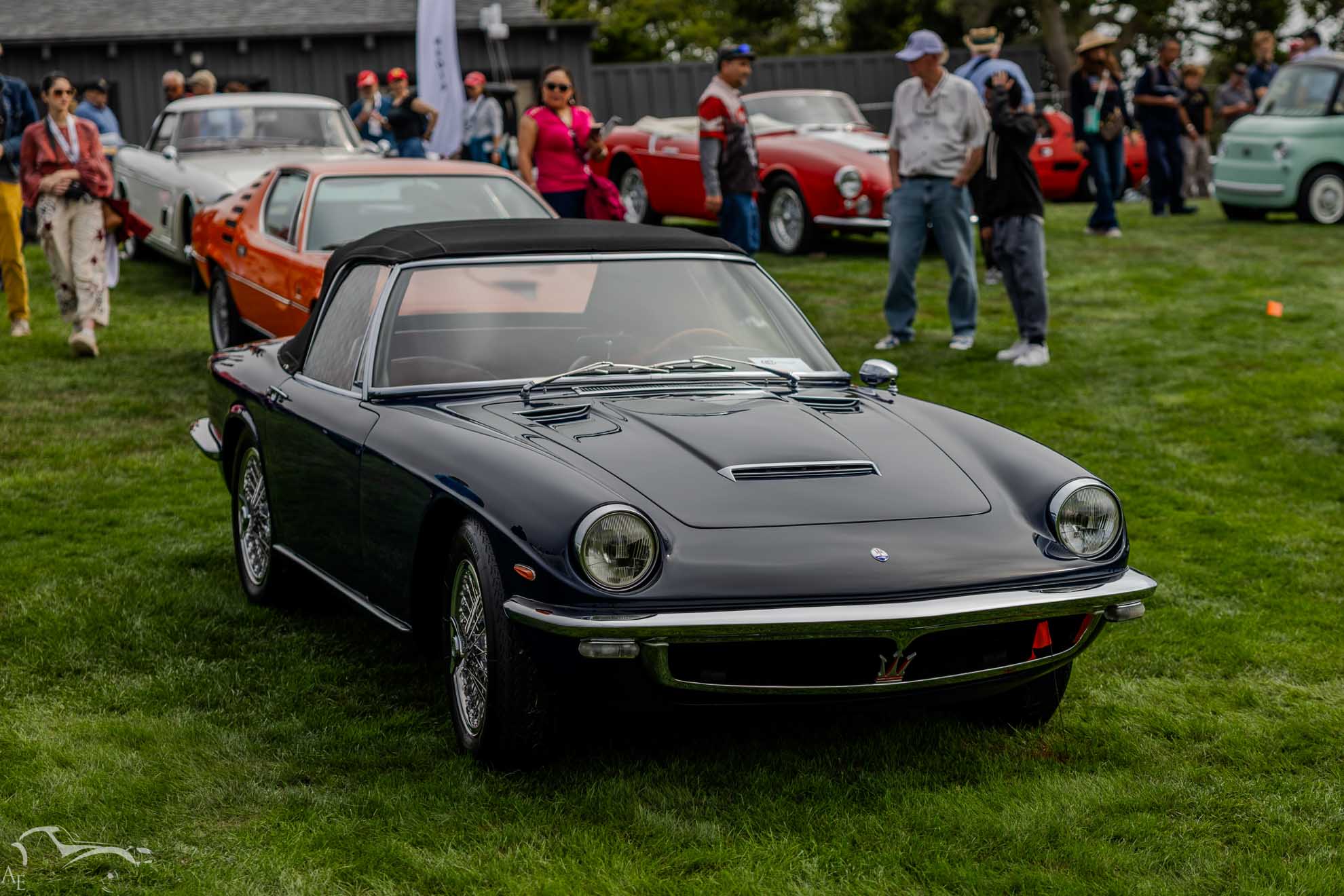
The dark blue Maserati Mistral Spyder was one of the most elegant open cars at the event. The Mistral was the first Maserati road car named after a wind, starting a tradition later followed by Ghibli, Bora, Khamsin and Shamal.
Pietro Frua styled the original Mistral coupé, while Giovanni Michelotti adapted the design into the Spyder and Vignale built the open bodies. Mechanically it shared much with the Sebring and used Maserati’s race-derived twin-cam straight-six with Lucas fuel injection, offered in 3.5-, 3.7- and later 4.0-litre forms. Only 124 Mistral Spyders were built, making them much rarer than the coupé.
The body is simple but full of details: the long bonnet, the sharp front, the low windscreen and the restrained tail. In dark blue it looked even more sophisticated. Red would make it more visible; blue makes it look expensive.
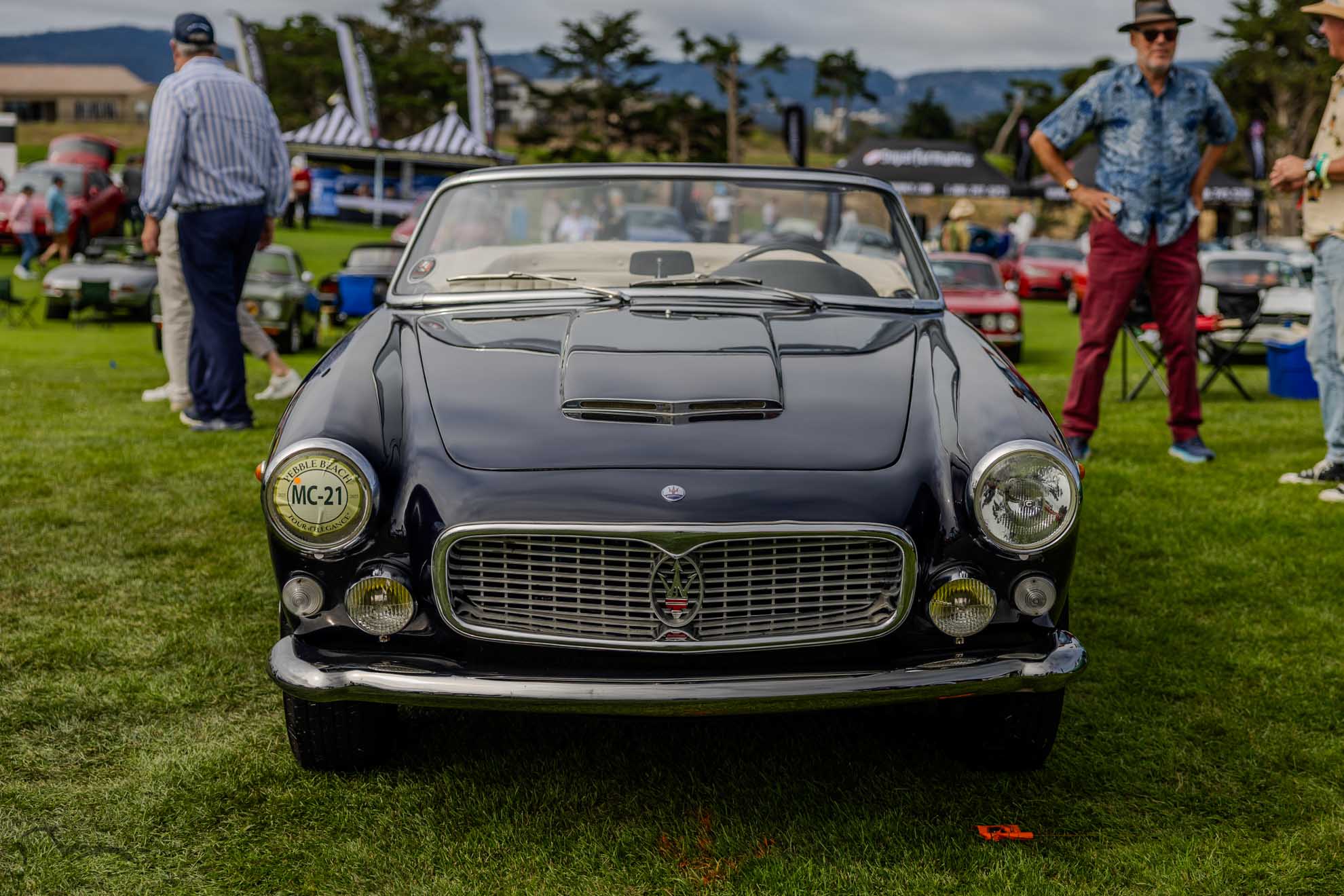
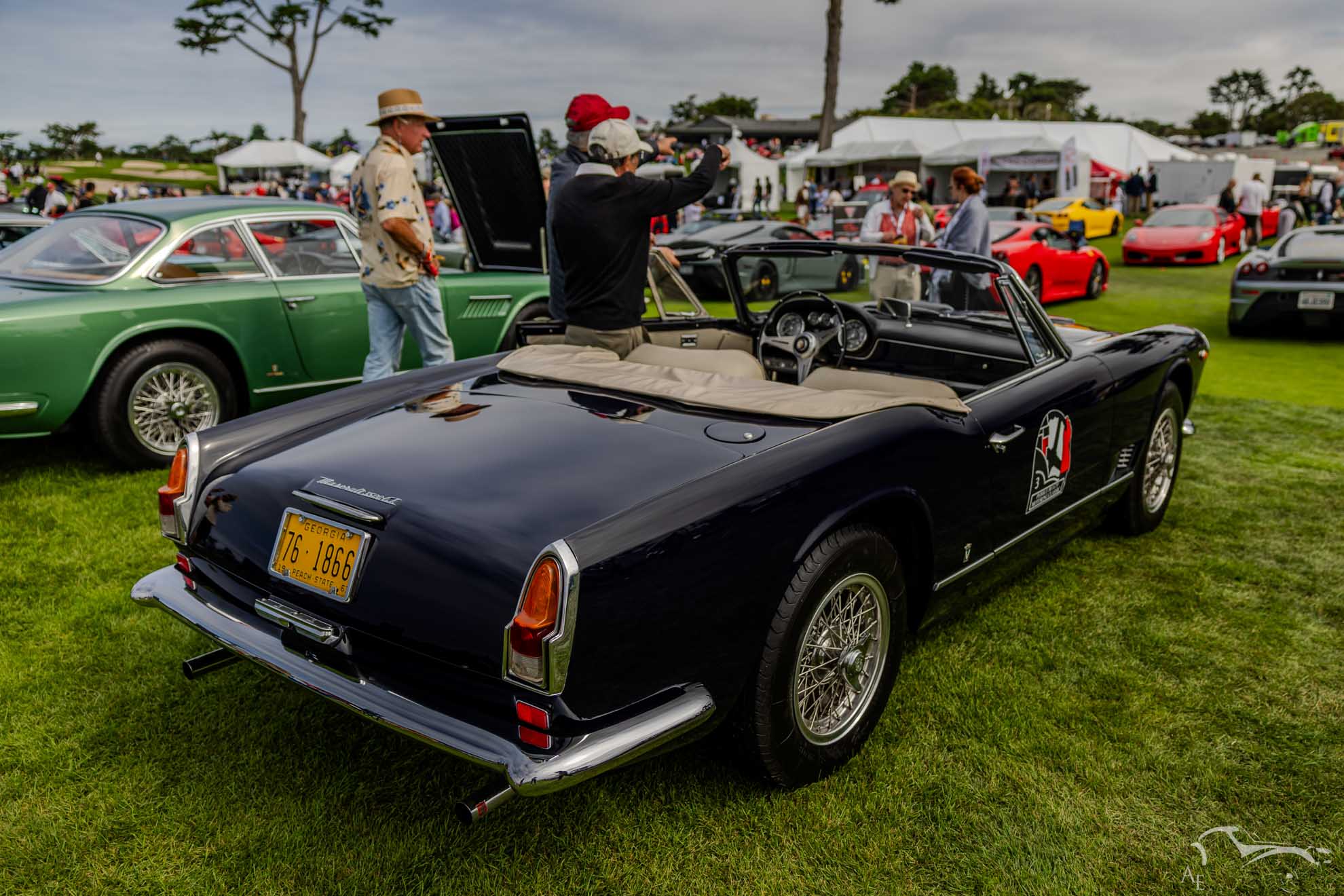
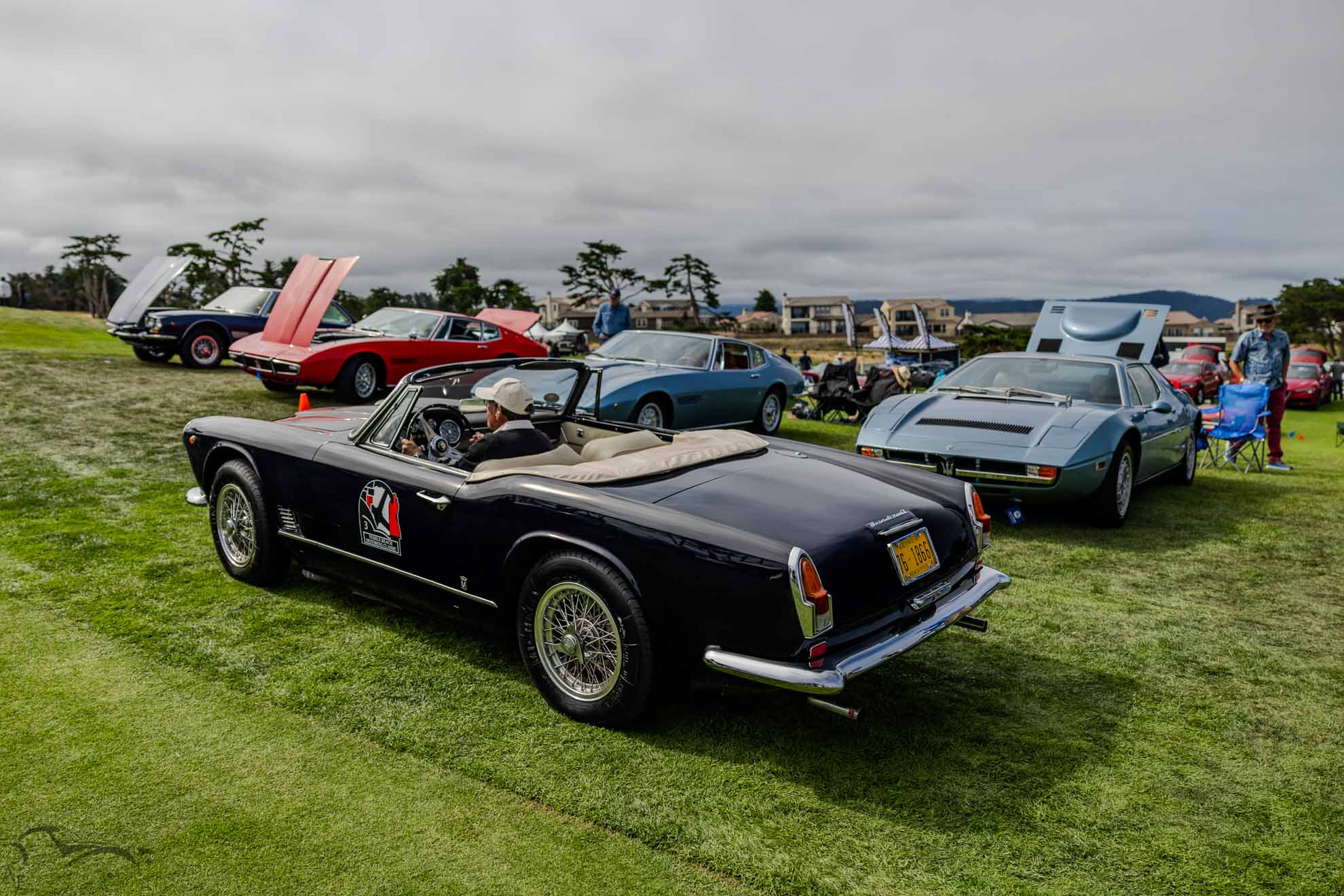
Beside the Mistral was a much more important car than I initially understood: Phil White’s 1959 Maserati 3500 GT Vignale Convertible Prototype, chassis 101.505, which received the Chairman’s Award. Designed by Giovanni Michelotti and built by Vignale, it was one of the small group of experimental open 3500 GTs which established the form of Maserati’s production Spyder.
It differs from the later production cars in details including its larger grille, bonnet treatment, front bumper and badging. The car was first delivered to Californian gentleman racer Joe Lubin. When photographed at Concorso Italiano it wore very dark blue paint with a cream interior; Maserati Classiche later confirmed its identity during a factory-supported restoration.
Under the bonnet is Maserati’s 3,485 cc twin-cam straight-six, fed by Weber carburettors, with period specifications of around 235 horsepower and a four-speed ZF manual gearbox. This is exactly the kind of prototype one can walk past if concentrating only on shape. Once its history is understood, it becomes one of the most consequential Maseratis on the field.
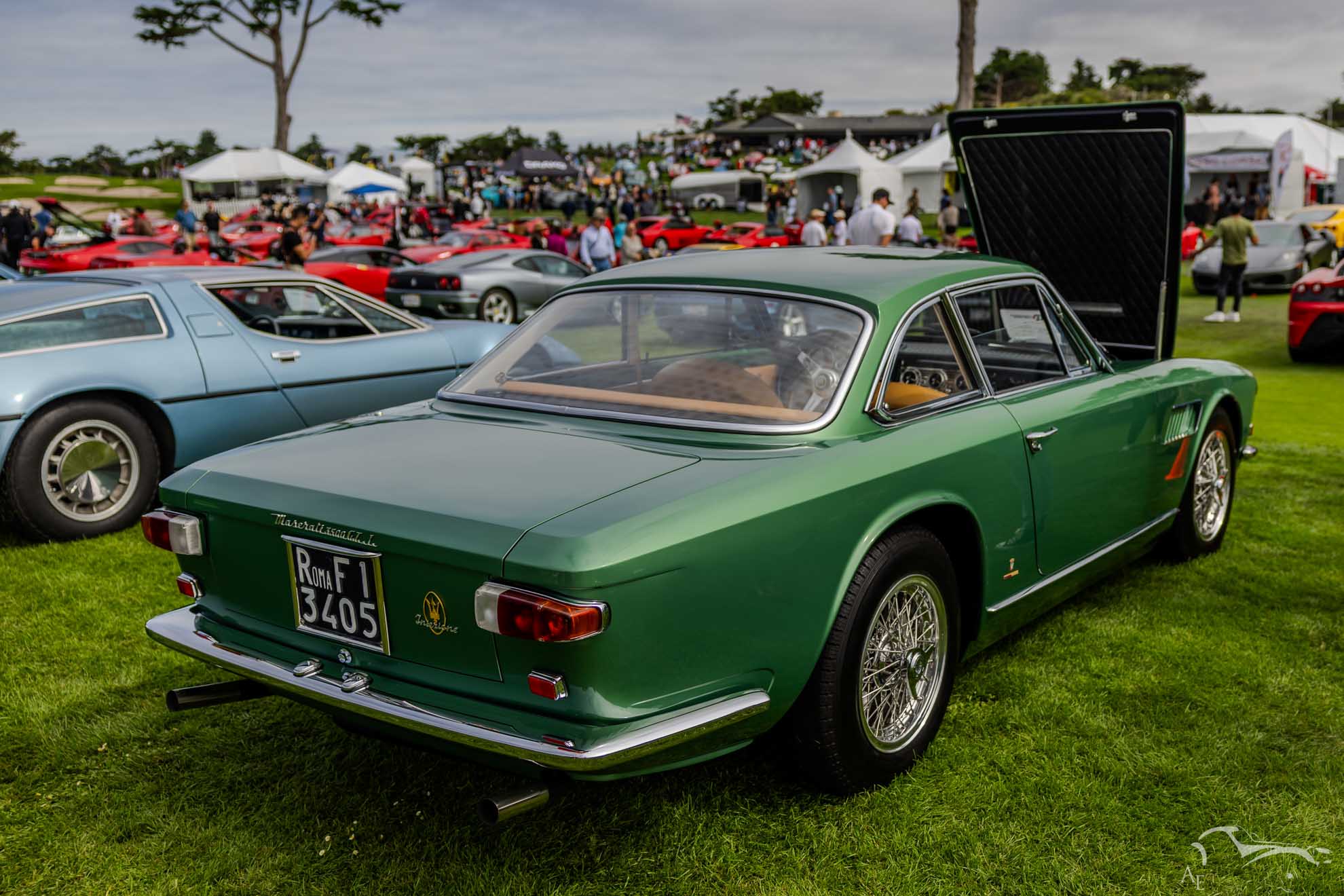
The green Maserati 3500 GTiS, better known as the Sebring, represented the next step toward a more usable grand tourer. Developed from the 3500 GT and bodied by Vignale, it was a 2+2 designed for high-speed travel rather than a pure two-seat sports car. Its name commemorated Maserati’s success at the 12 Hours of Sebring.
It is not usually considered the most beautiful classic Maserati, partly because the front is busier than the Mistral’s. I think the color makes a considerable difference. This muted green softened the chrome and made the car feel less formal. Between a Sebring and a Mistral, I would take the Mistral, but for actually crossing Europe with luggage and passengers the Sebring suddenly becomes very logical.
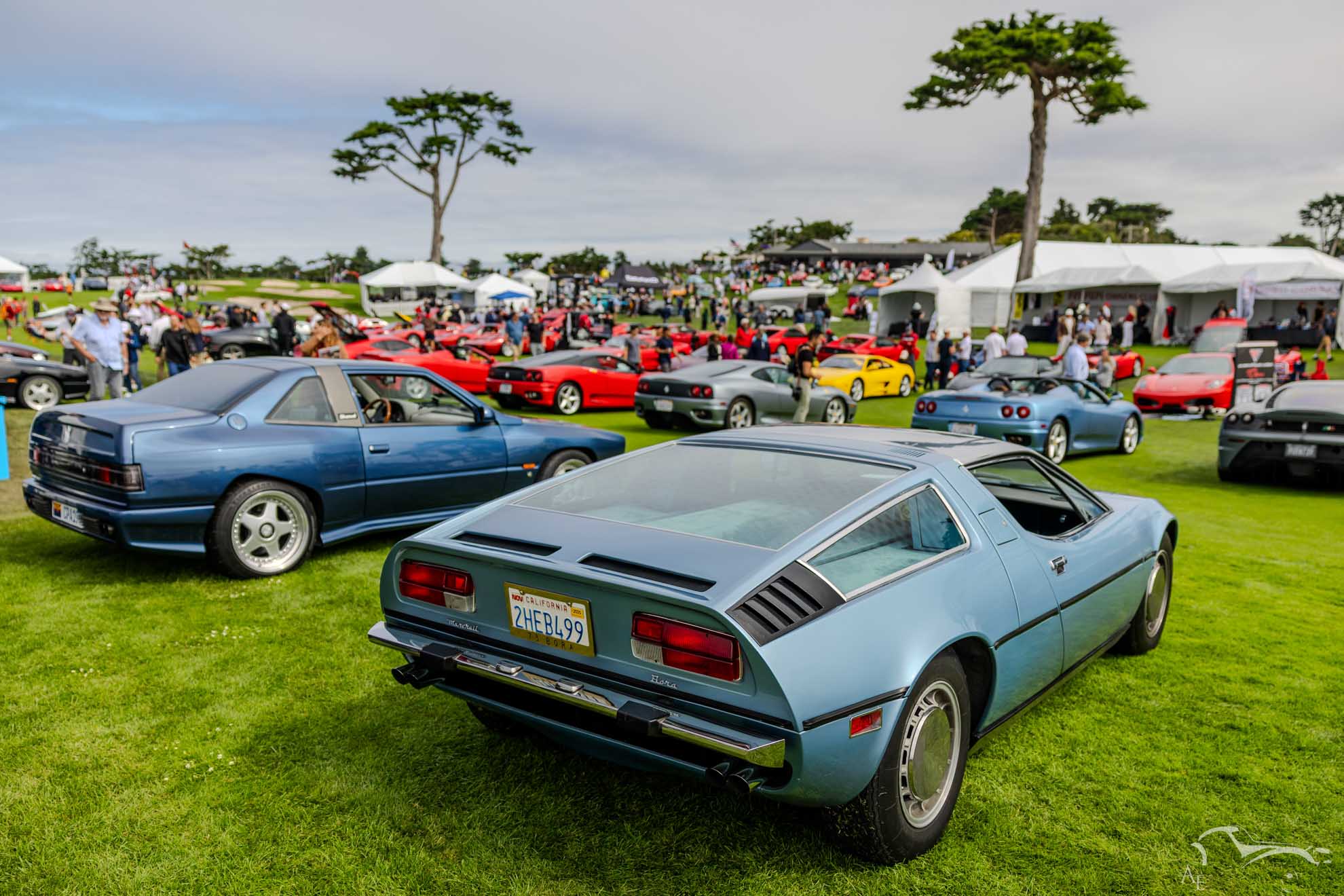
The light blue Maserati Bora jumped forward by almost a decade. Introduced in 1971, it was Maserati’s first series-production mid-engined road car and one of Giorgetto Giugiaro’s cleanest Italdesign wedges.
The Bora combined a V8 engine with a surprisingly luxurious cabin and used Citroën-derived high-pressure hydraulics for several functions, including the brakes, pedals and adjustable driver’s seat. That complexity is one reason ownership can be intimidating today, but it also makes the Bora much more interesting technically than a simple Italian body wrapped around conventional components.
I have always thought the Bora deserved more attention. It is less outrageous than a Countach and less famous than a Miura, but its stainless-steel roof panel, broad glass tail and almost architectural surfaces have aged exceptionally well. Light blue was an inspired choice for it.
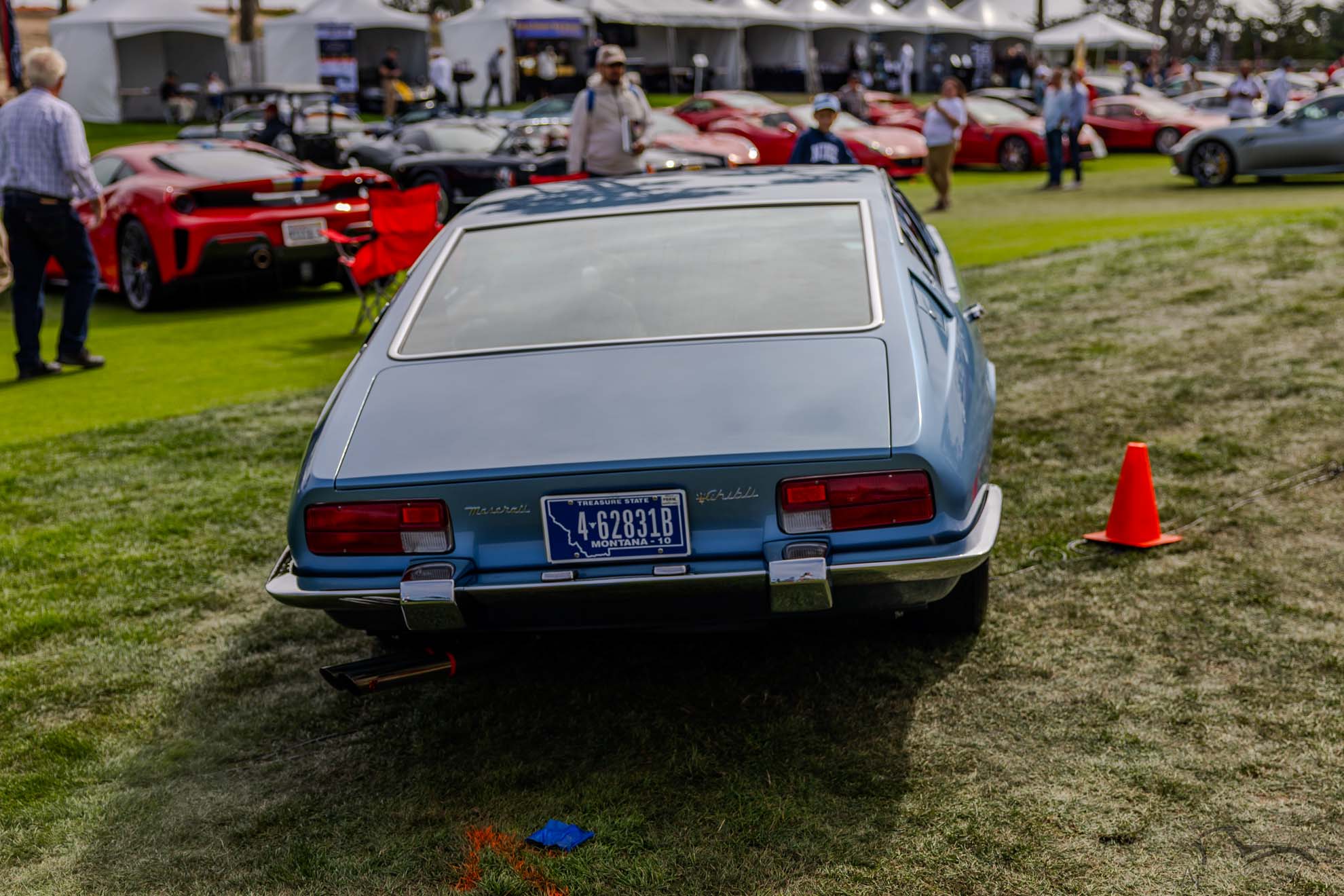
The blue first-generation Ghibli returned to the front-engined GT formula. Presented in 1966 with another Giugiaro-designed body, it placed Maserati’s V8 behind one of the longest and lowest bonnets of the period.
The Ghibli looks more aggressive than the Mistral and more conventional than the Bora, but perhaps it is the best-balanced of the three. The hidden headlights and fastback tail give it visual drama, while the cabin and luggage space make it a real grand tourer. It competed in imagination with the Ferrari Daytona and Lamborghini Espada, even if the personalities of the three cars were very different.
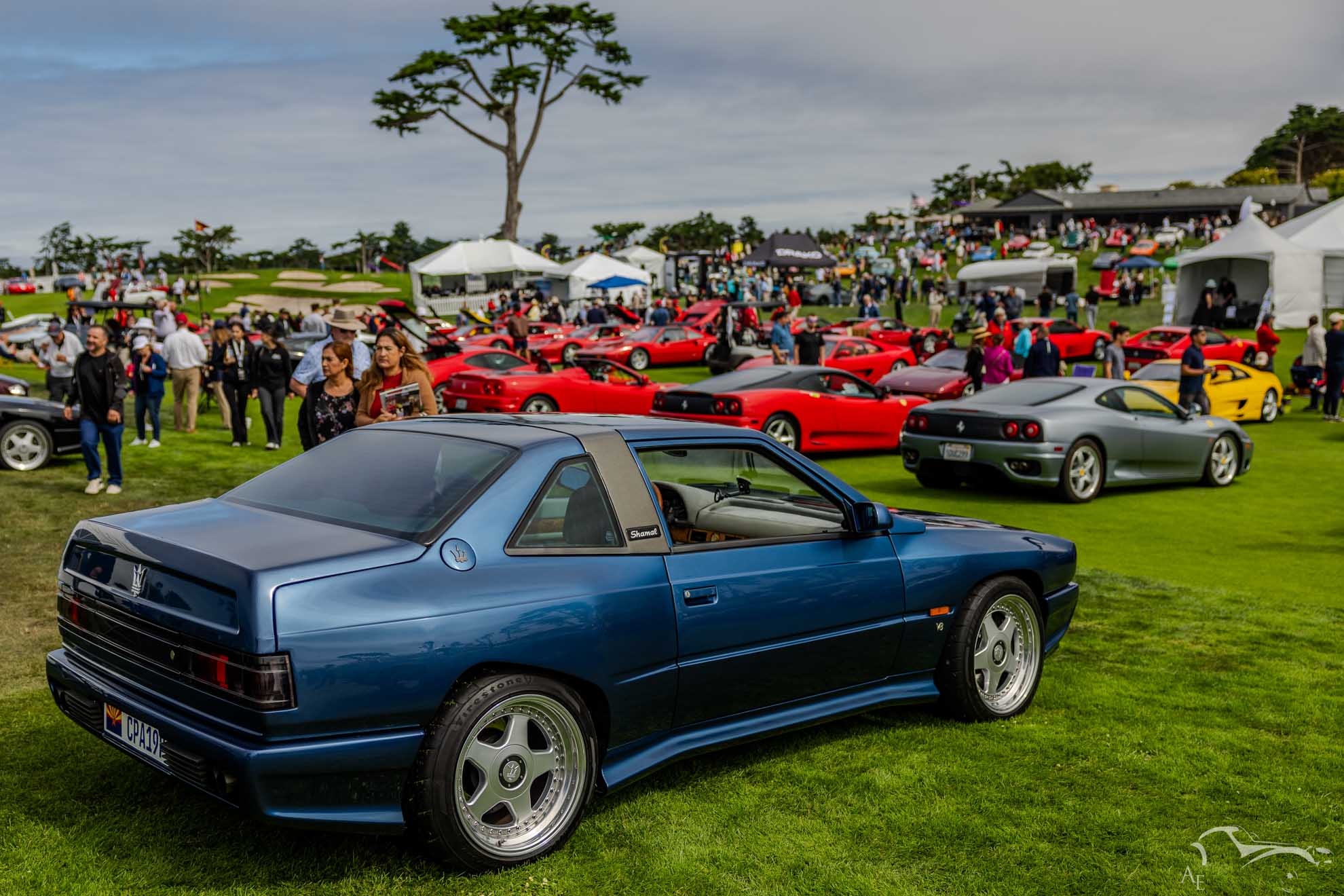
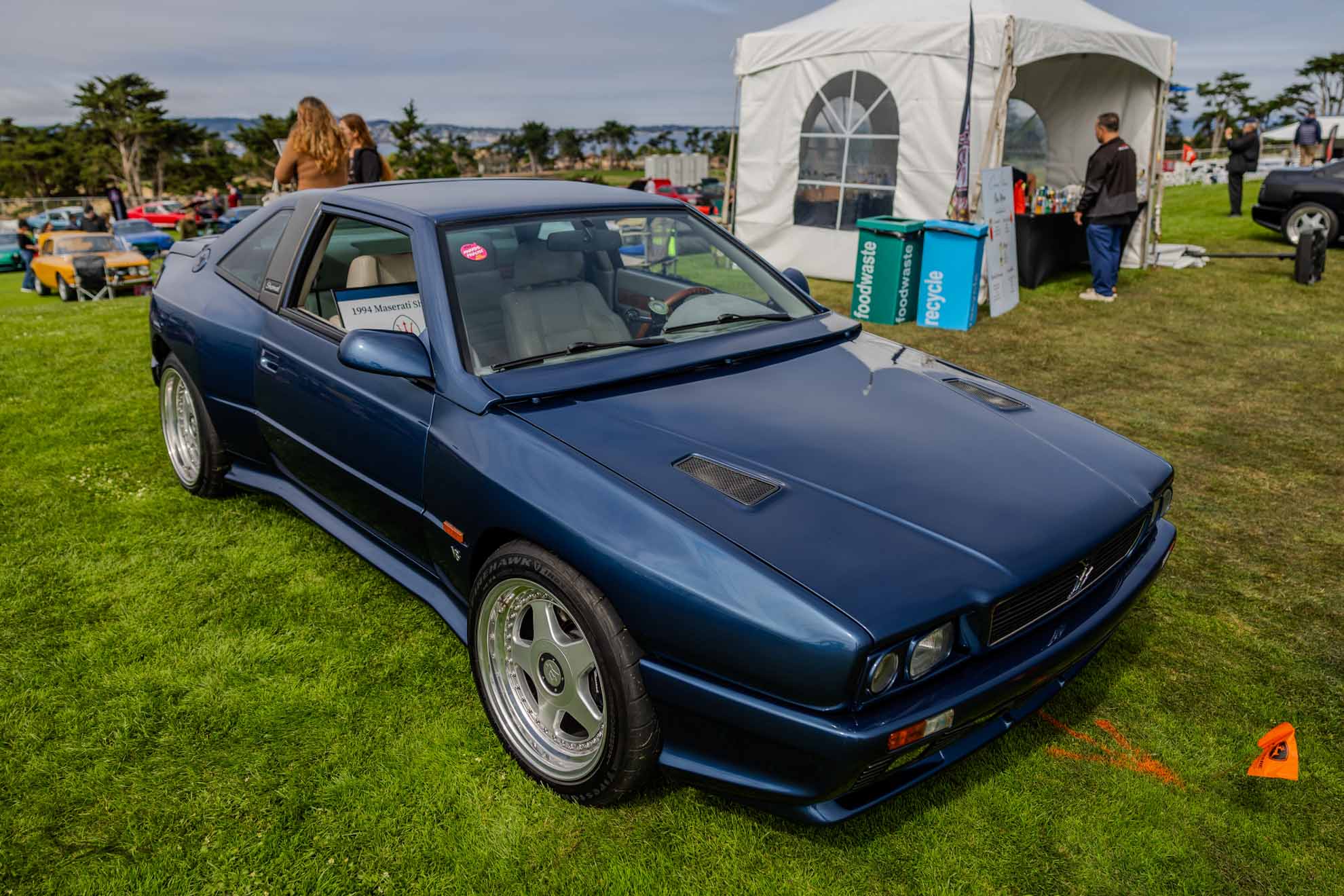
The blue Maserati Shamal was from a completely different era. Marcello Gandini reworked the compact Biturbo proportions into something much more muscular, with boxed arches, a distinctive black hoop across the roof and a 3.2-litre twin-turbo V8 producing around 326 horsepower.
Fewer than 400 Shamals were built between 1990 and 1996. They have the reputation expected from a complicated, low-volume Maserati of that period, but they also have huge character. I like cars that cannot be confused with anything else, and from the three-quarter rear view a Shamal is instantly identifiable.
Would I trust one for a 2,000-kilometre road trip? Probably not without an extremely good specialist. Would I want to try one anyway? Of course.
Lancia: engineering before marketing
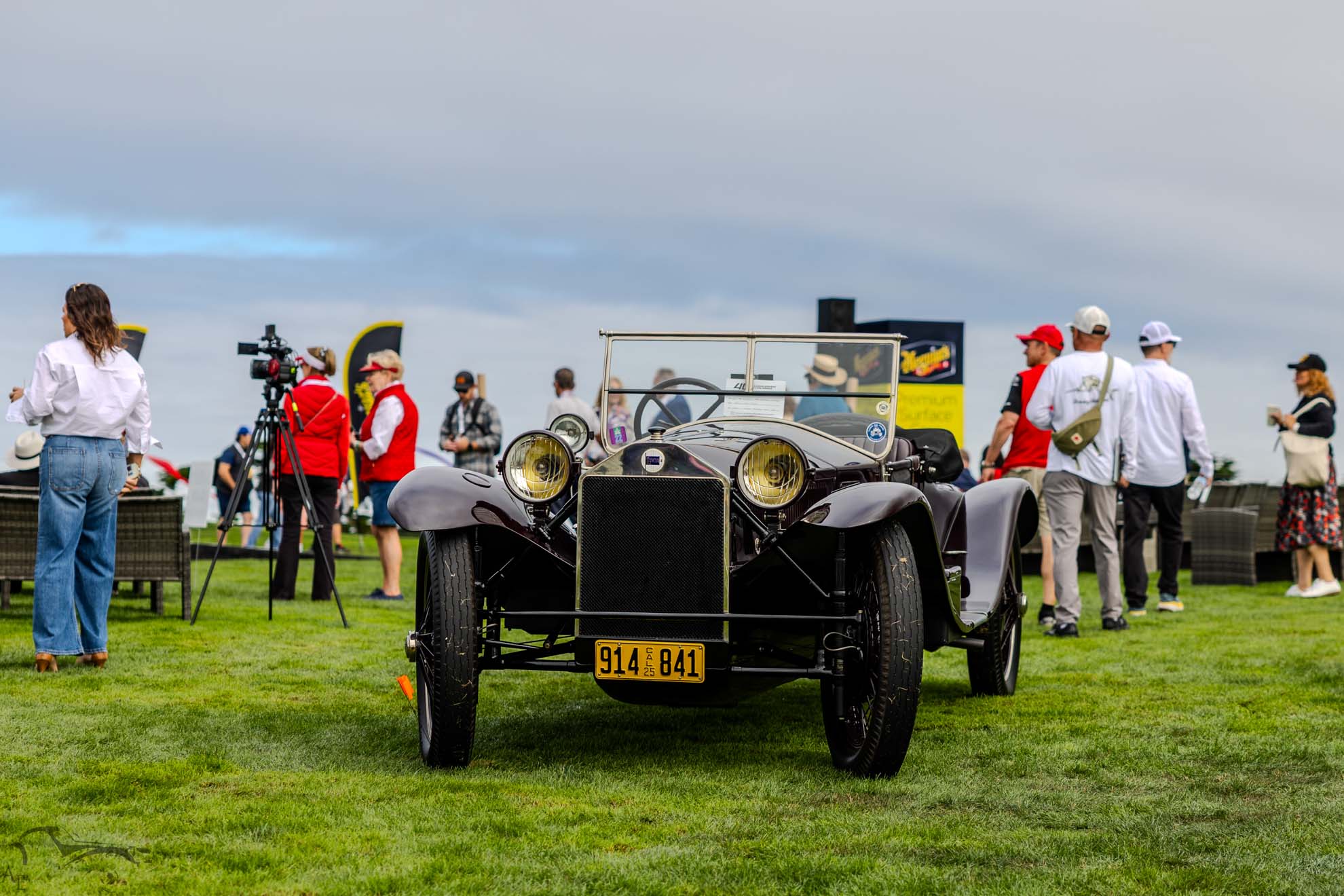
The 1925 Lancia Lambda with Casaro coachwork, owned by Paul and Vicki Tullius, was one of the most technically important cars on the entire field. It does not look as spectacular as the Cisitalia Aerodinamica or the Miura, but the Lambda changed how cars could be constructed.
Introduced in the early twenties, it used a load-bearing unitary body structure instead of the conventional separate chassis and featured independent front suspension. Its narrow-angle V4 helped keep the car compact. These were not gimmicks; they were solutions that anticipated the architecture of most modern cars.
The Casaro body on this example adds another layer of interest. It has the light, purposeful look of an interwar sports tourer rather than a formal saloon. Lancia’s tragedy is that the company spent decades inventing excellent engineering solutions and later became known by too many people only through rallying—or worse, not known at all.
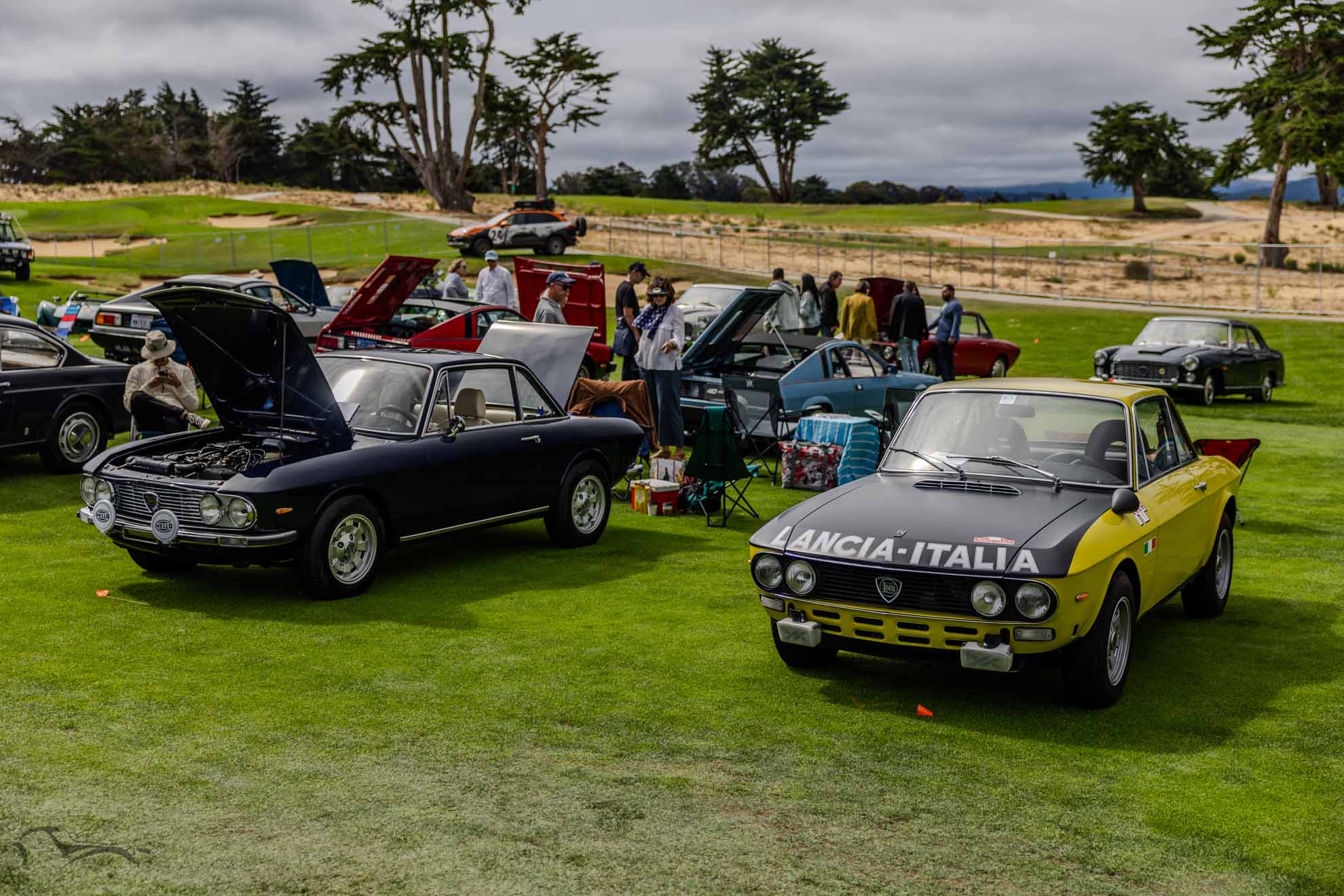
The red and black Fulvia rally car brought us into the period most enthusiasts associate with the brand. The Fulvia’s narrow-angle V4, front-wheel drive and precise handling made it an unlikely but extremely effective competition car. Its 1972 Monte Carlo Rally victory remains one of Lancia’s defining achievements.
This example wore a much more aggressive stance and competition decoration than a standard road Fulvia. I do not know its individual competition history and therefore will not invent one, but visually it captured the idea perfectly: small dimensions, large lamps and a body that looks ready to attack an Alpine pass.
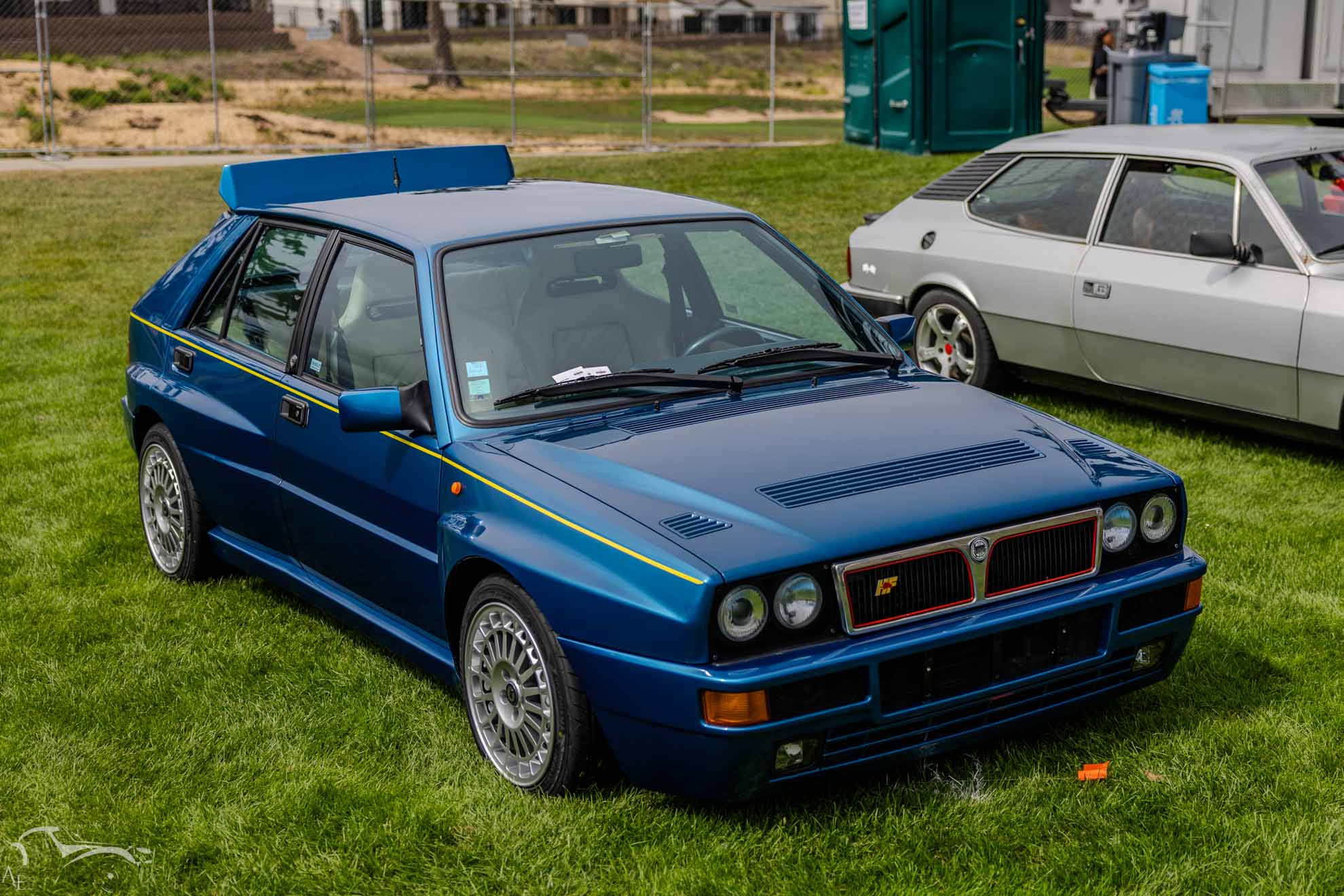
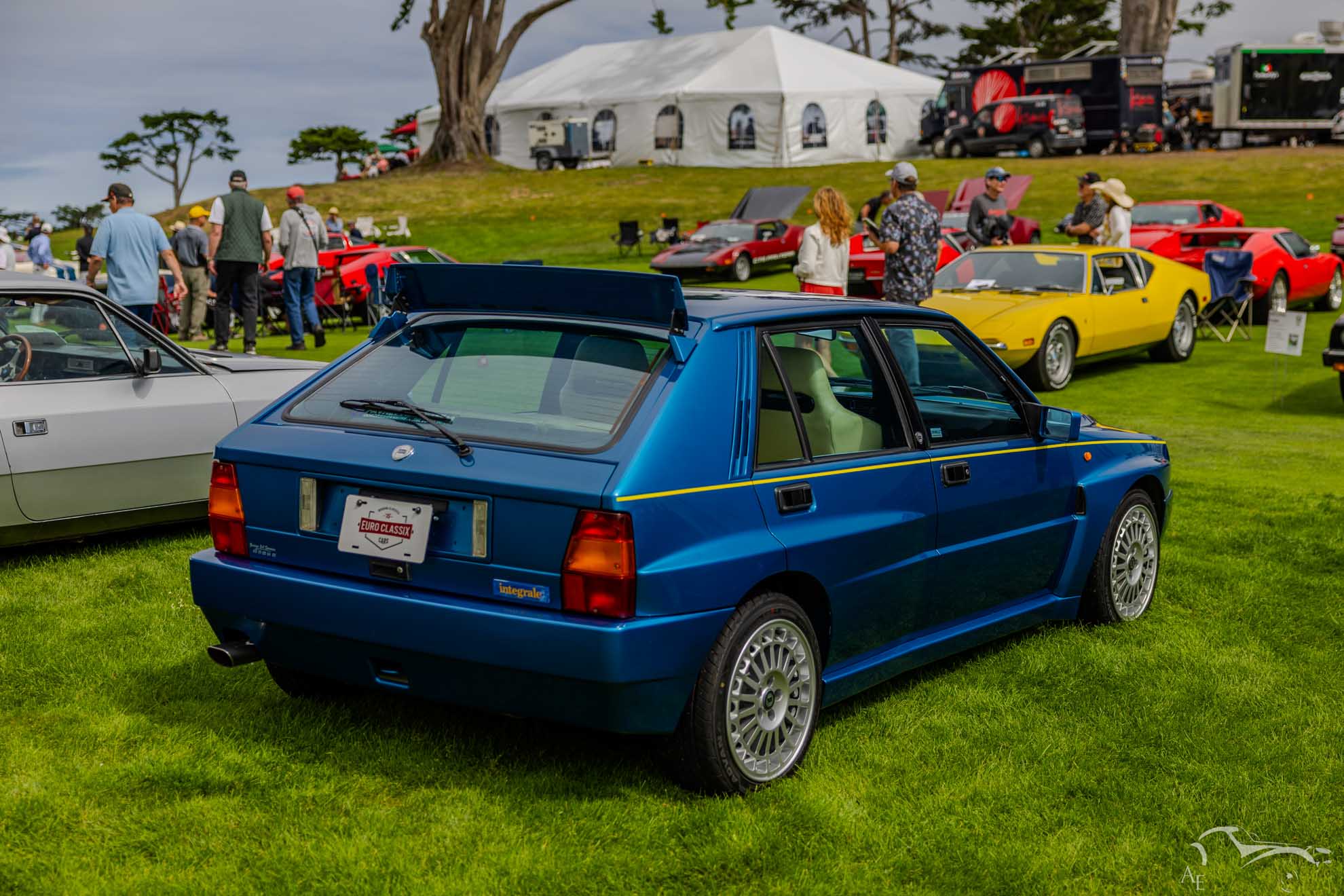
The blue Delta HF Integrale Evoluzione was the obvious later counterpart. By the Evoluzione period, the Delta had grown wide arches, revised suspension geometry and larger wheels, turning a modest family hatchback into one of the most recognizable rally homologation cars ever built.
The Integrale’s World Rally Championship record made it an icon, but the road car remains compelling because it still feels connected to an ordinary Delta. That contrast is essential. A modern 600-horsepower SUV is fast because it was designed to be fast. An Integrale is exciting because engineers kept forcing more performance into a shape that was never supposed to contain it.
Fiat: every possible interpretation of the affordable sports car
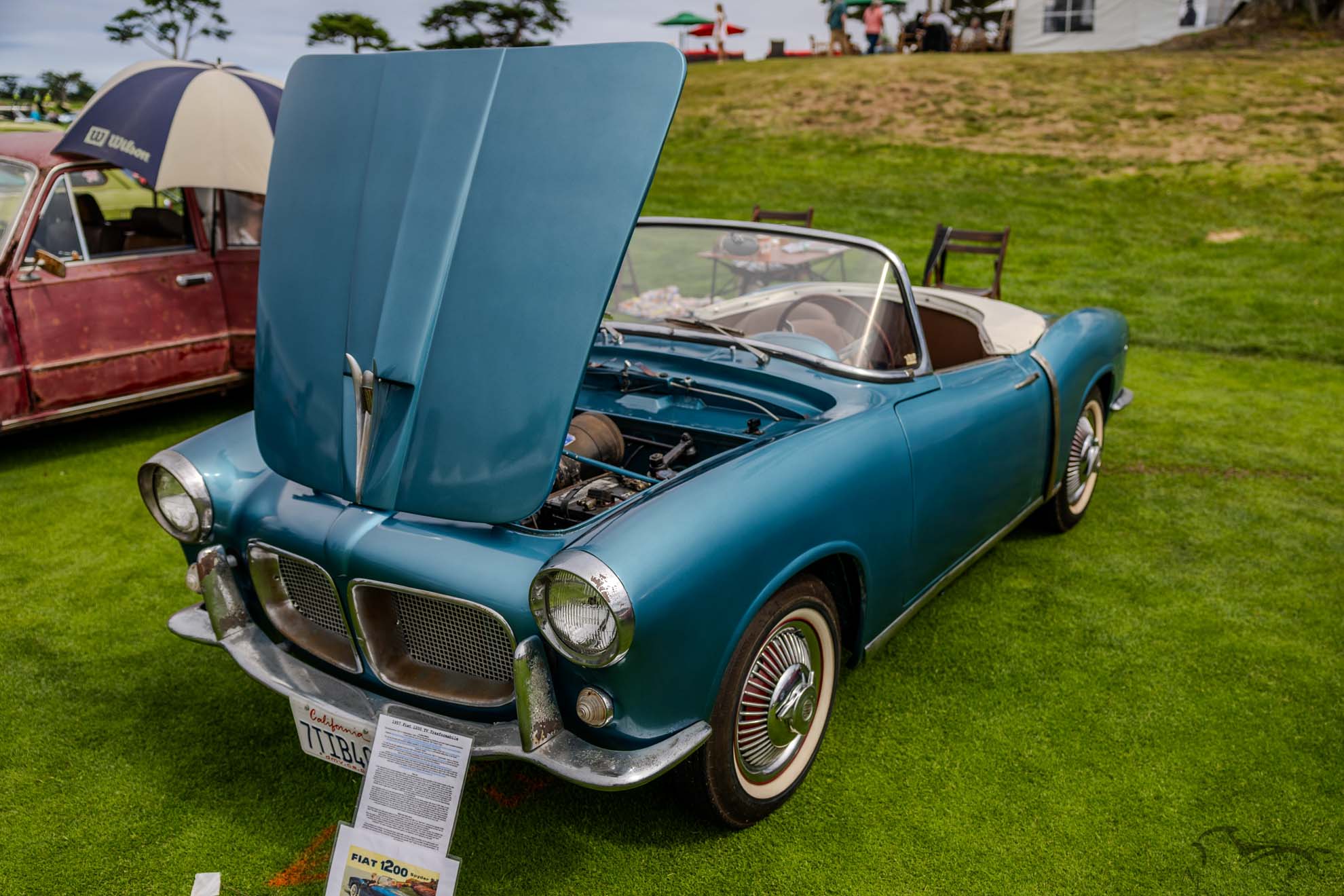
The blue 1958 Fiat 1200 TV Trasformabile belonged to an earlier generation than the later Pininfarina 1200 Spider. “TV” stood for Turismo Veloce, while Trasformabile described the convertible body. With its split grille, upright windscreen and vertical bonnet, it has the slightly optimistic appearance of a small post-war sports car trying to look much more expensive than it was.
It was not built to challenge Ferrari on outright speed. Its appeal came from accessible Italian style: a compact open body, modest running costs and just enough sporting intent to make an ordinary drive feel special. Concorso Italiano needs cars like this. Without them, the history of Italian motoring becomes an inaccurate sequence of expensive supercars.
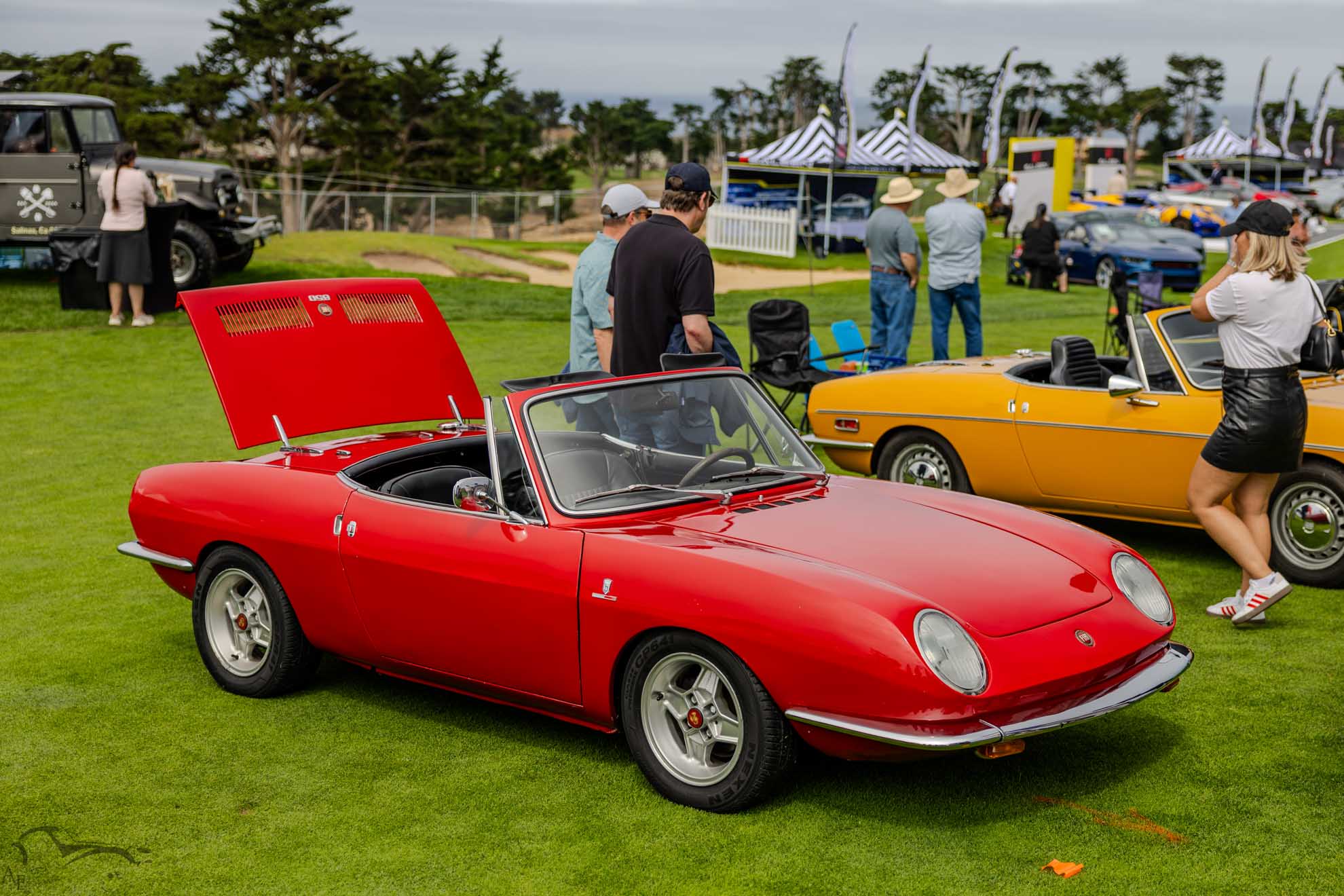
The red Fiat 850 Spider was another example of affordable glamour. Designed by Giorgetto Giugiaro at Bertone, it placed a small engine behind the cabin and wrapped the mechanical package in a surprisingly exotic-looking body.
Nobody buys an 850 Spider for straight-line performance. You buy it because it is small enough to use all of its ability on a normal road, because the steering wheel seems absurdly close to the front axle, and because even parking it becomes an occasion. It is probably more honest fun at legal speeds than many modern supercars.
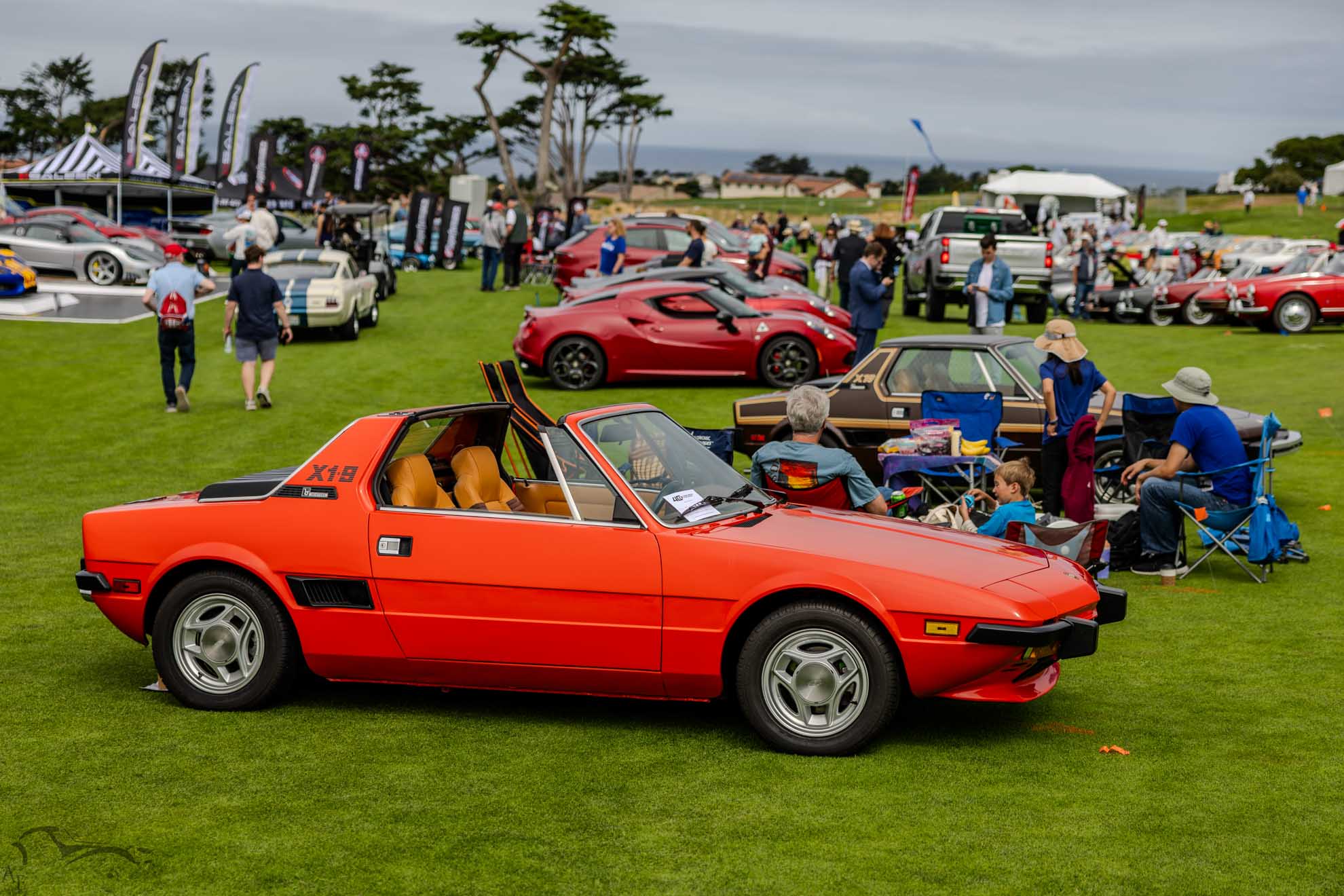
The orange X1/9 pushed the same idea into the seventies with a mid-mounted engine, wedge styling and a removable targa roof. Bertone designed the car around practical packaging, including luggage compartments at both ends, which made it one of the rare small mid-engined cars that could genuinely be used every day.
The X1/9 has spent too long being treated as a cheap curiosity. Rust, modest power and years of neglect destroyed many, but a good one demonstrates that balance and low weight matter more than an impressive horsepower figure. The orange color was exactly right; subtlety would be missing the point.
Alfa Romeo: from a prepared Giulia to the carbon 4C
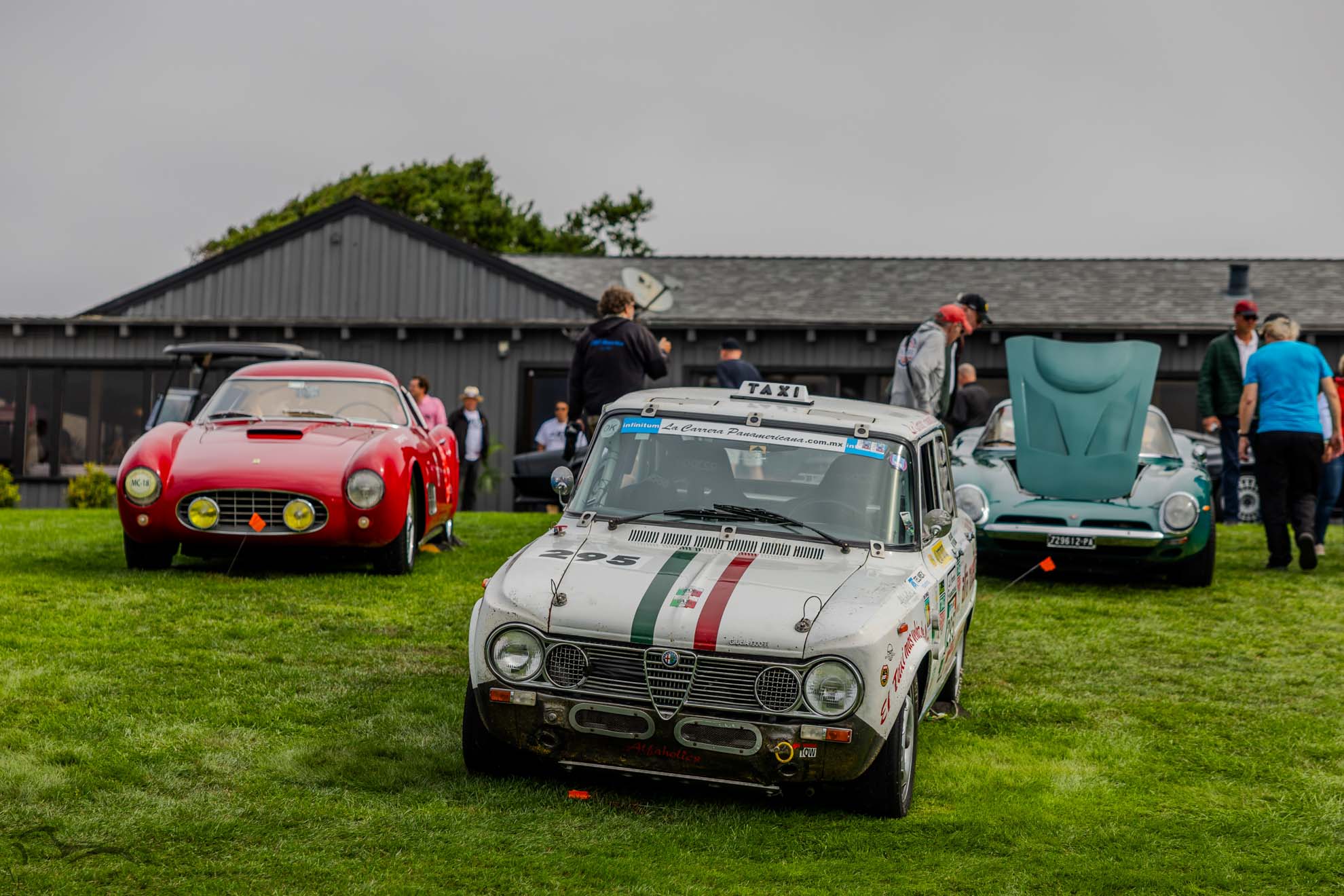
This red and white Alfa Romeo Giulia Berlina was identified by the organizers as the Alfa Romeo Panamericana Rally car in the Italian Legacy display. Its number 295, scrutineering labels and visible competition wear support genuine event use. I could not establish its exact year, crew, chassis number or result, so I will not assign it a more specific Carrera history than the available evidence allows.
The base Giulia remains one of Alfa Romeo’s great designs. It looks like a simple three-box saloon, but its body was developed with serious attention to aerodynamics, while the twin-cam engines and well-sorted chassis gave it the dynamic character of a sports car with four doors.
This is the sort of classic I increasingly appreciate. A coupé is more obviously special, but a fast Berlina lets you take friends, luggage and bad weather without removing the pleasure from the drive.
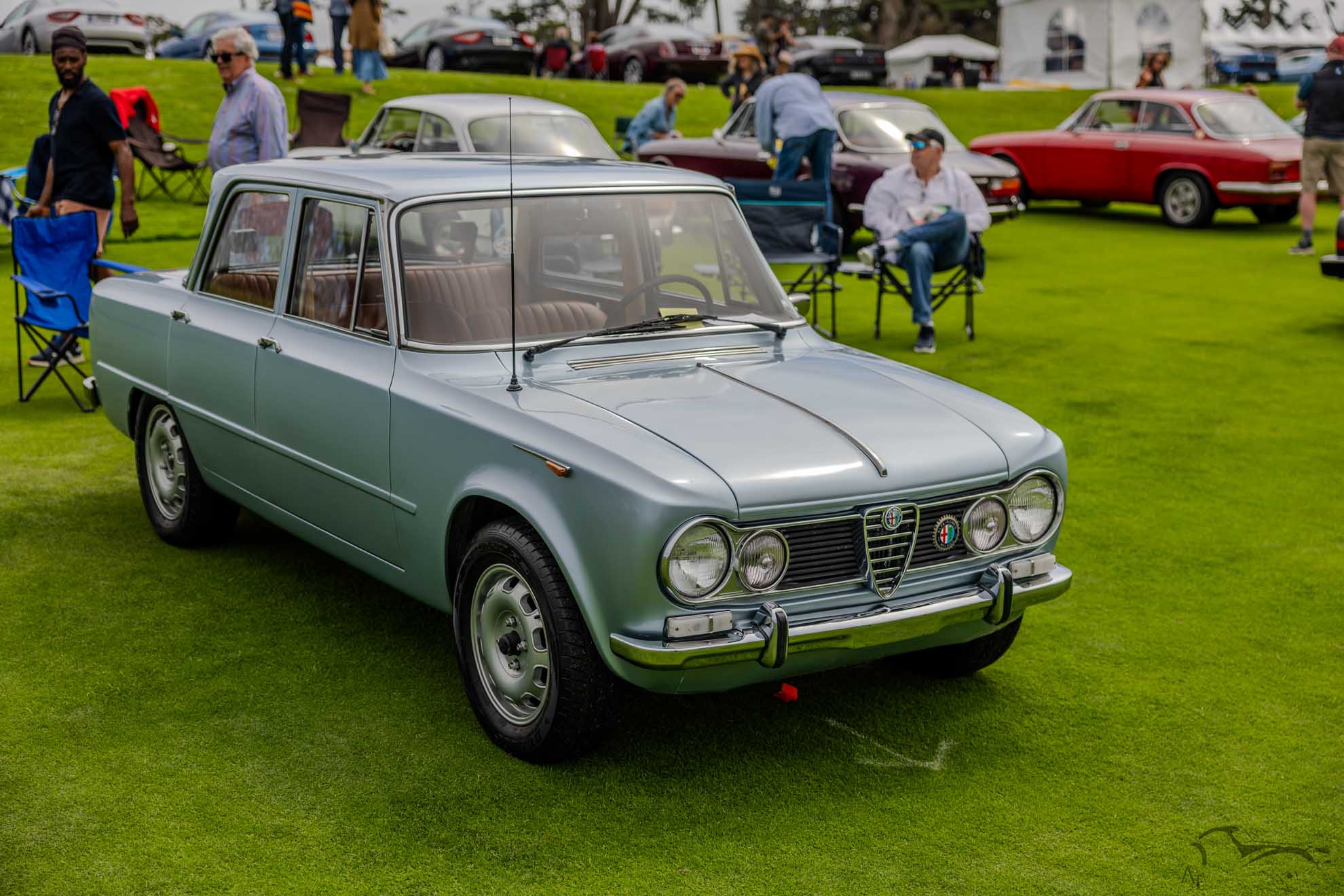
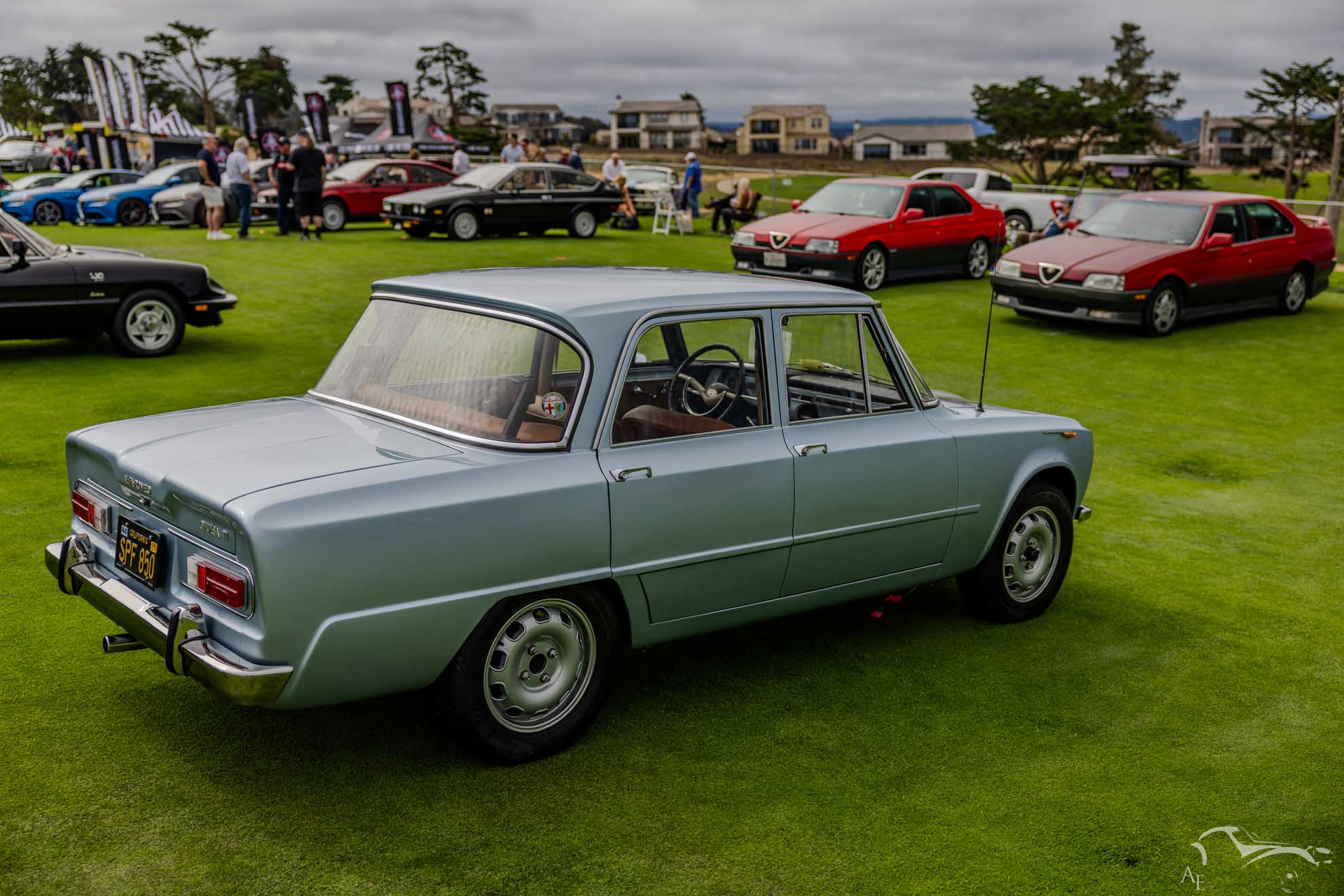
The pale blue Giulia 1600 later in the field showed the standard design much more clearly. No rally lights, no aggressive stance, just the clean shape and delicate pillars of the original saloon.
Placed next to the prepared car, it created a good question: preserve or modify? The standard car is historically cleaner and probably the one collectors will value most. The prepared version invites you to use it harder. I disagree with the idea that every surviving Giulia must become a museum object; the risk is turning a driver’s car into furniture.
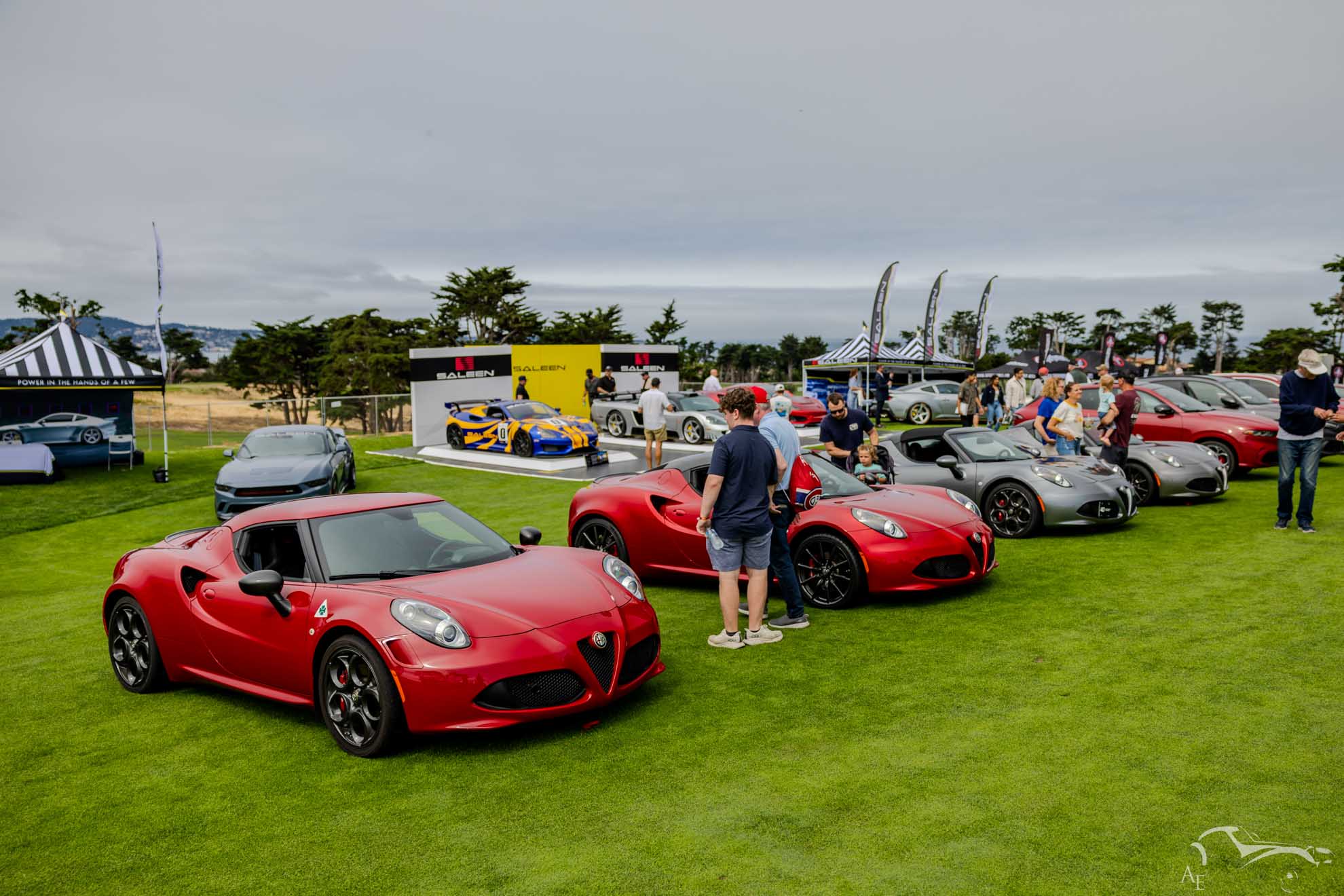
The red Alfa Romeo 4C was the modern conclusion to that philosophy. Its carbon-fibre monocoque, mid-mounted turbocharged 1.75-litre engine and lack of power steering made it unusually uncompromising for a relatively accessible sports car.
The 4C was criticized for its steering behaviour, cabin quality and sometimes nervous responses on imperfect roads. Those criticisms are valid. Yet Alfa Romeo actually built a light carbon-tub sports car when most manufacturers were adding screens, insulation and weight. I would rather have an imperfect ambitious car than a perfectly competent one that nobody remembers.
Ferrari classics: from the Dino to the Daytona
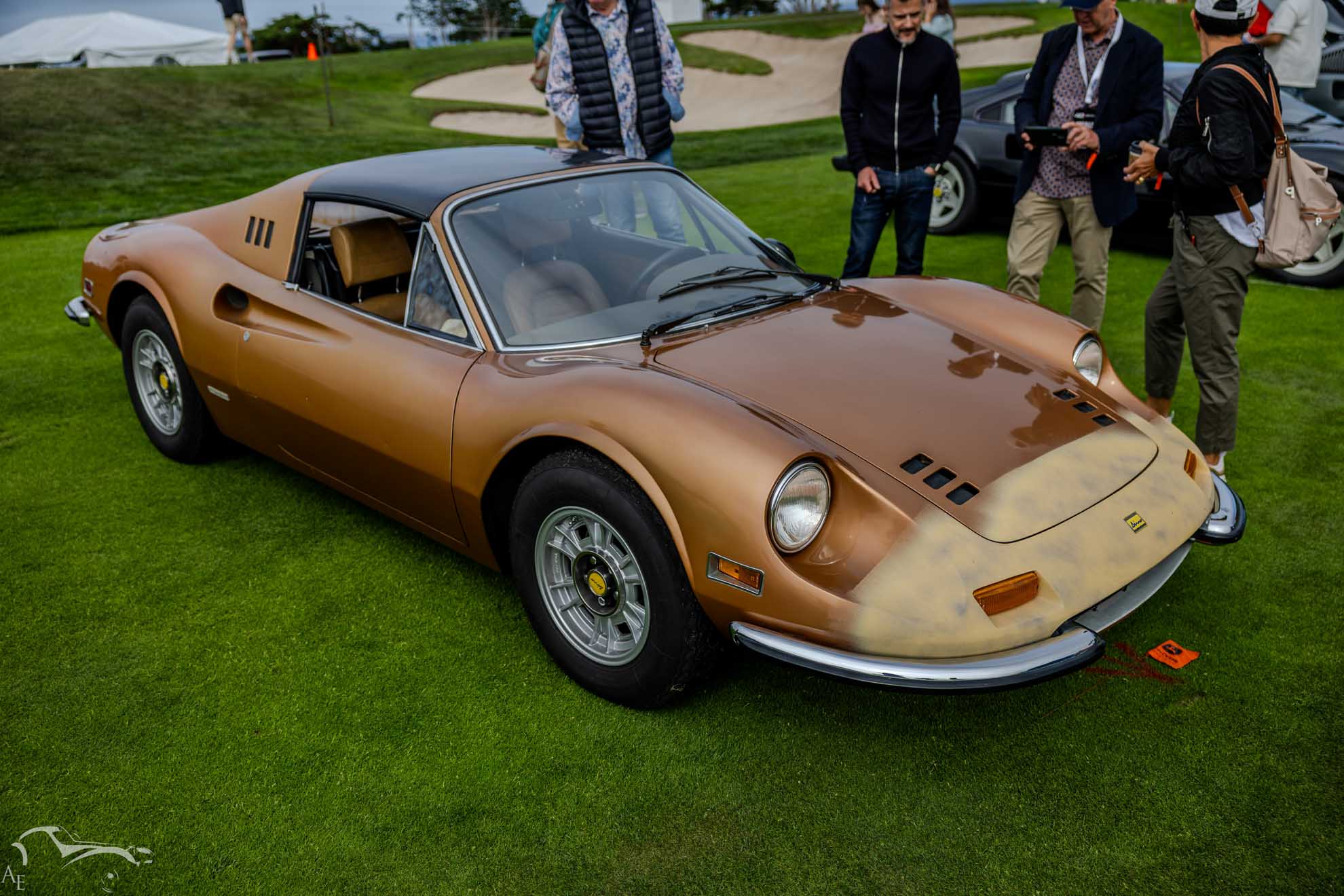
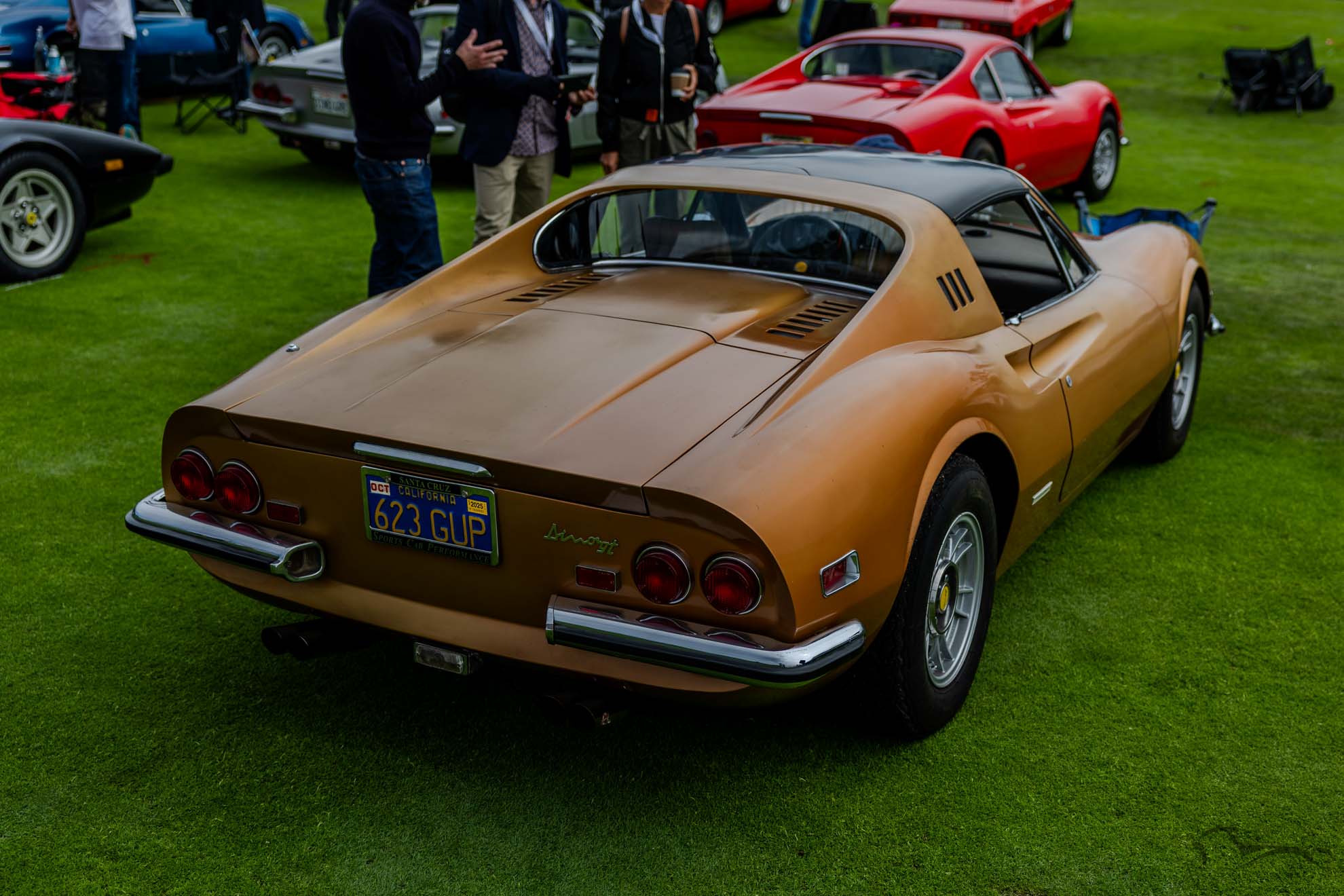
A bronze Dino 246 GT opened the more classical Ferrari section, even though the car famously did not wear Ferrari badges when new. The Dino sub-brand allowed Ferrari to introduce a smaller, less expensive model powered by a V6 rather than the traditional V12. This car had a very visible and interesting patina and I wondered what could have made such an effect on the paint.
The 246 GT used a 2.4-litre engine and a wheelbase longer than the earlier 206 GT. Its Pininfarina shape remains one of the most perfectly proportioned mid-engined road cars ever produced. Bronze is not the obvious choice, and that is why I liked it. Red makes a Dino look like a small Ferrari; bronze lets it exist as its own object.
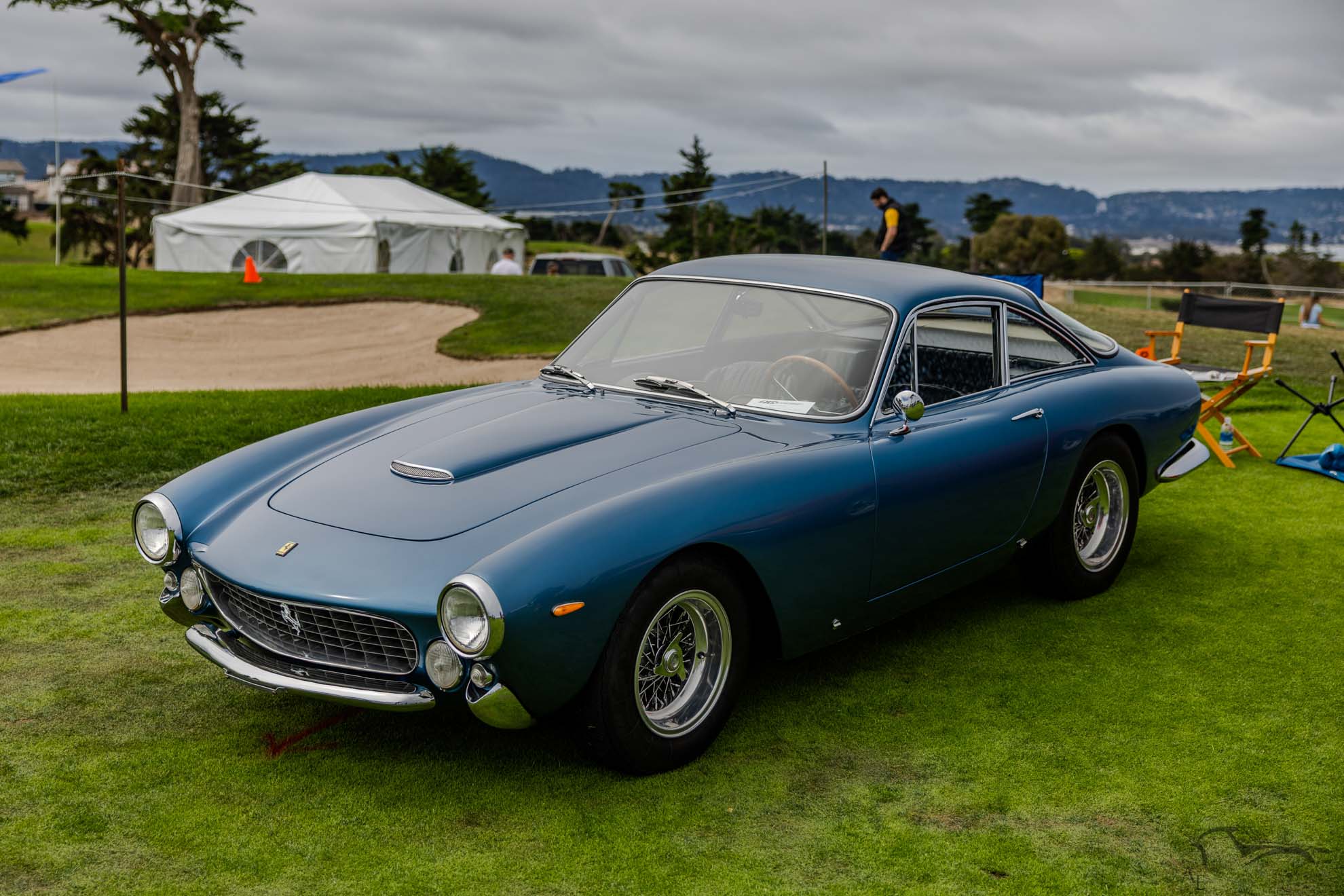
The blue Ferrari 250 GT Berlinetta Lusso was more delicate. Launched in 1962, the Lusso was the refined road-going conclusion of the 250 GT family, combining the Colombo three-litre V12 with one of Pininfarina’s most elegant bodies.
Approximately 350 were built. The car was not intended to be the most aggressive competition Ferrari, despite sharing much of its engineering language with racing 250s. It was a fast, luxurious grand tourer, and the blue paint suited that role perfectly.
Would I choose it over a 275 GTB? The 275 is more muscular and technically more advanced. The Lusso is purer. This is one of those questions where the answer would probably change every morning.
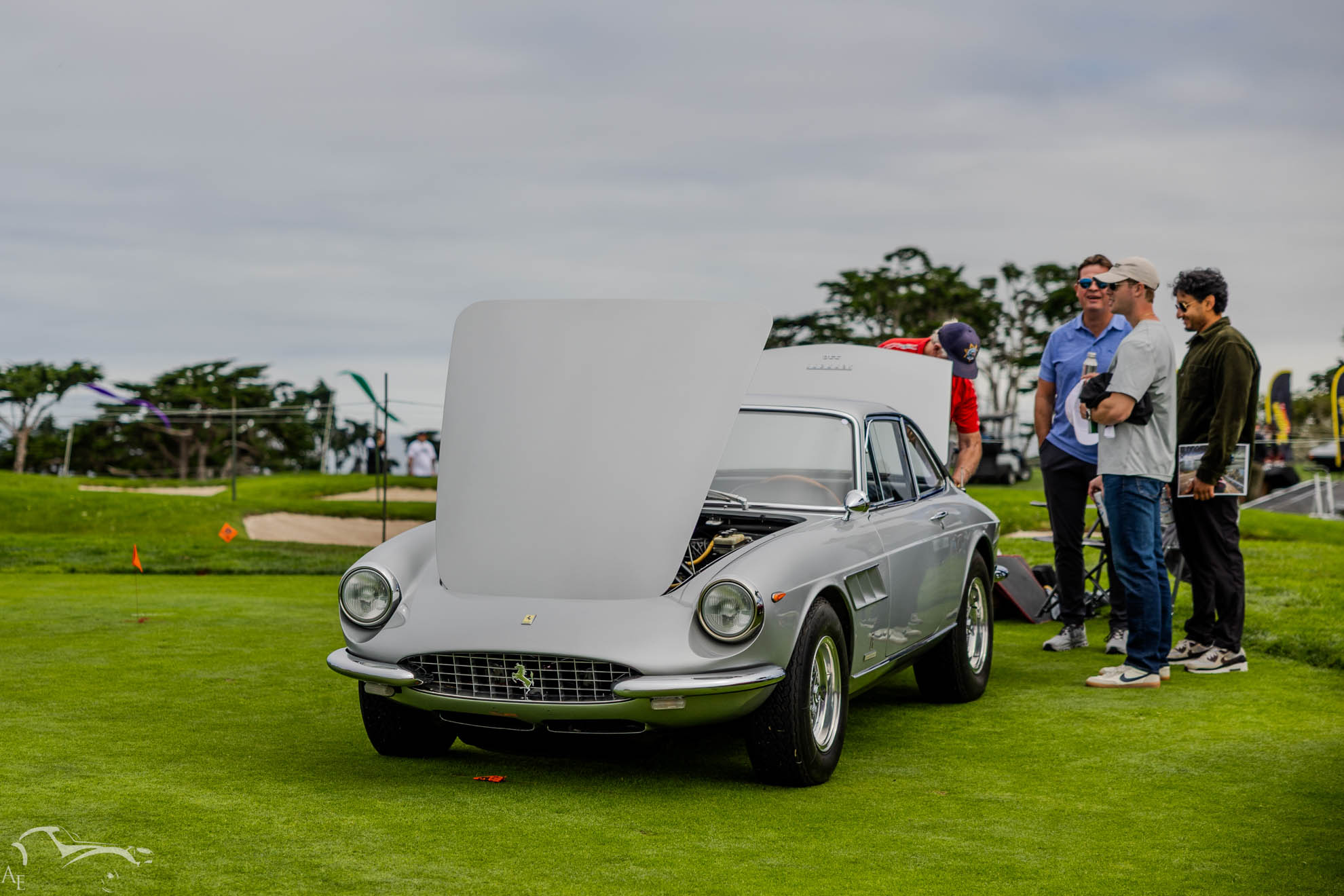
The silver Ferrari 330 GTC sat between the Lusso and the Daytona in both time and character. It combined a four-litre V12 with a two-seat Pininfarina body and a rear transaxle, creating one of Ferrari’s most balanced grand tourers of the sixties.
The design borrows cues from several relatives without looking derivative: a front reminiscent of the 500 Superfast, a roof and cabin close to the 250 Lusso, and a rear that would influence later models. It is less famous than the Daytona and less romanticized than the Lusso, which may make it one of the best classic Ferraris for somebody who actually wants to drive.
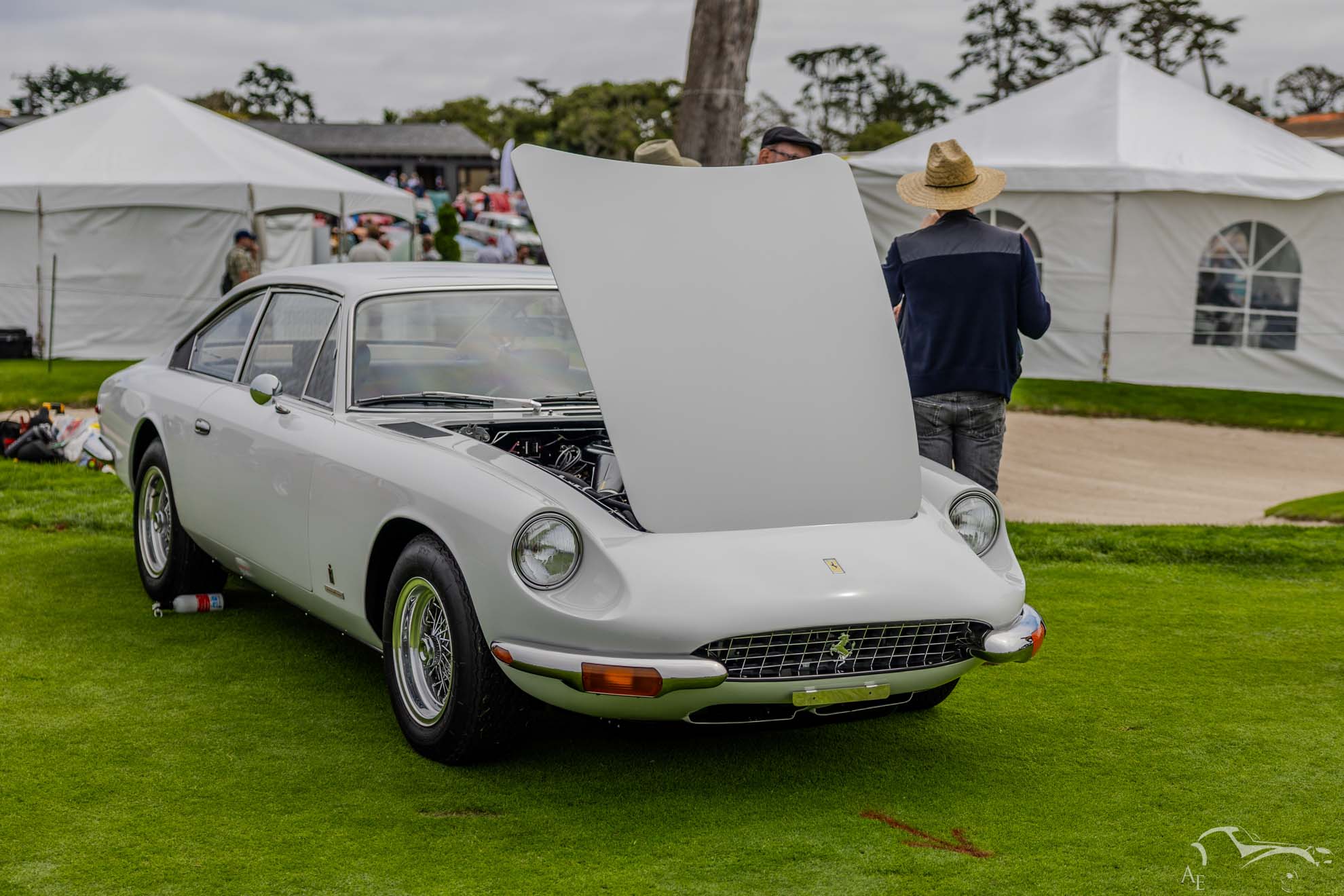
The very similar white coupé photographed with its bonnet open was a Ferrari 365 GTC. The easiest visible distinction is the ventilation: the 330 GTC has outlets on the front wings, while the 365 moved them to the bonnet. Underneath, the later car used the larger 4.4-litre V12 and was a proper four seater. It is a classic Ferrari for somebody who values mechanical improvement more than public recognition.
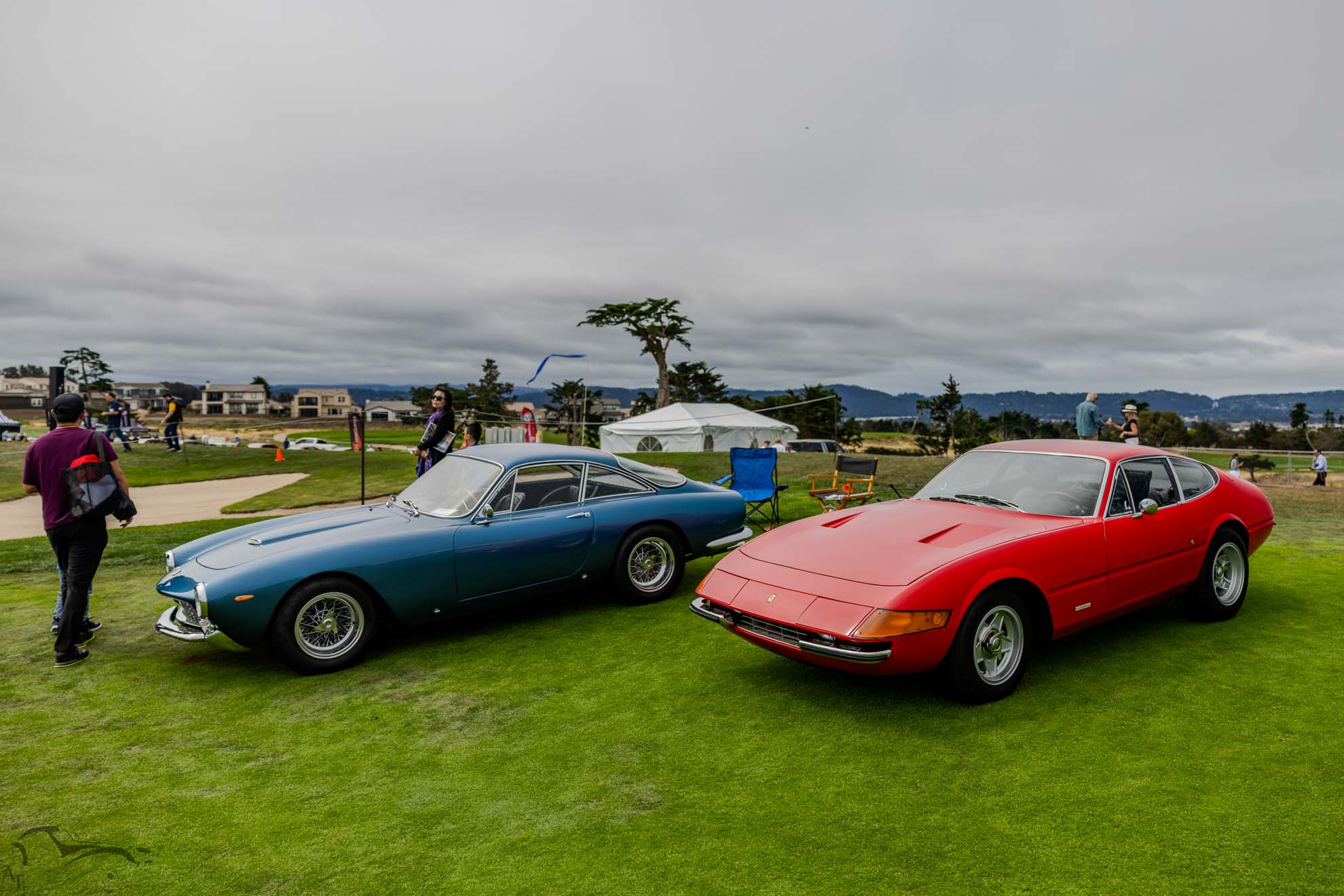
The red 365 GTB/4, universally known as the Daytona even though Ferrari did not officially use the name at launch, was the most imposing classic front-engined Ferrari in the field. Its 4.4-litre V12 and sharp Pininfarina body were introduced in 1968, just as the industry seemed convinced that every future supercar had to place its engine behind the driver.
Ferrari’s answer was effectively to perfect the traditional formula. The Daytona is heavy at low speeds, the controls require commitment and the long nose demands concentration, but once moving it becomes the archetype of the high-speed V12 GT.
I like that it was parked at the same event as the Miura. They represent two completely different answers to the same late-sixties question, and both were correct.
The analogue V8 Ferrari lineage
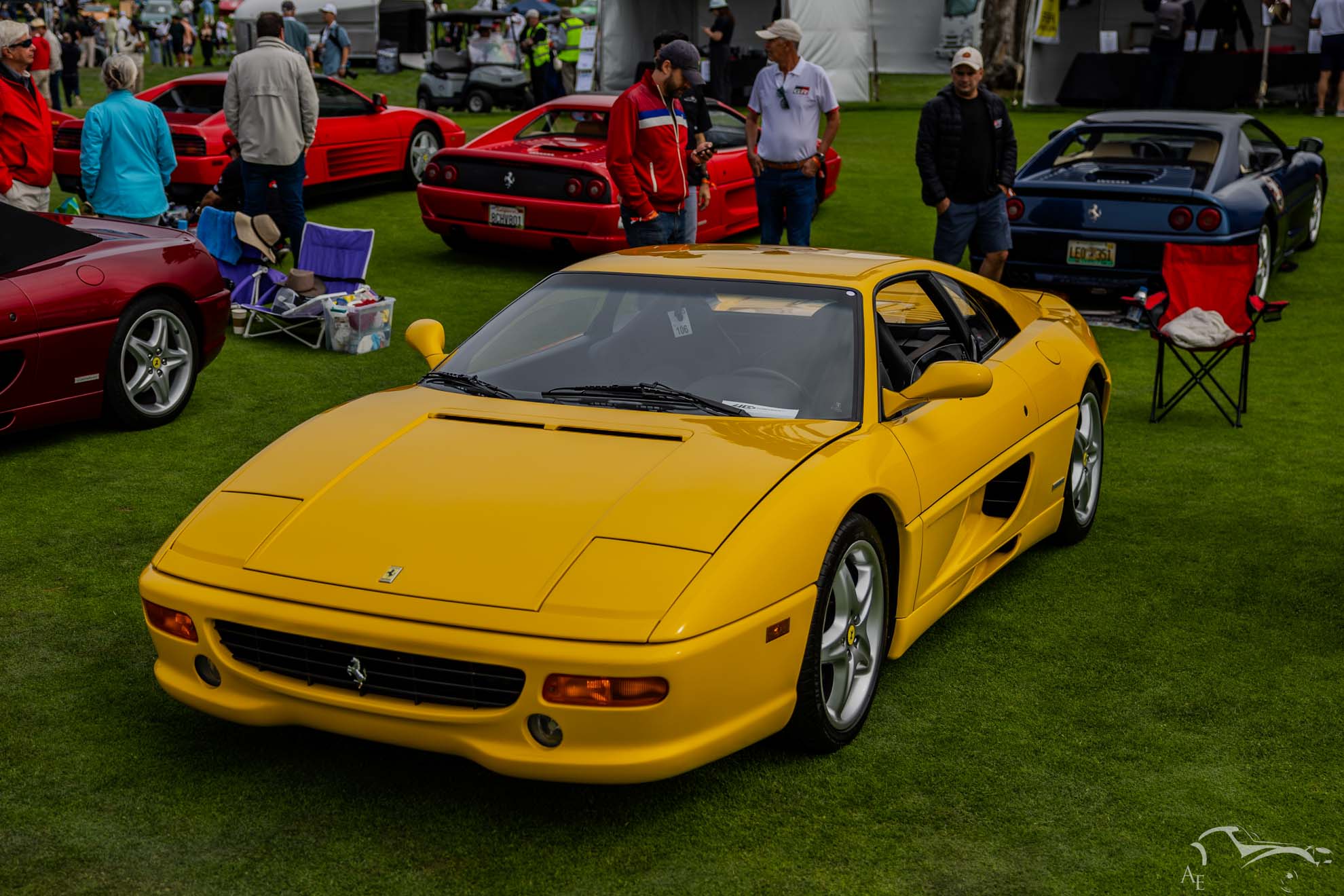
The yellow Ferrari F355 Coupé offered one of the brightest specifications of the day. The F355’s 3.5-litre V8 used five valves per cylinder and produced 380 horsepower, but its significance goes beyond the numbers. It was the car that corrected many of the 348’s weaknesses while retaining compact dimensions, hydraulic steering and the option of a gated manual gearbox.
Red is the obvious choice and probably the easiest to resell, but yellow emphasizes the air intakes, making the car look more exotic. I would still choose a dark blue or silver F355, although this yellow one had considerable presence.
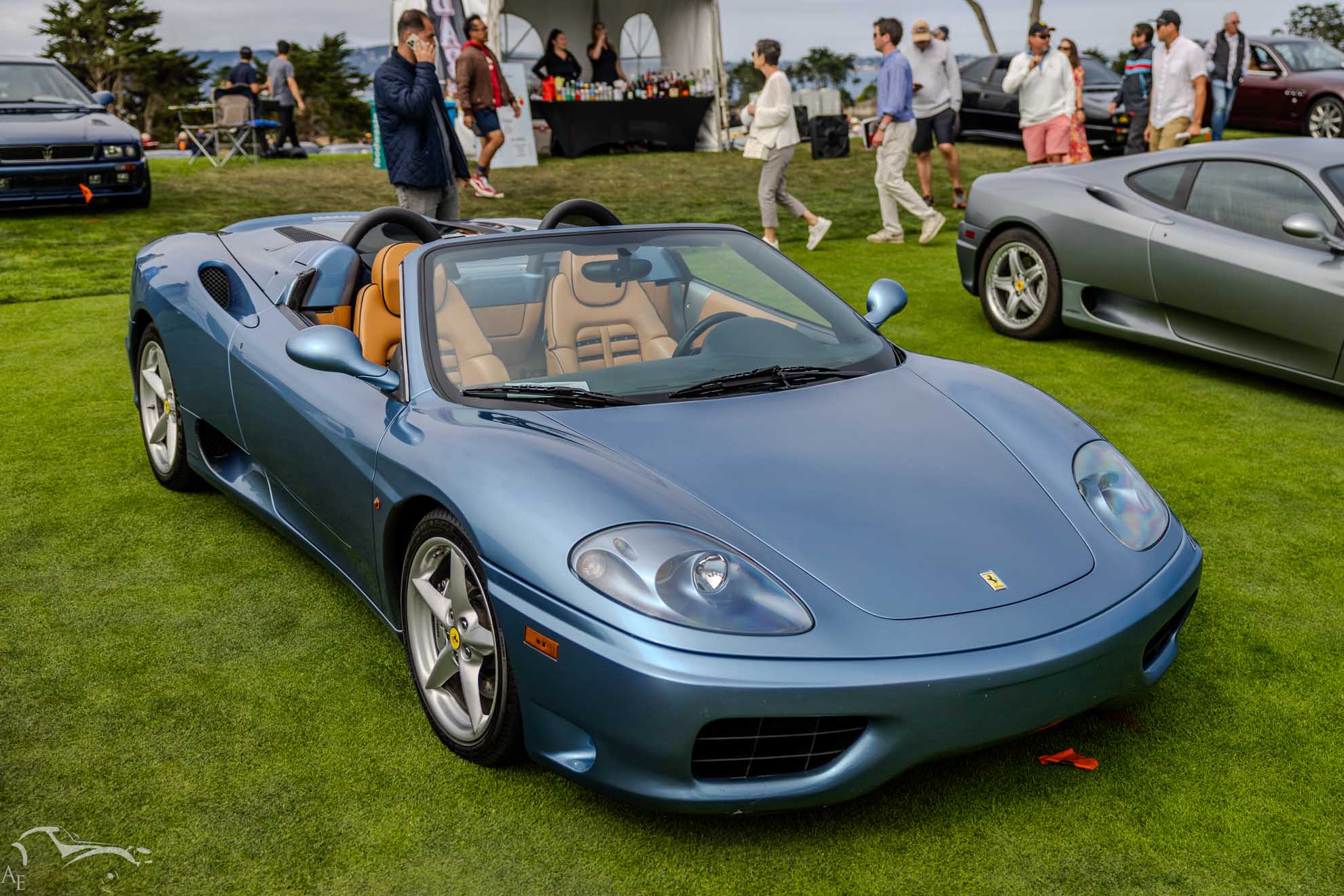
This “Azzuro California” Ferrari 360 Spider showed how radically the design changed afterward. The 360 introduced an aluminium spaceframe and a much more organic Pininfarina body, with its engine visible through glass on the Modena coupé and the structure adapted for the Spider.
Many people now see the 360 as the beginning of the modern Ferrari. It is larger and more usable than the F355, but still old enough to offer a manual gearbox, relatively simple electronics and a naturally aspirated V8. In blue it looked far less obvious than the thousands of red examples that defined the period.
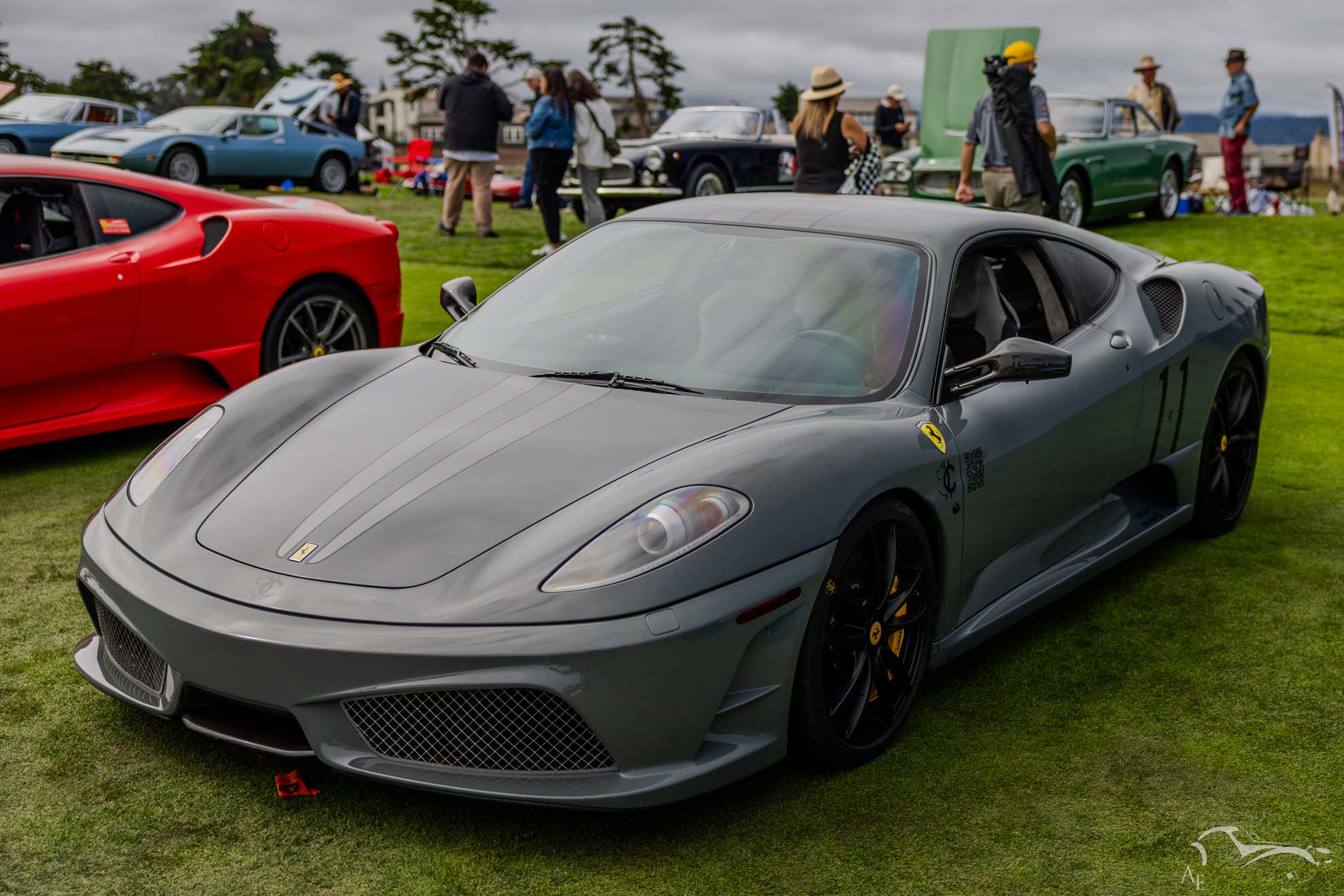
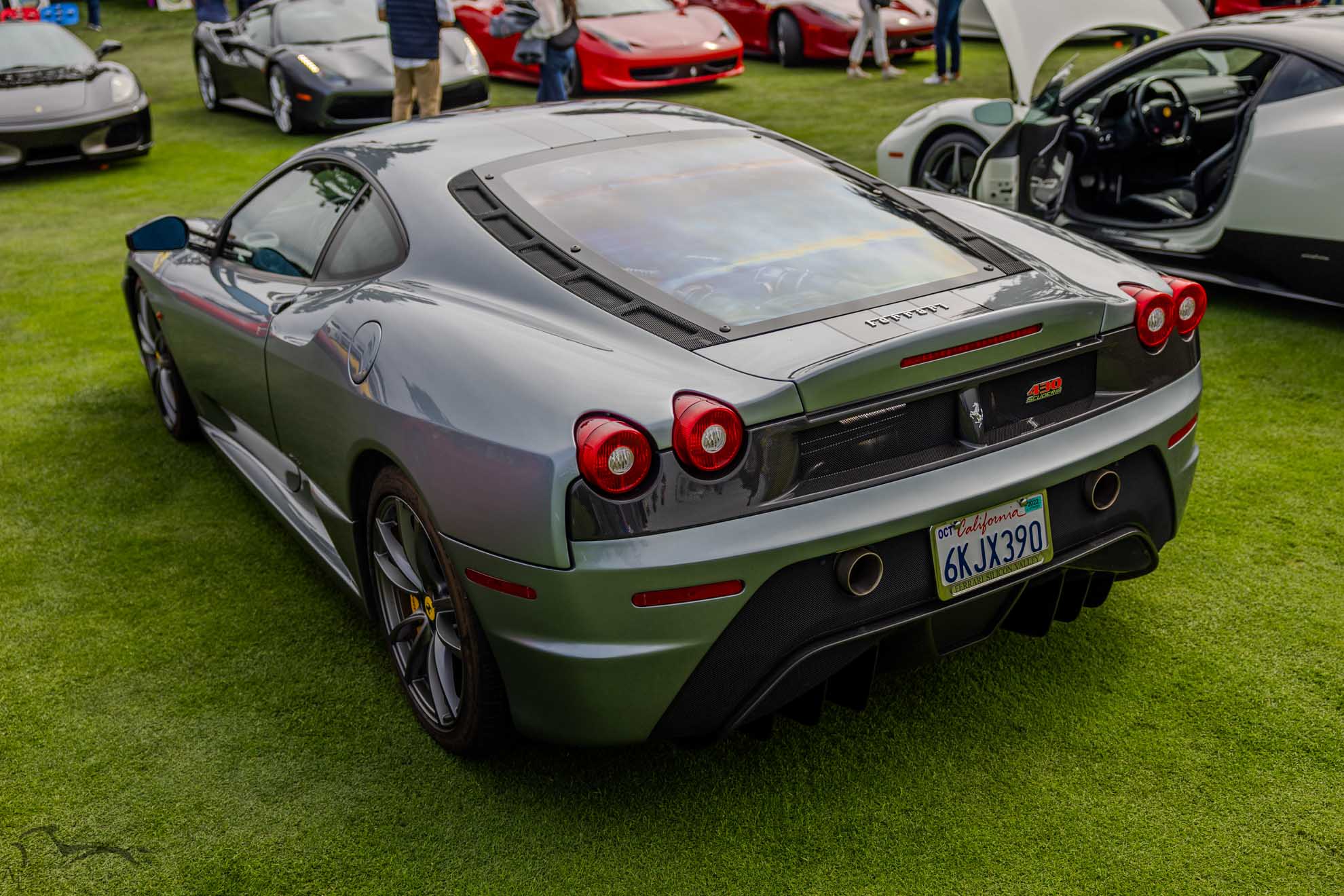
The grey 430 Scuderia developed the idea further with 510 horsepower, faster shifts, a more sophisticated electronic differential and a chassis calibration influenced by Michael Schumacher’s development input.
Objectively, the Scuderia is the more capable car. Subjectively, I might still take the Challenge Stradale. The 430 is faster almost everywhere, but the 360-based car has a delicacy and soundtrack which make the speed feel more special. This is another case where progress improved the numbers without necessarily settling the argument.
The Ferrari 550 family: one Coupé, two Barchettas and a personal problem
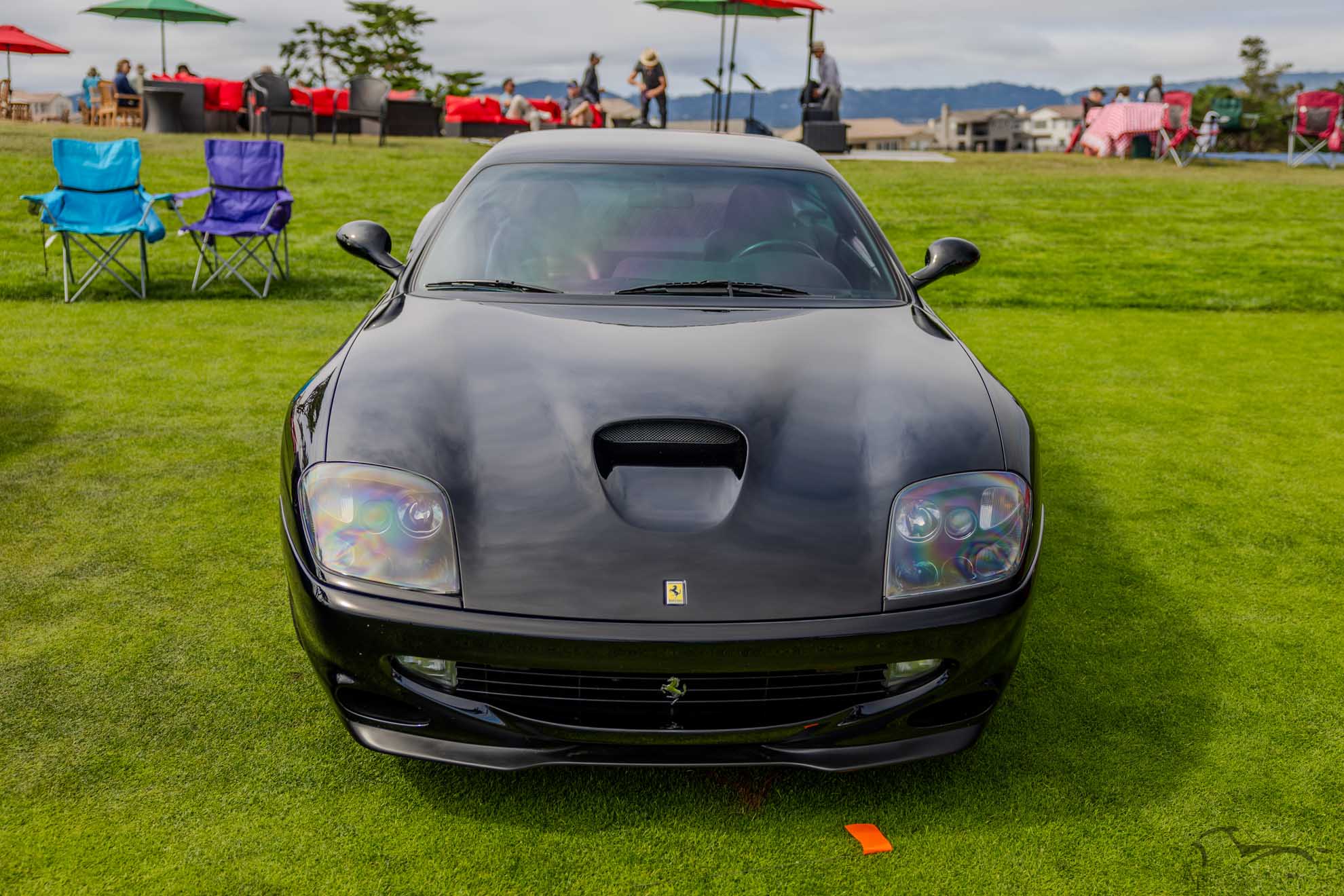
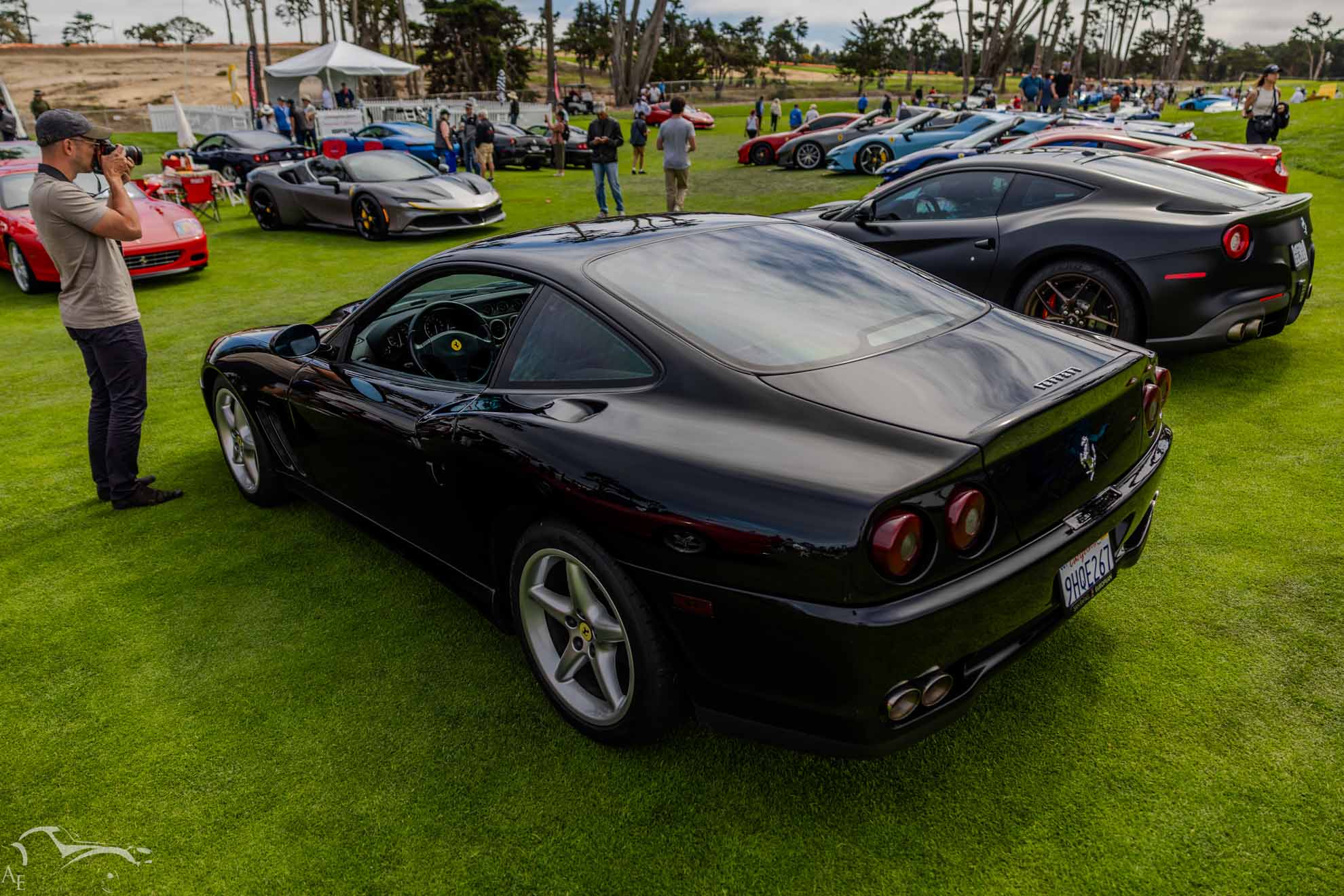
The black standard Ferrari 550 Maranello gave a useful reference after the green ENRO race conversion. In normal form the 550 is a restrained front-engined GT, powered by a naturally aspirated 5.5-litre V12 and connected to a six-speed manual transaxle.
Black hides some of the Pininfarina lines, but it also reinforces the car’s discreet character. A 550 is not supposed to scream for attention like an F50. It is a car that can cross a continent, carry luggage and still feel special every time the metal gear lever moves through the gate.
My own experience makes it difficult to be objective. When a 550 is working correctly, I wonder why anybody needs a more modern Ferrari. When an old switch, sensor, seal or Fiat-sourced trim piece decides otherwise, I remember exactly why modern cars exist.
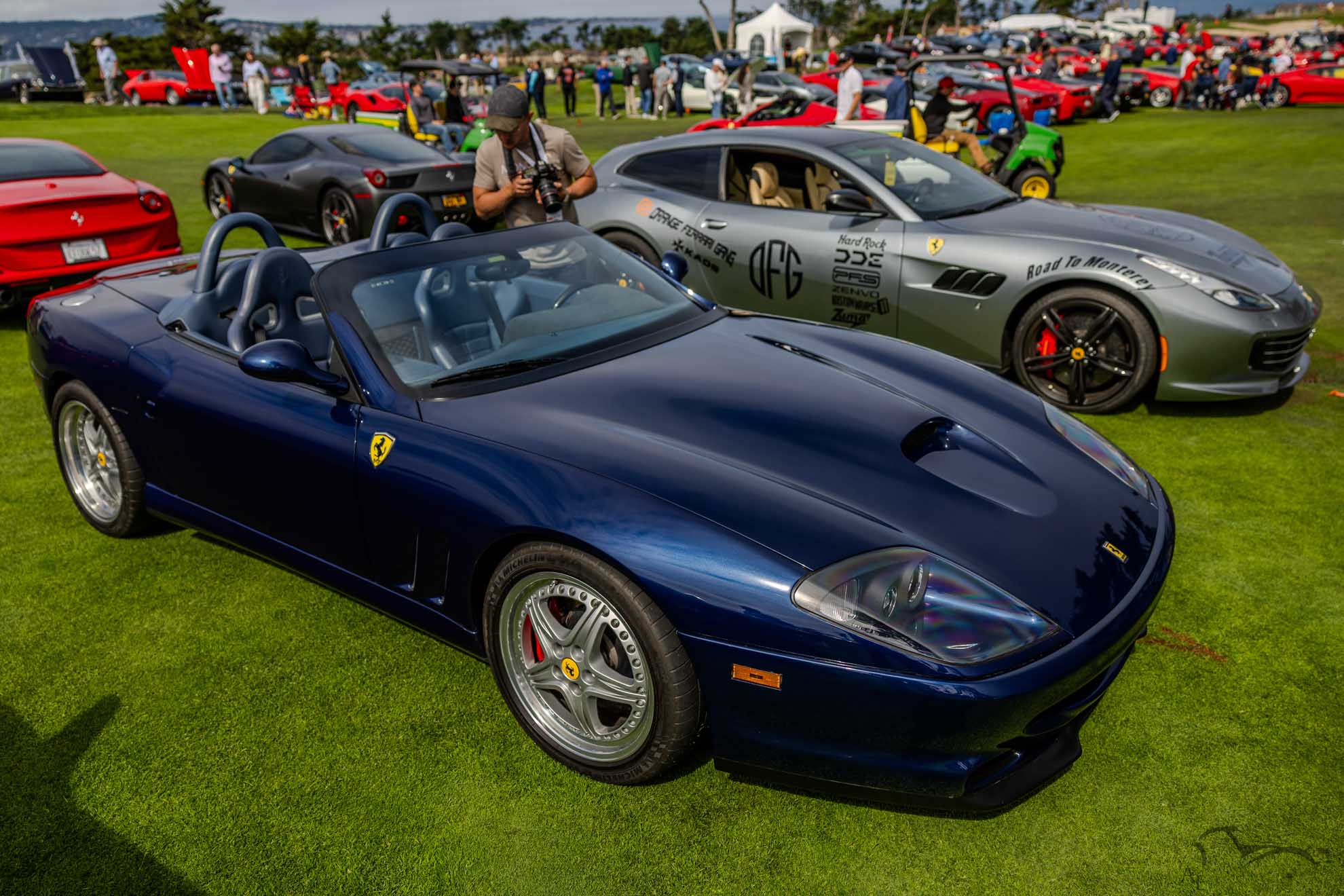
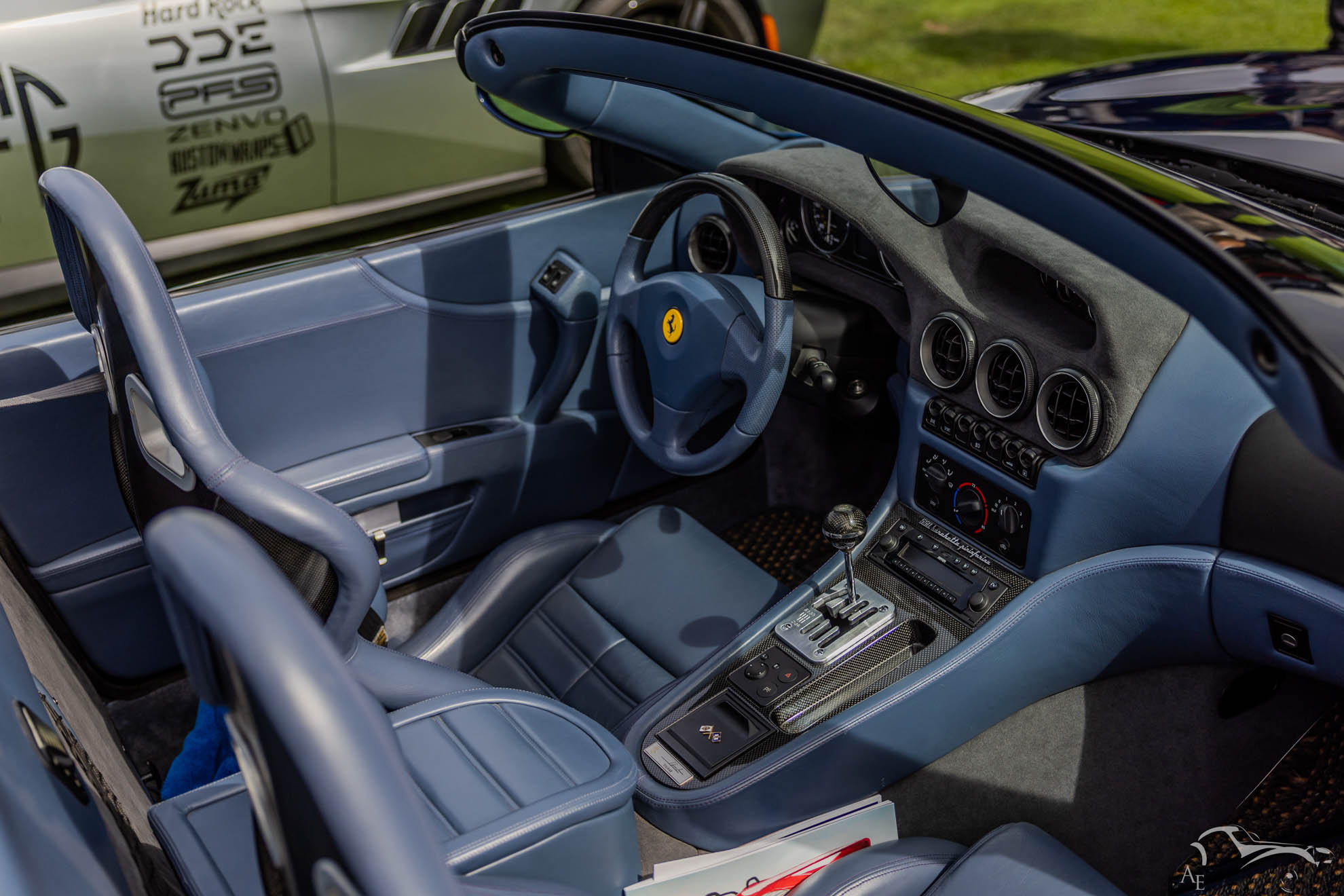
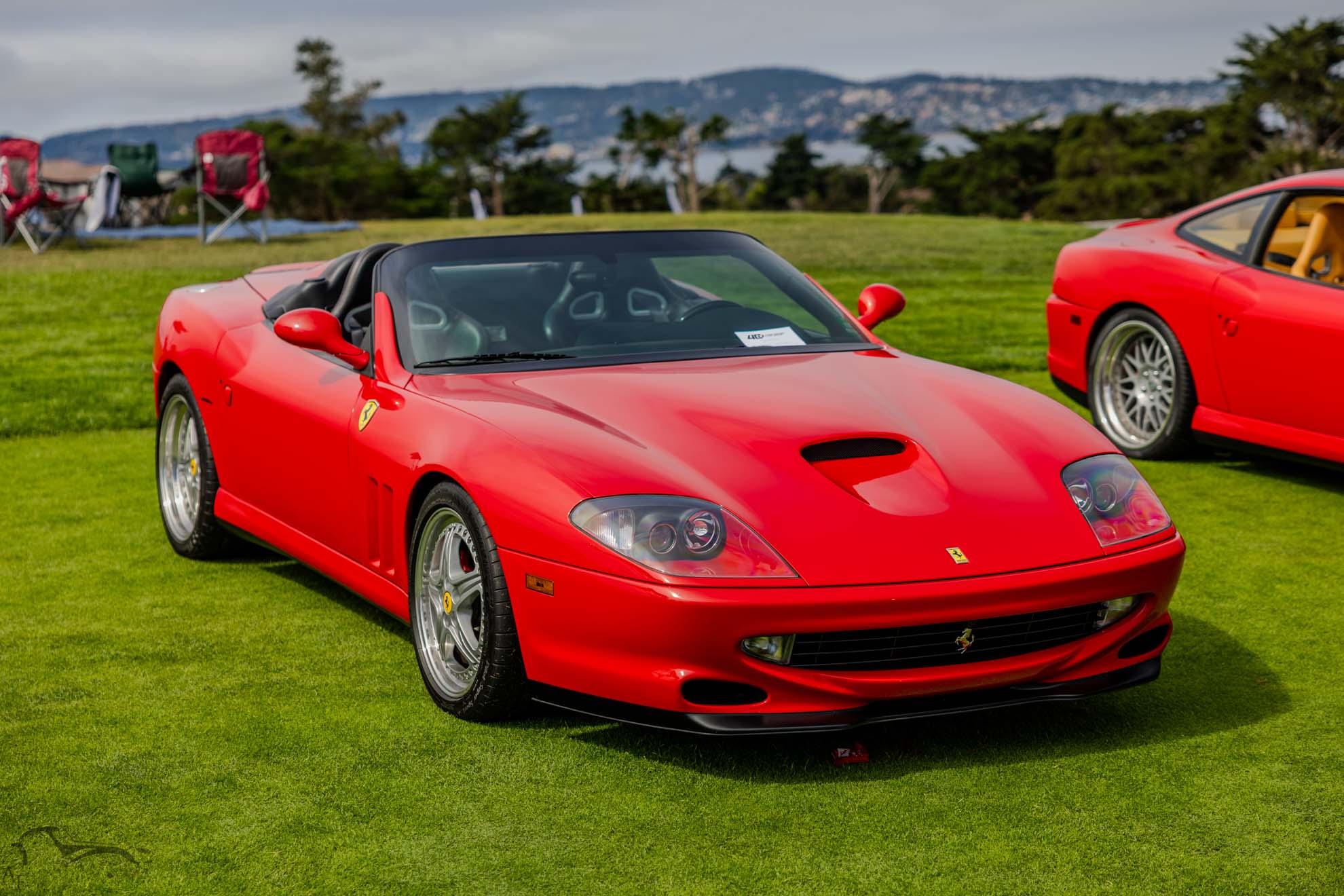
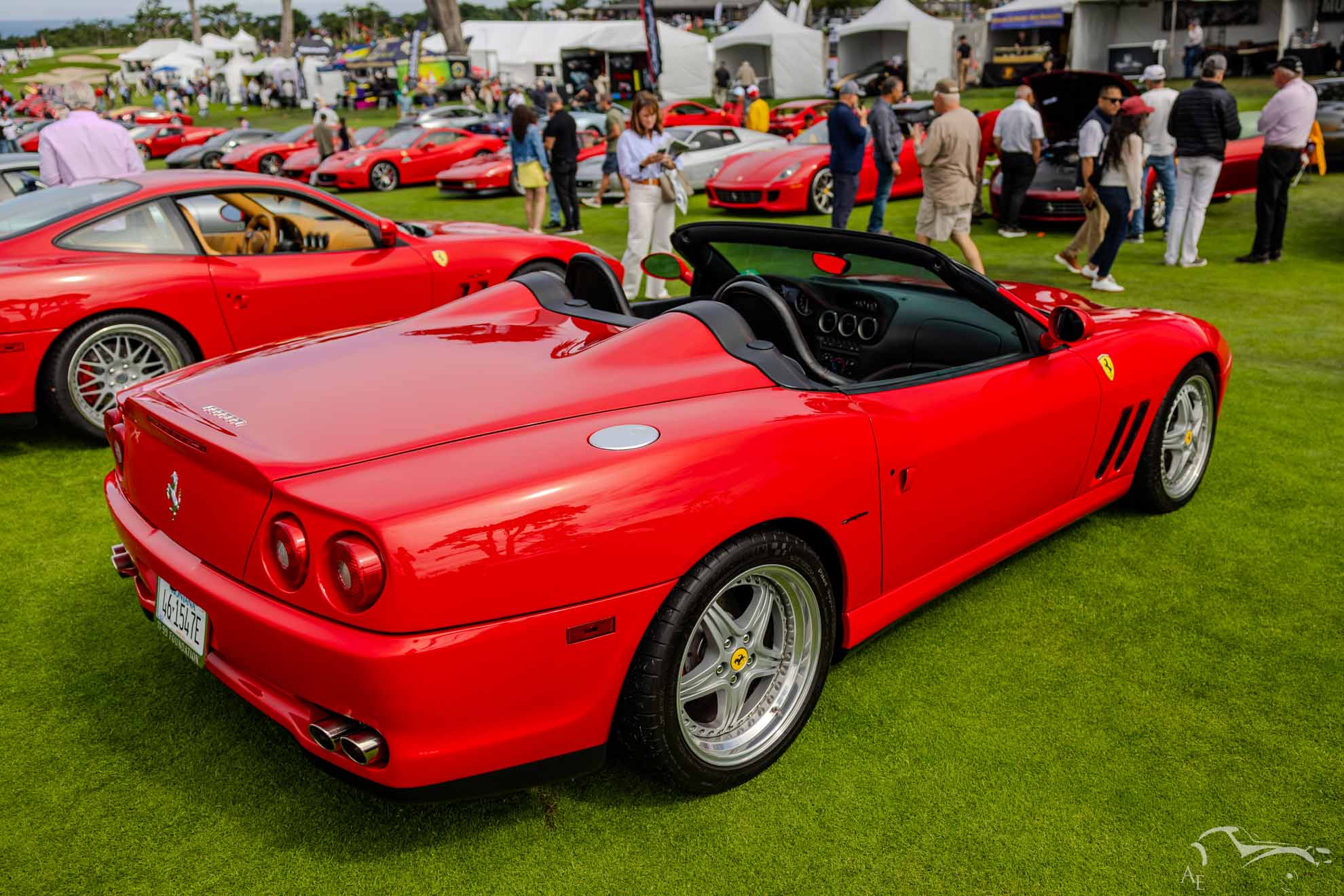
Two 550 Barchettas, one blue and one red, showed the most eccentric derivative of the platform. Ferrari built the Barchetta to celebrate Pininfarina’s 70th anniversary, removing the fixed roof and producing only 448 examples.
The emergency fabric roof was famously unsuitable for high-speed use, which means the Barchetta is not really a conventional convertible. It is a fair-weather speedster with a V12, manual gearbox and two aerodynamic humps behind the seats. That limitation makes it less practical than a 550 Maranello, but also far more memorable.
The red car is the iconic specification. I would choose the blue one. A Barchetta is already conspicuous; there is no need to make it shout even louder.
From 458 to 296: the speed of Ferrari evolution
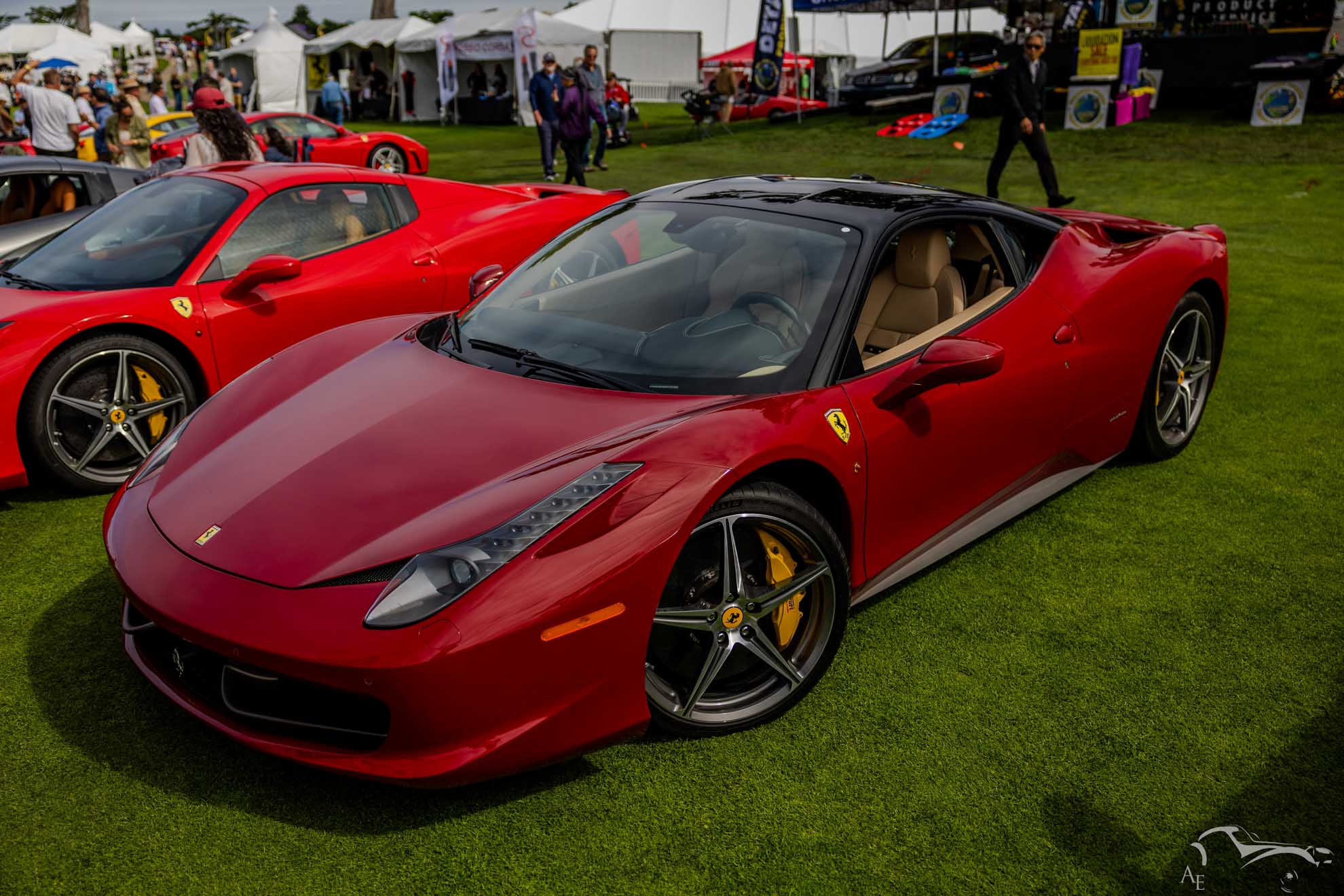
The red Ferrari 458 Spider represented one of the defining modern Ferrari generations. The 458 was the last regular mid-engined V8 model with a naturally aspirated engine. The Ferrari Club Best of Show went to Don Ferrari’s 2011 Ferrari 458.
Its 4.5-litre V8 produced 570 horsepower and revved to 9,000 rpm, while the dual-clutch gearbox made the older F1 transmission immediately feel dated. The car also introduced a level of electronic integration that made huge performance accessible without removing all the driver’s involvement.
A normal red 458 might seem almost too common for an award at Concorso Italiano, but condition and presentation matter. More importantly, the 458 is now old enough that perfect, unmodified examples deserve preservation.
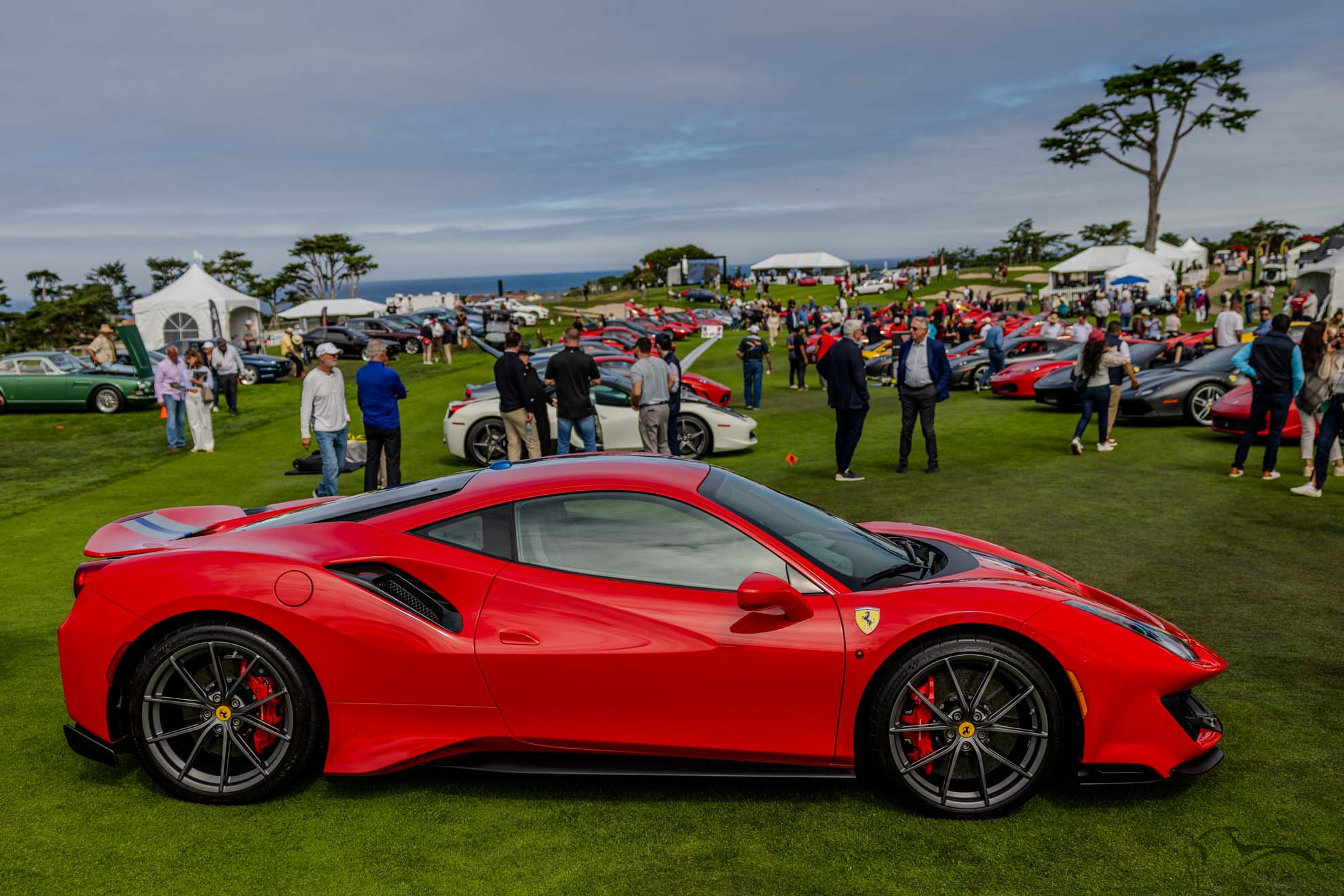
The red 488 Pista illustrated Ferrari’s move from naturally aspirated response to turbocharged force. It has a 720-horsepower twin-turbo V8 derived from the 488’s engine, with extensive aerodynamic and weight-saving work.
The Pista is objectively faster and more effective than a 458 Speciale in most situations, yet the debate will always return to sound and throttle response.
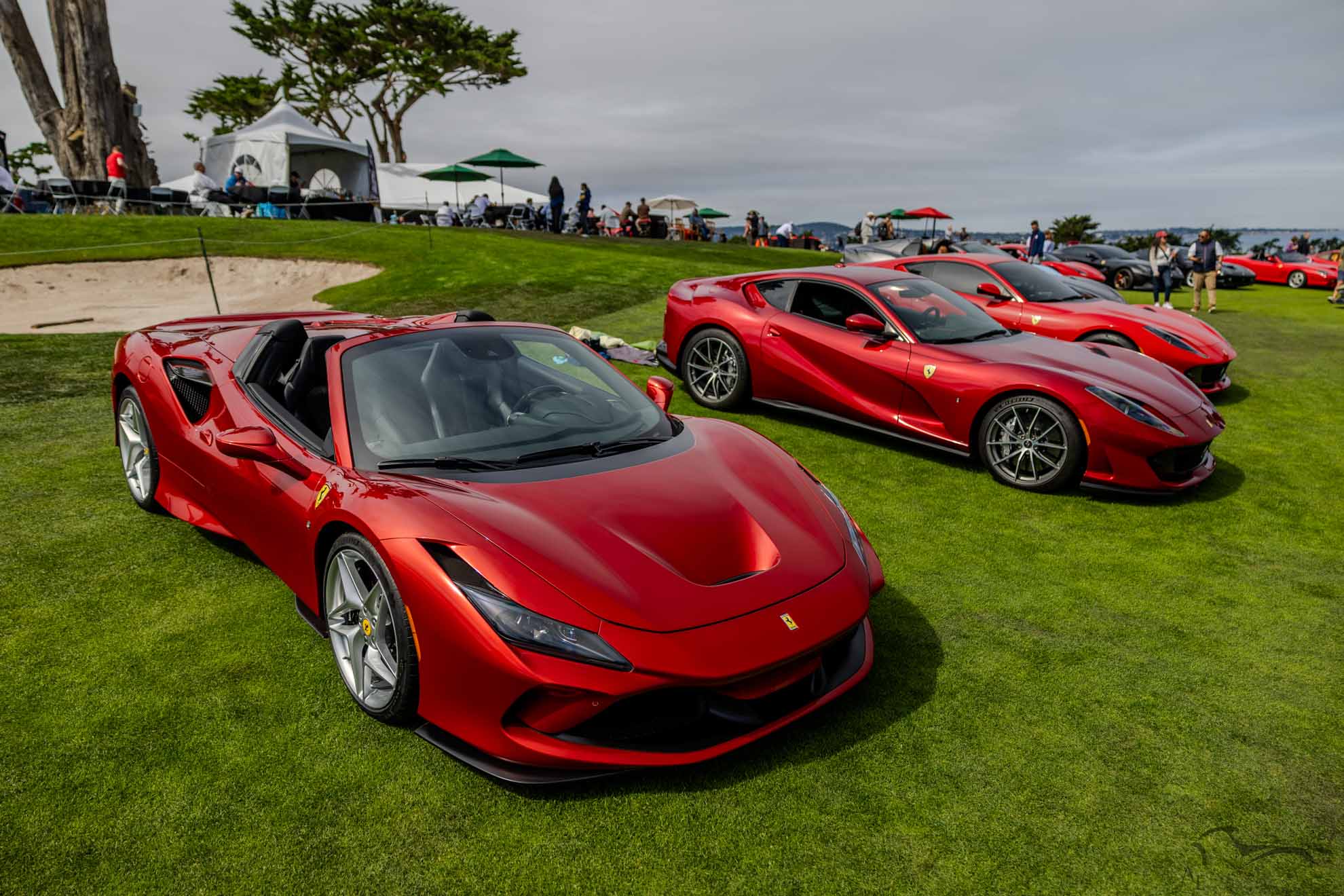
The red F8 Spider represented the final evolution of Ferrari’s non-hybrid mid-engined V8 line. It retained the 720-horsepower engine and added the usability of a retractable hardtop.
I have driven both the F8 Spider and the 812 GTS, and the F8 left me with mixed feelings. It is devastatingly fast and extremely competent, but perhaps too competent. The electronics, gearbox and turbocharged torque make everything happen with very little effort. That is excellent if the goal is pace; it can be less satisfying if the goal is theatre.
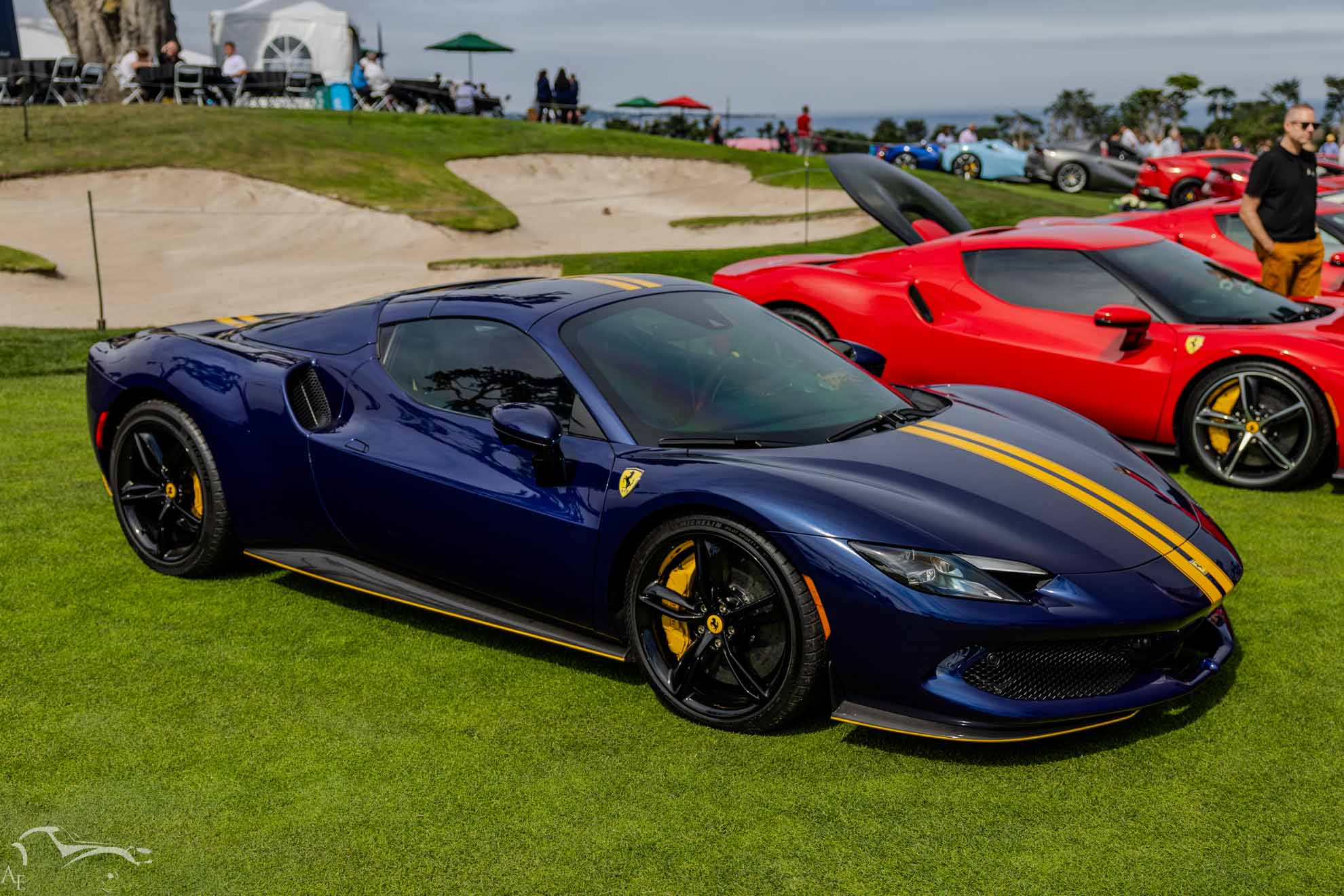
The 296 GTS replaced eight cylinders with a three-litre twin-turbo V6 and an electric motor, for a combined output of 830 horsepower. On paper it sounds like a loss of identity. In practice, the compact V6, instant electric response and short wheelbase created one of Ferrari’s most energetic modern road cars.
The hybrid system adds weight and complexity, which owners will have to confront in the long term. The advantage is a level of response turbo engines normally struggle to provide. I still find the 296’s design less beautiful than the 458’s, but dynamically it may be the more interesting car than the F8. And this spec was gorgeous!
Ferrari V12s and hybrids at the top of the field
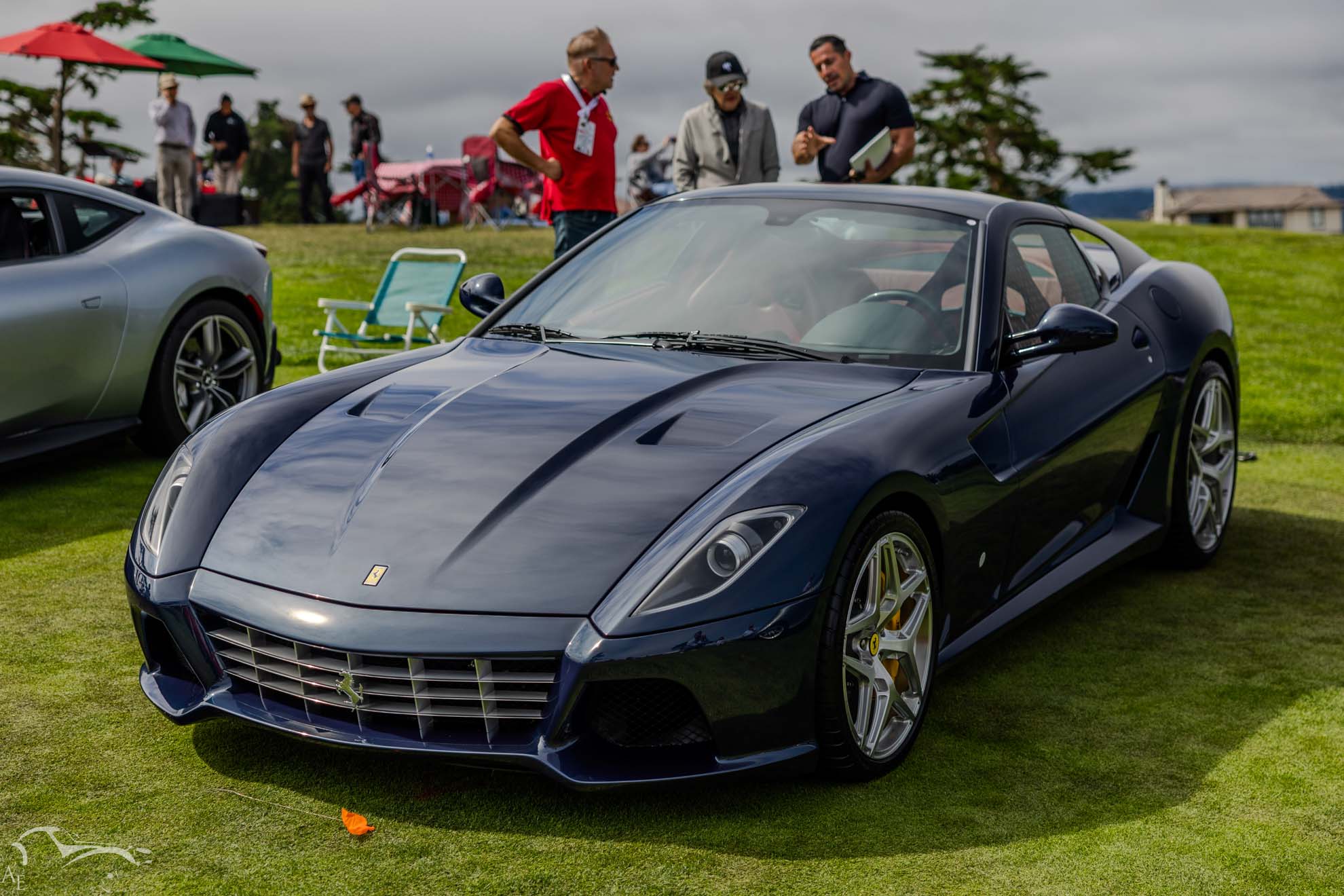
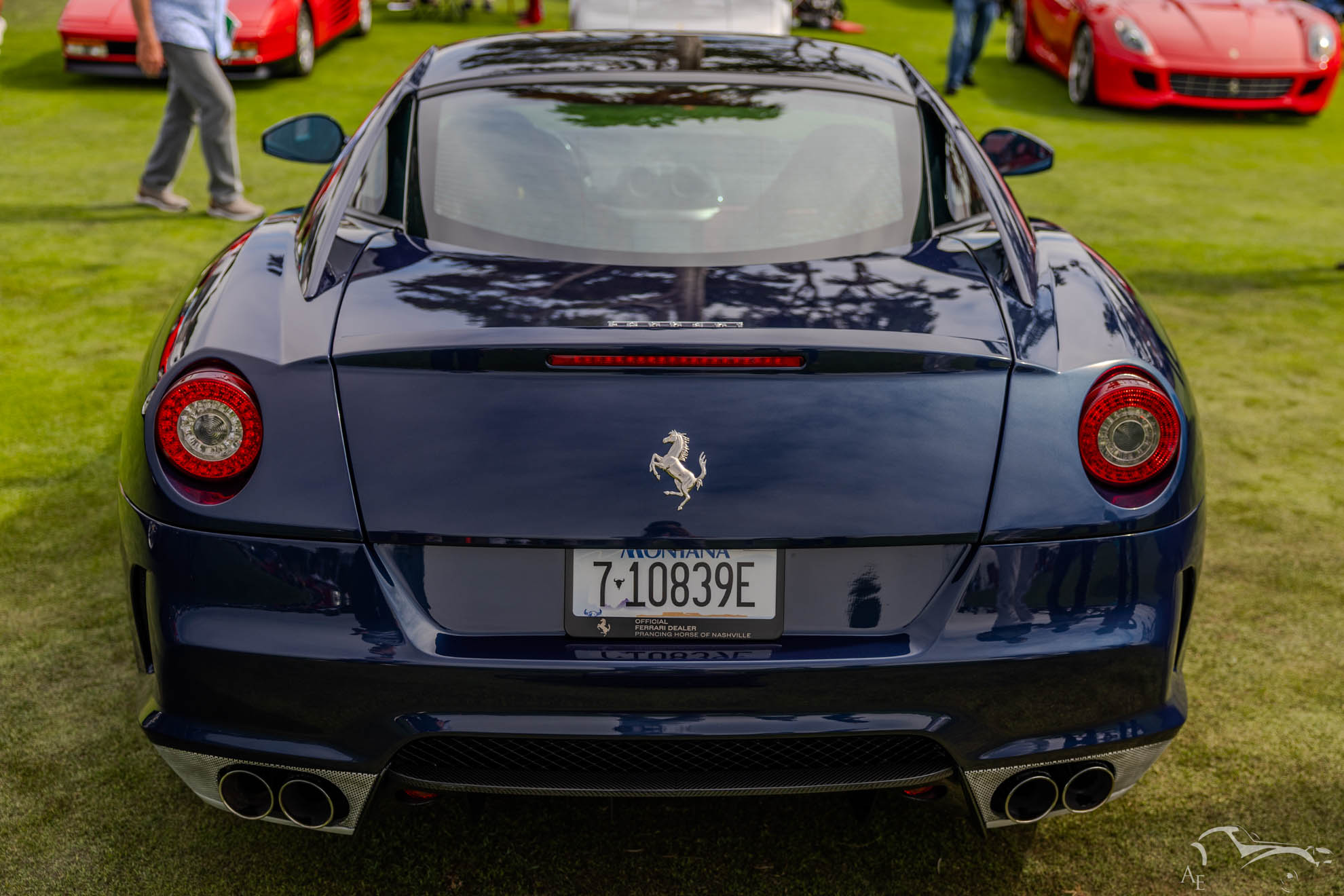
A dark blue custom 599 GTB offered the perfect contrast with Fiorella. The road car used a 620-horsepower 6.0-litre V12 related to the Enzo’s engine, but wrapped it in a genuine grand touring package with luggage space, climate control and a much calmer personality.
The 599 is large and its early F1 gearbox has not aged as gracefully as the engine, but the car’s ability remains extraordinary. In dark blue it looked elegant enough to explain why turning one into a drift car feels both sacrilegious and brilliant. This car had special front lights and bumpers.
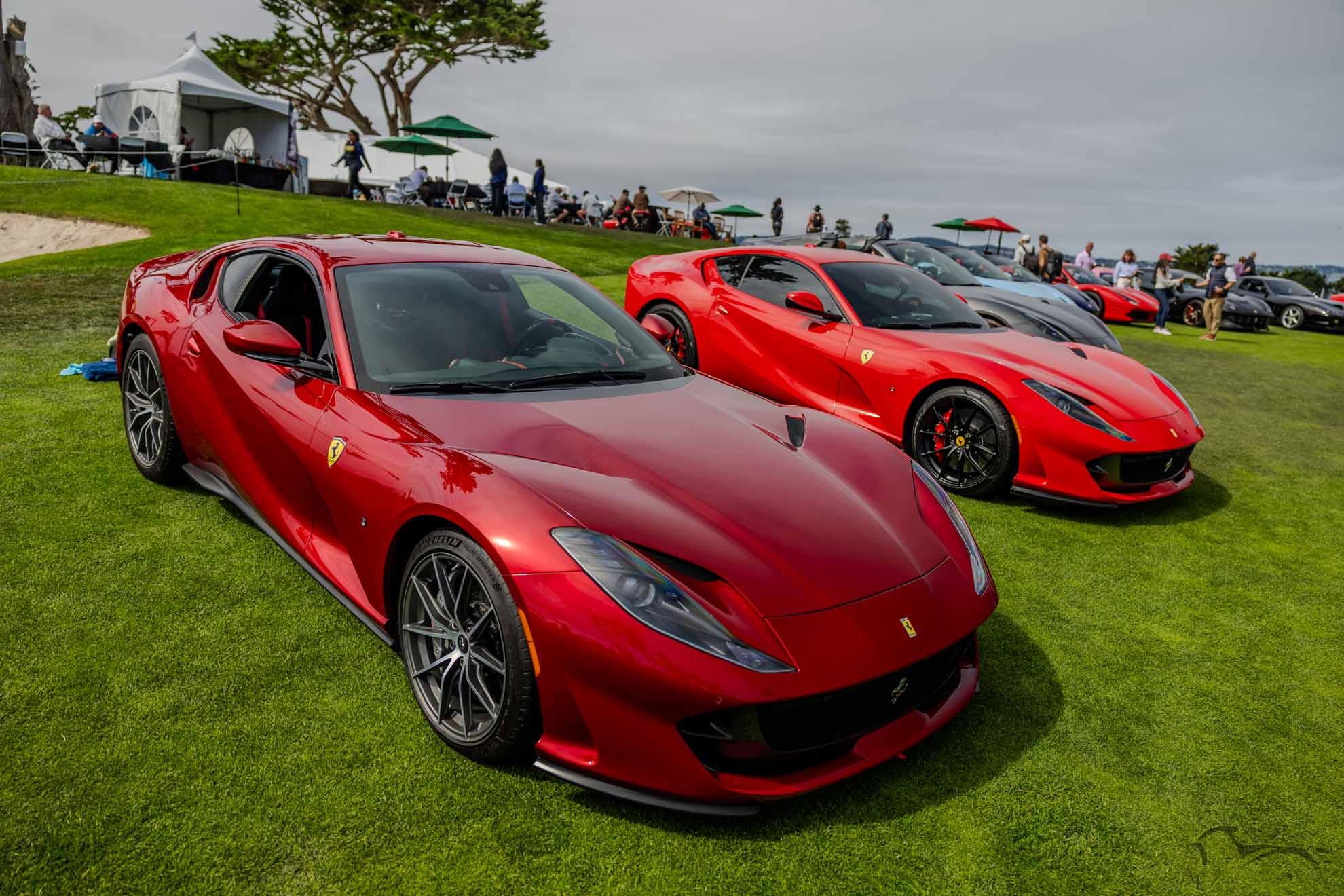
The dark metallic red 812 Superfast represented Ferrari’s final regular-production front-engined V12 generation before the arrival of the 12Cilindri. Its naturally aspirated 6.5-litre engine produced 800 horsepower and combined an almost absurd top-end with the usability expected from a modern GT.
This is where color becomes important on a modern Ferrari. The 812 has many vents, creases and aerodynamic channels; a darker shade calms them, while a bright solid red exposes every line at once.
Ferrari’s modern problem remains visible. Every new car must be faster than the previous one, but a front-engined V12 Ferrari also needs elegance. At some point, aerodynamic necessity starts fighting the original reason people wanted the car.
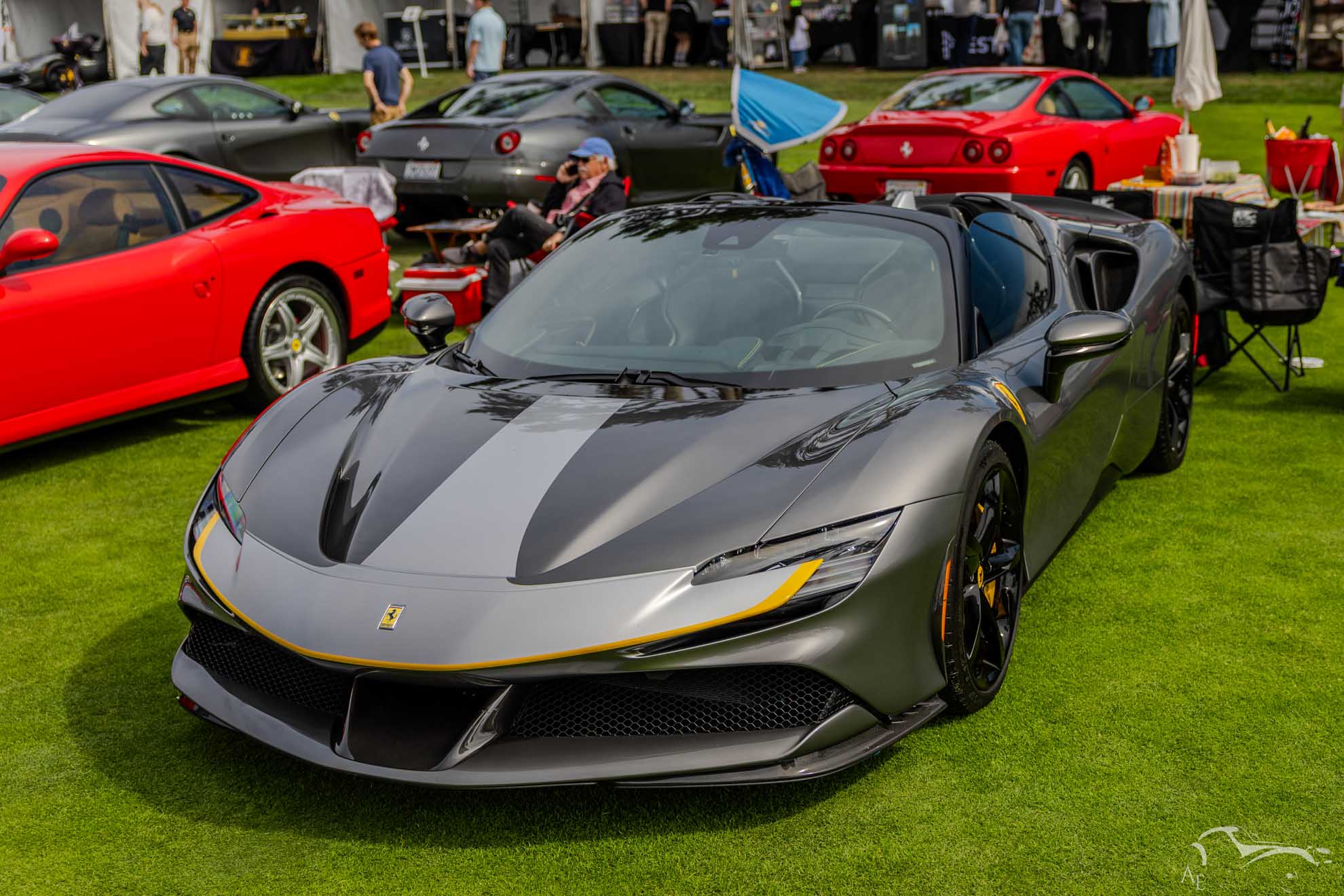
The grey SF90 Spider showed how far the company moved in only a few years. The SF90 combines a twin-turbo V8 with three electric motors for 1,000 horsepower, all-wheel drive and acceleration figures that would have belonged to a racing prototype not long ago.
Its yellow details and central stripe made it particularly aggressive. The Spider is technically astonishing, but I am still not convinced the SF90 has the visual identity expected from Ferrari’s first series-production plug-in hybrid flagship.
The advantages are obvious: immense speed, traction and technology. The disadvantages are just as real: weight, complexity and a driving experience that can feel mediated by layers of software. Would I take one over an Enzo at the same event? Not for a second.
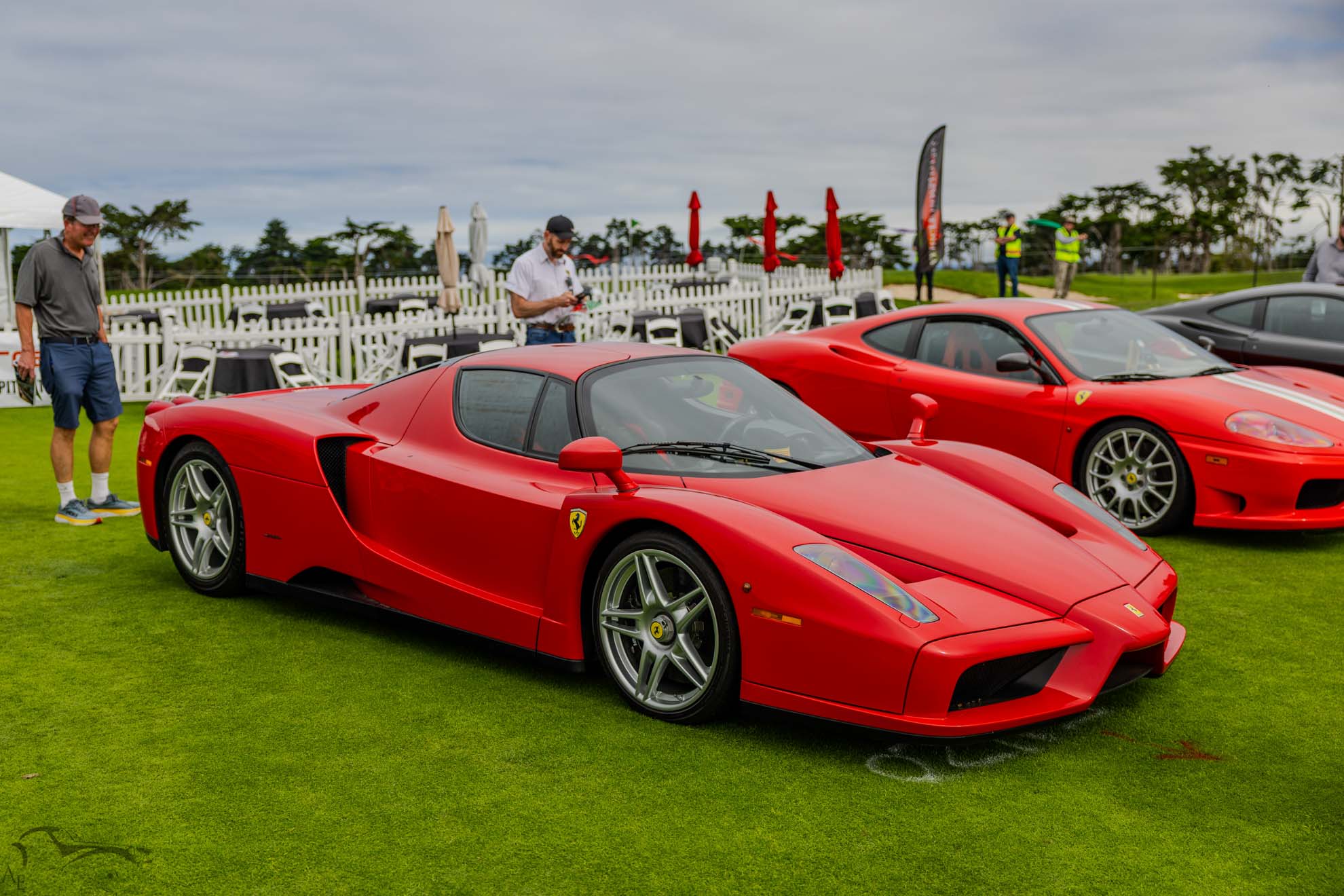
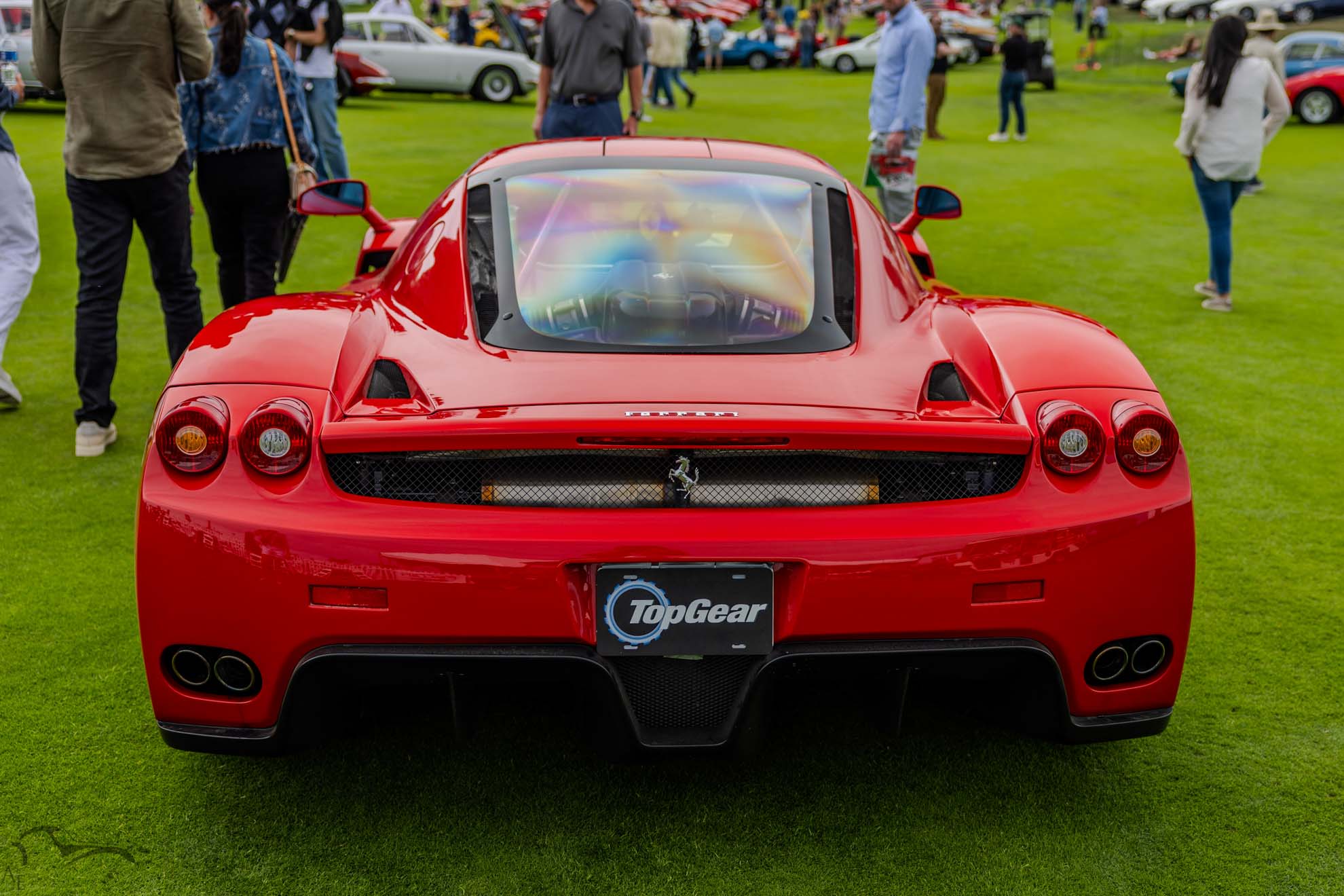
The red Ferrari Enzo at the end of the Ferrari area reinforced that point. Designed under Ken Okuyama at Pininfarina and built in roughly 400 examples, it used a 6.0-litre naturally aspirated V12, carbon-fibre structure and an automated manual gearbox inspired by Formula 1 practice of the period.
The Enzo’s design remains divisive, but it is instantly recognizable. The nose, exposed carbon details and high tail do not try to be conventionally pretty. It looks like a machine built around airflow and performance, yet it remains much simpler than a modern hybrid hypercar.
The gearbox is slow by current standards and brutal when used badly. That is part of its personality. A modern car hides the process; the Enzo makes every shift an event. The market currently seems obsessed with the Carrera GT, but I suspect the Enzo’s moment will return very strongly.
Lamborghini Miura: still the center of gravity
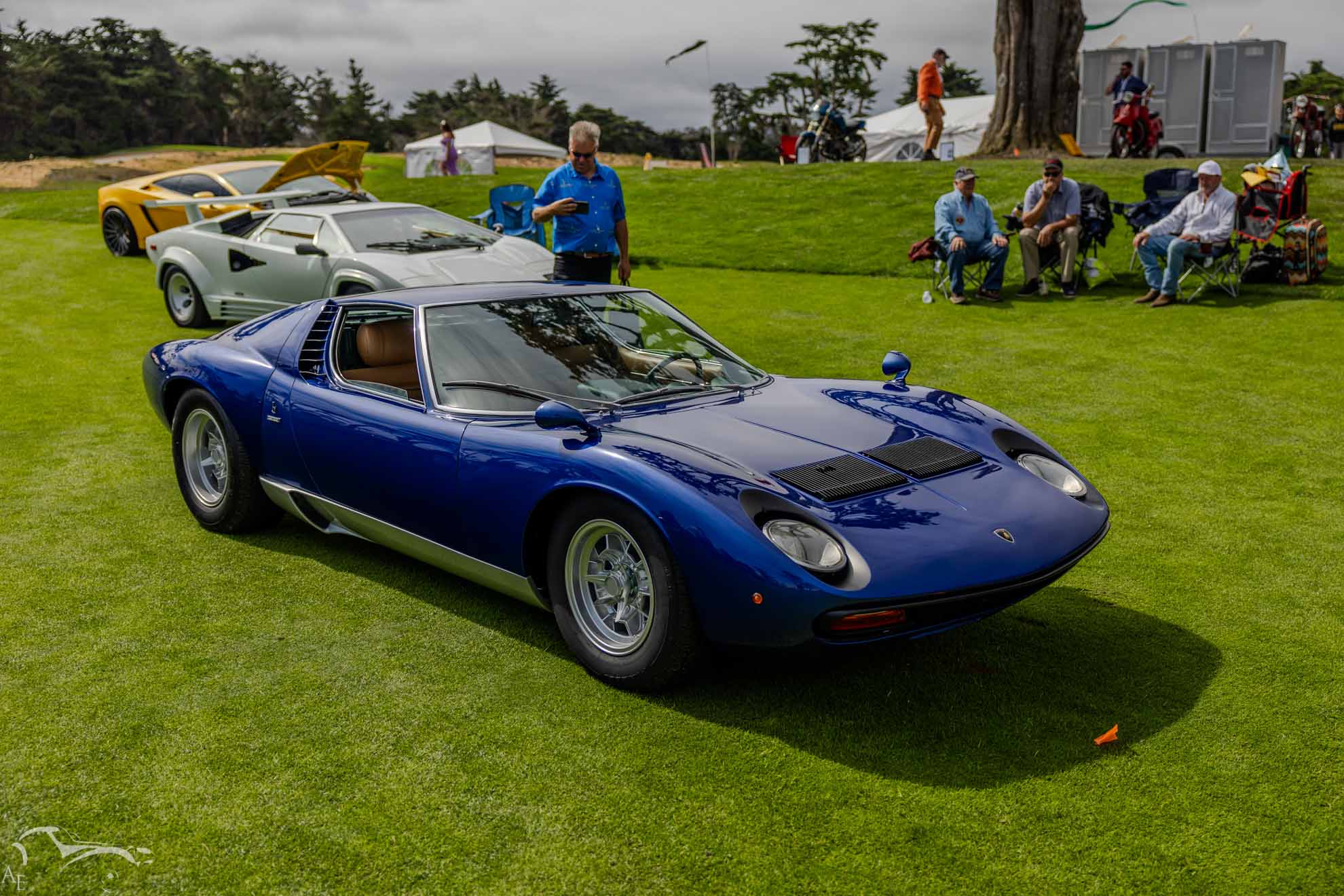
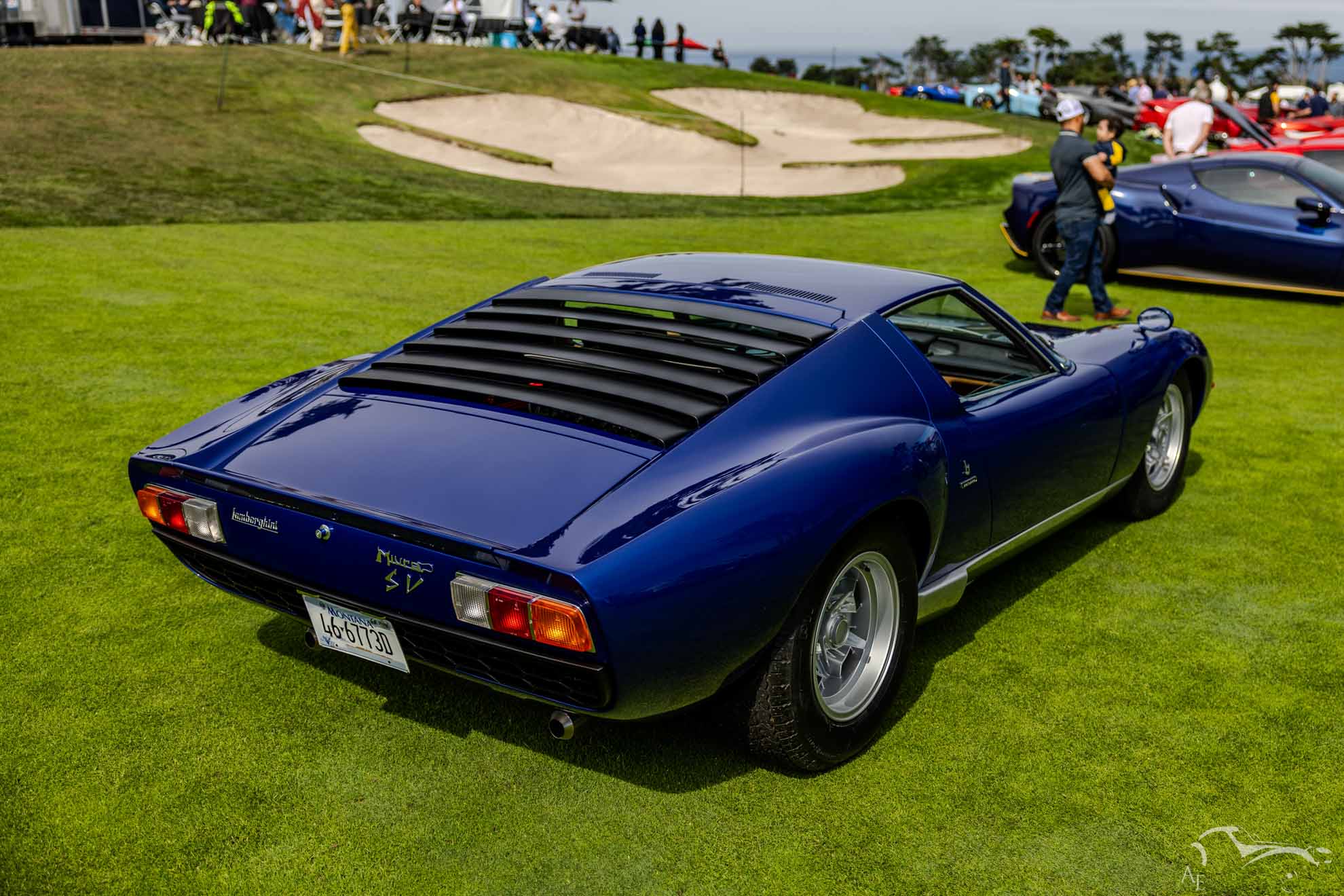
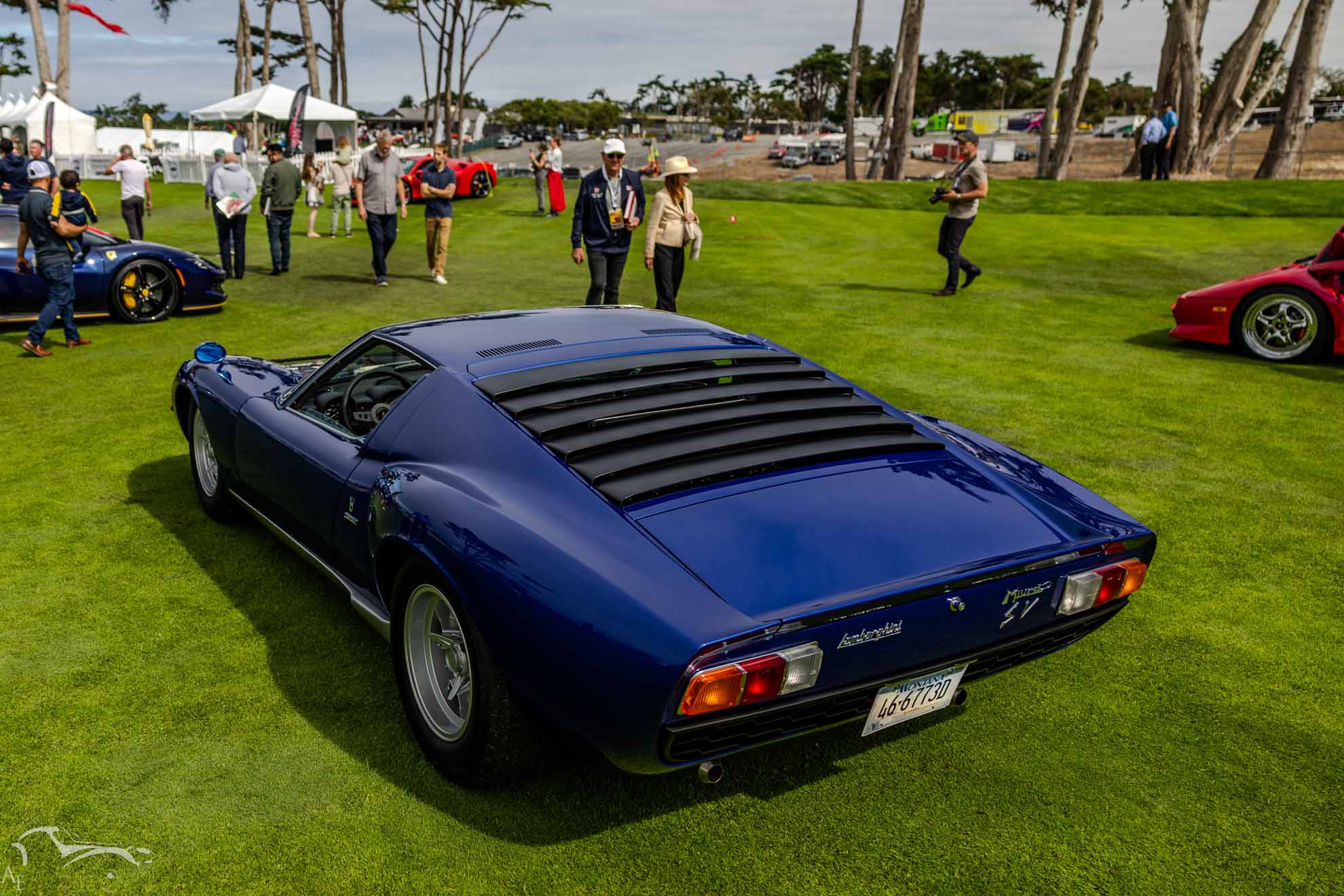
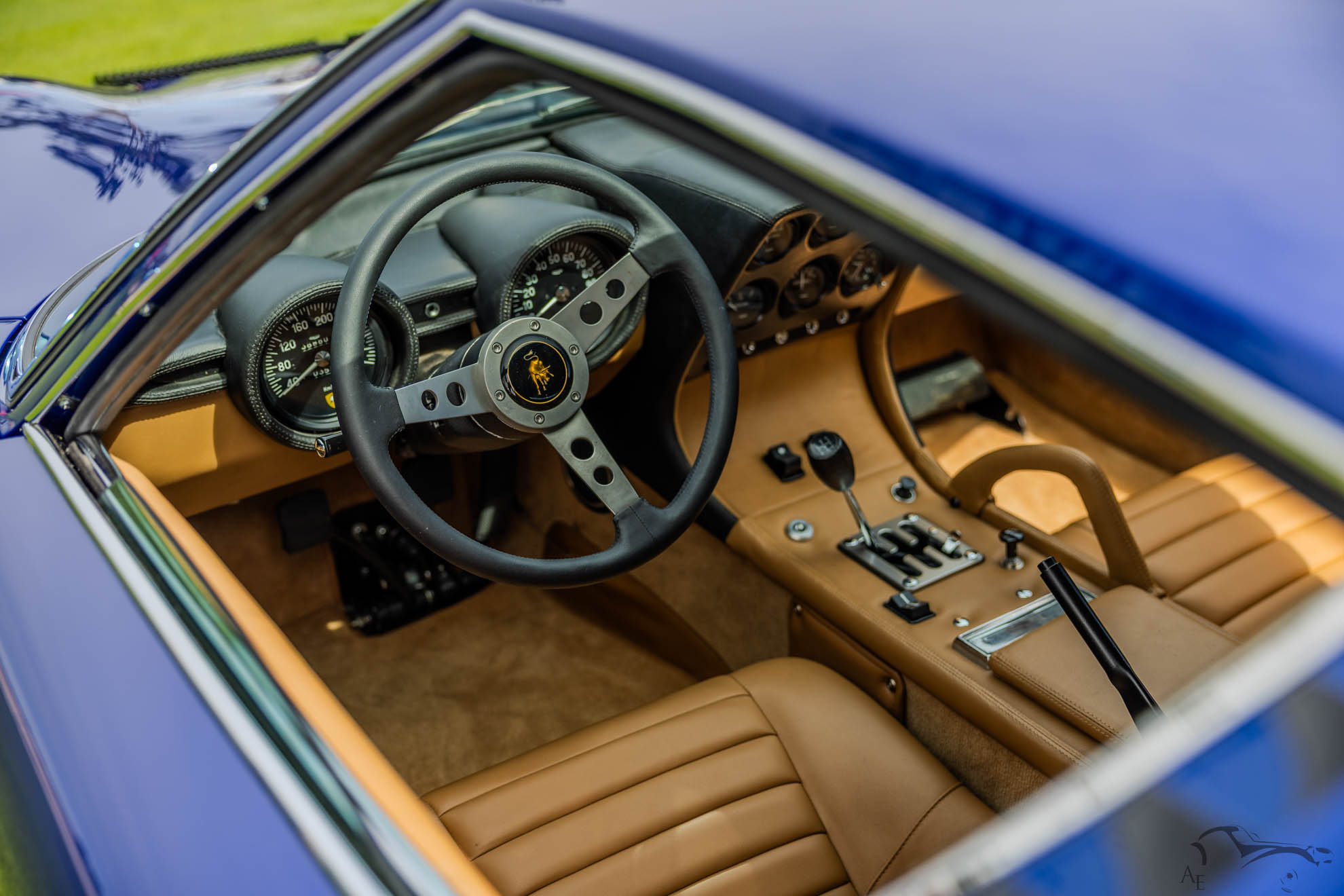
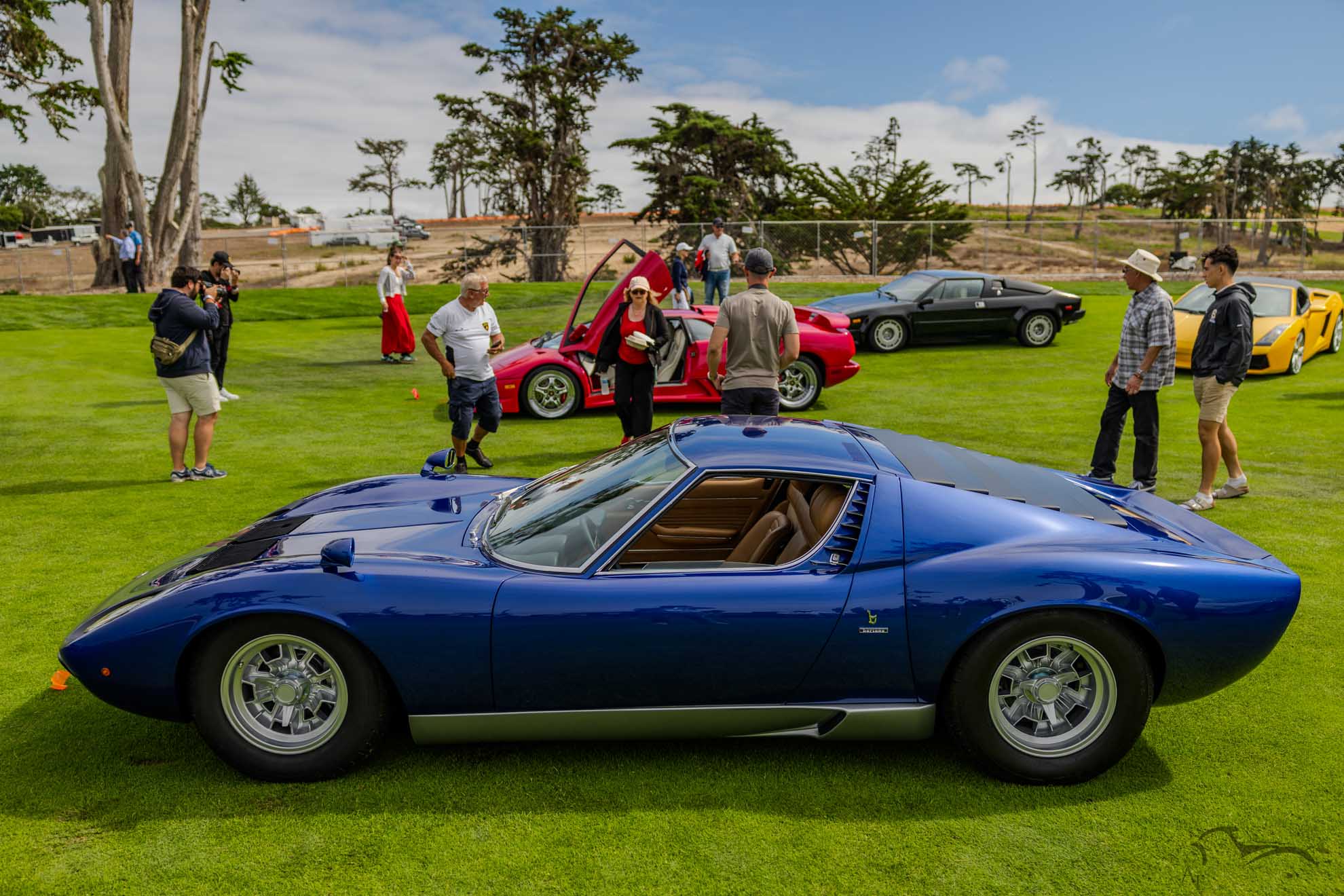
This car chassis 4788, has the split sump engine, and is actually a 1971 S model but during a restoration the car was damaged in the rear. Some SV parts were then exchanged, specially the front hood. Valentino Balboni recommended a new rear frame to the owner, including the better SV suspensions, and arranged from Marchase to build one, as they were the original frame builders for the Miura. This particular car has had all the SV additions since then, and the current owner owns it since 47 years! The body and paint were done by Gary’s Rods and Restoration while the engine was redone by Jeff Stefan.
The Miura’s transverse V12 and gearbox share the same compact package behind the cabin, a solution that created its extraordinary proportions but also considerable heat and mechanical complexity. None of that matters when you see one. More than half a century later, the roof remains impossibly low and the body still makes people stop mid-conversation.
The Diablo at 35: from elegance to excess
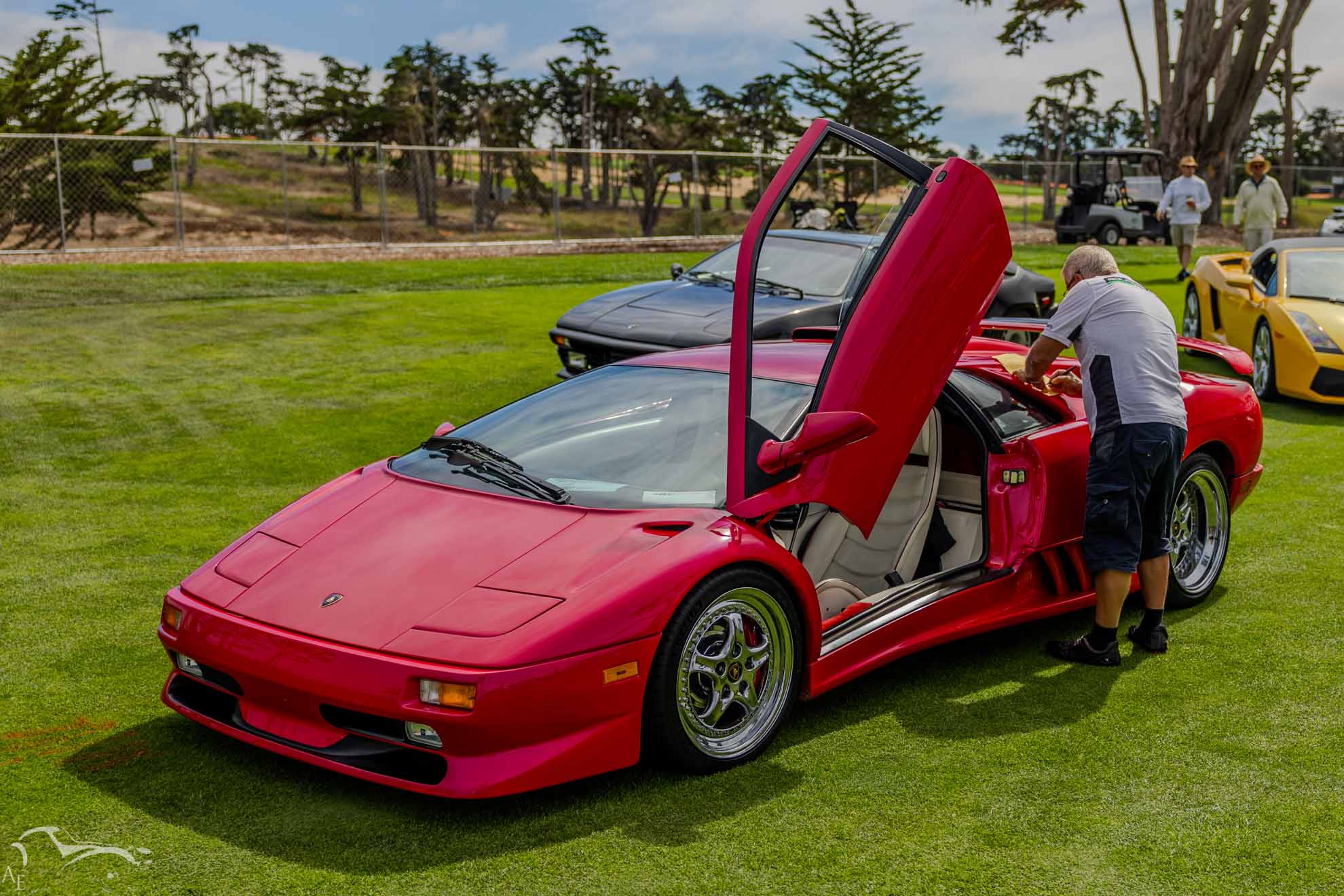
The Diablo celebrated its 35th anniversary with one of the largest themed displays at Concorso Italiano 2025.
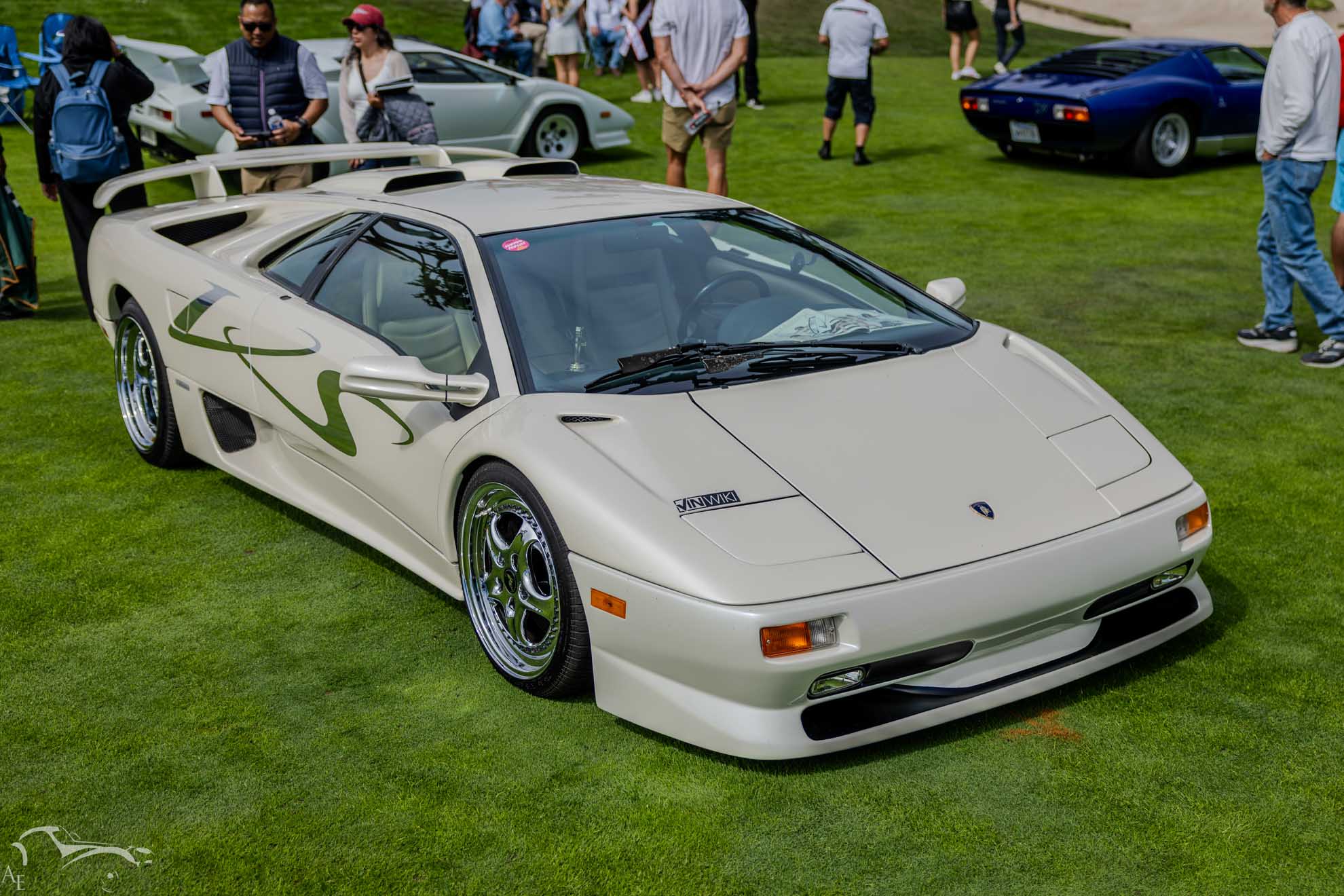
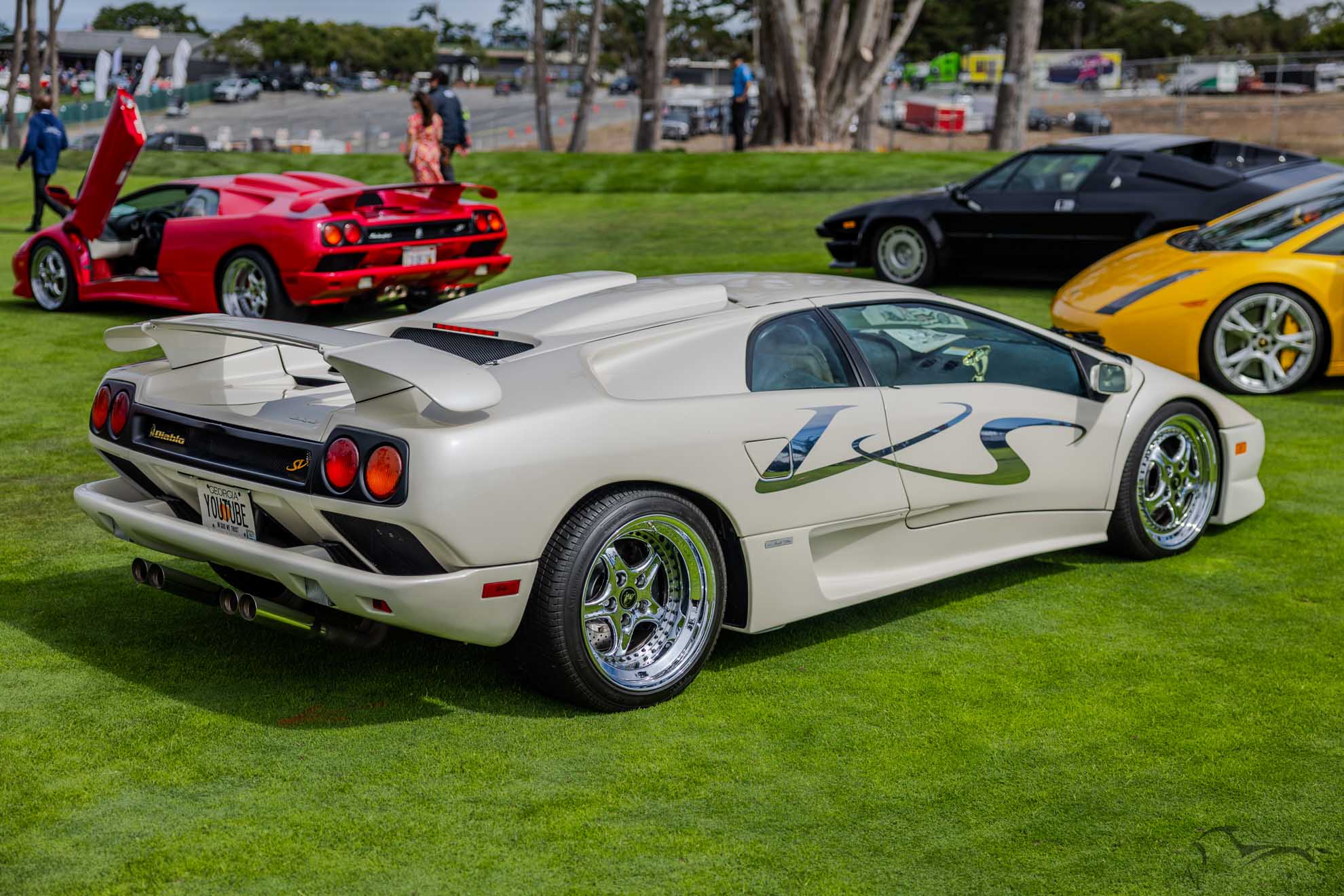
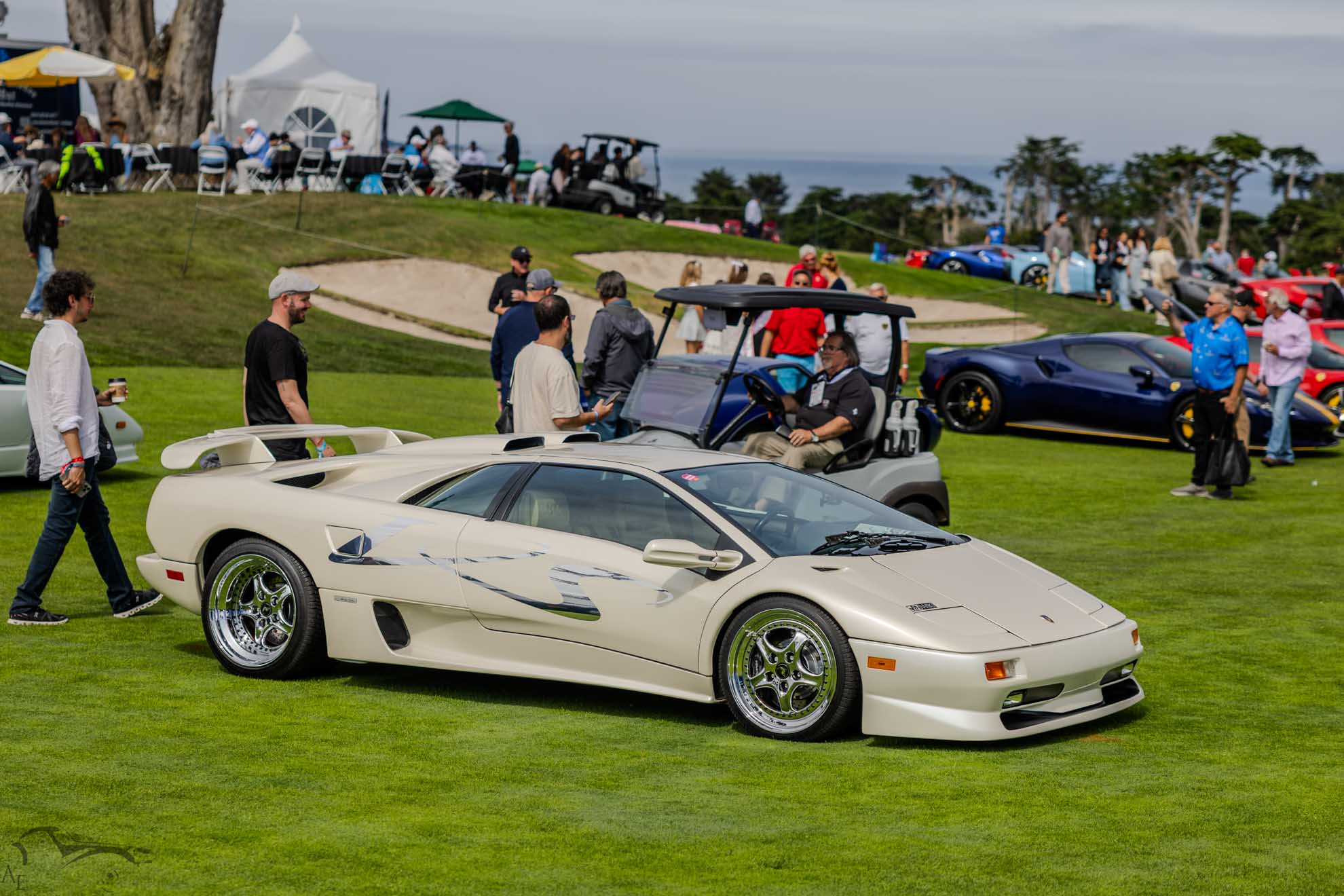
The most discussed Diablo was Ed Bolian’s 1998 Victoria’s Secret SV. It is often described online as a “Victoria’s Secret edition”, but that wording is misleading. It was not a normal factory limited series. It was a specially commissioned Diablo SV created with Lamborghini USA for the Victoria’s Secret Christmas catalogue.
The car appeared in pearl white with prominent chrome Victoria’s Secret graphics and matching branded luggage, offered in the catalogue for around 350,000 US dollars. Following a long disappearance, accident history and years in storage, it was restored for its return to public view in its pearl-white catalogue appearance, complete with recreated VS graphics.
This is exactly the kind of car that divides serious collectors. On one side, it is a marketing object whose current appearance is anything but subtle. On the other, it is a uniquely documented piece of late-nineties culture connecting supercars, fashion catalogues and the pre-internet idea of outrageous luxury.
I would not call it the most beautiful Diablo. I would call it one of the Diablos with the best story.
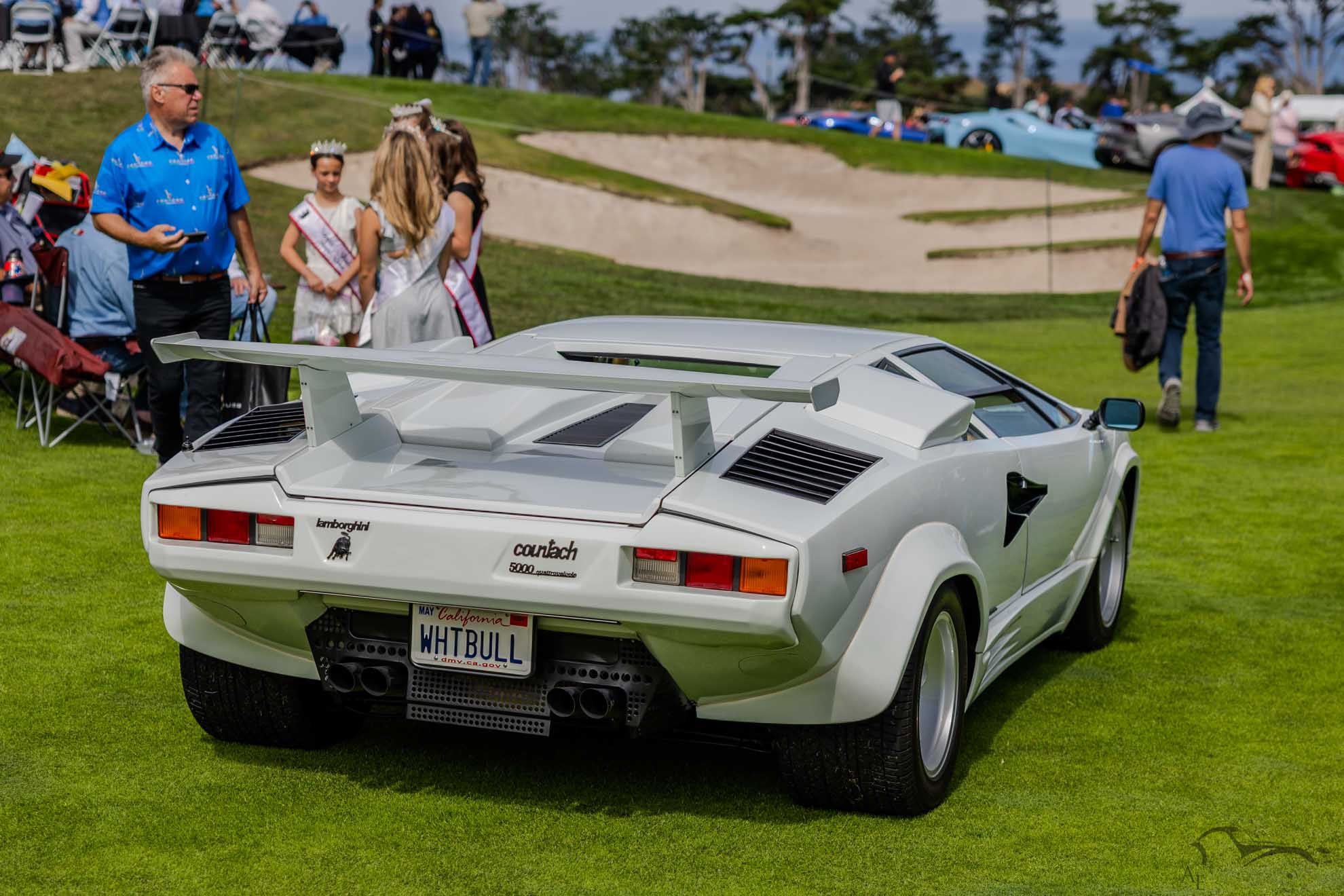
The white Countach 5000 Quatrovalvole parked among the Diablos showed the lineage clearly. Introduced in 1988, it was the most brutal of the Countach evolutions. Purists often prefer the cleaner LP400 “Periscopio” and I understand them. The 5000 QV has more strakes, ducts and body-colored elements than the original shape needs. Yet in white, with the period wheels and enormous rear haunches, it remains magnificently excessive.
The Countach is uncomfortable, difficult to see out of and awkward to enter. These are not hidden disadvantages; they are part of the contract. Anybody expecting a sensible supercar has approached the wrong object.
The blue Diablo SV demonstrated how much the model’s personality changes with color and graphics. The SV returned the Diablo to rear-wheel drive and added more power, larger intakes and the enormous side lettering that became one of its defining details. I loved the White Bull matching number plate.
With its silver details, the blue example looked almost restrained by Diablo standards. I would take it over a red one. Lamborghini owners may disagree, but the car is dramatic enough without needing every color in the catalogue.
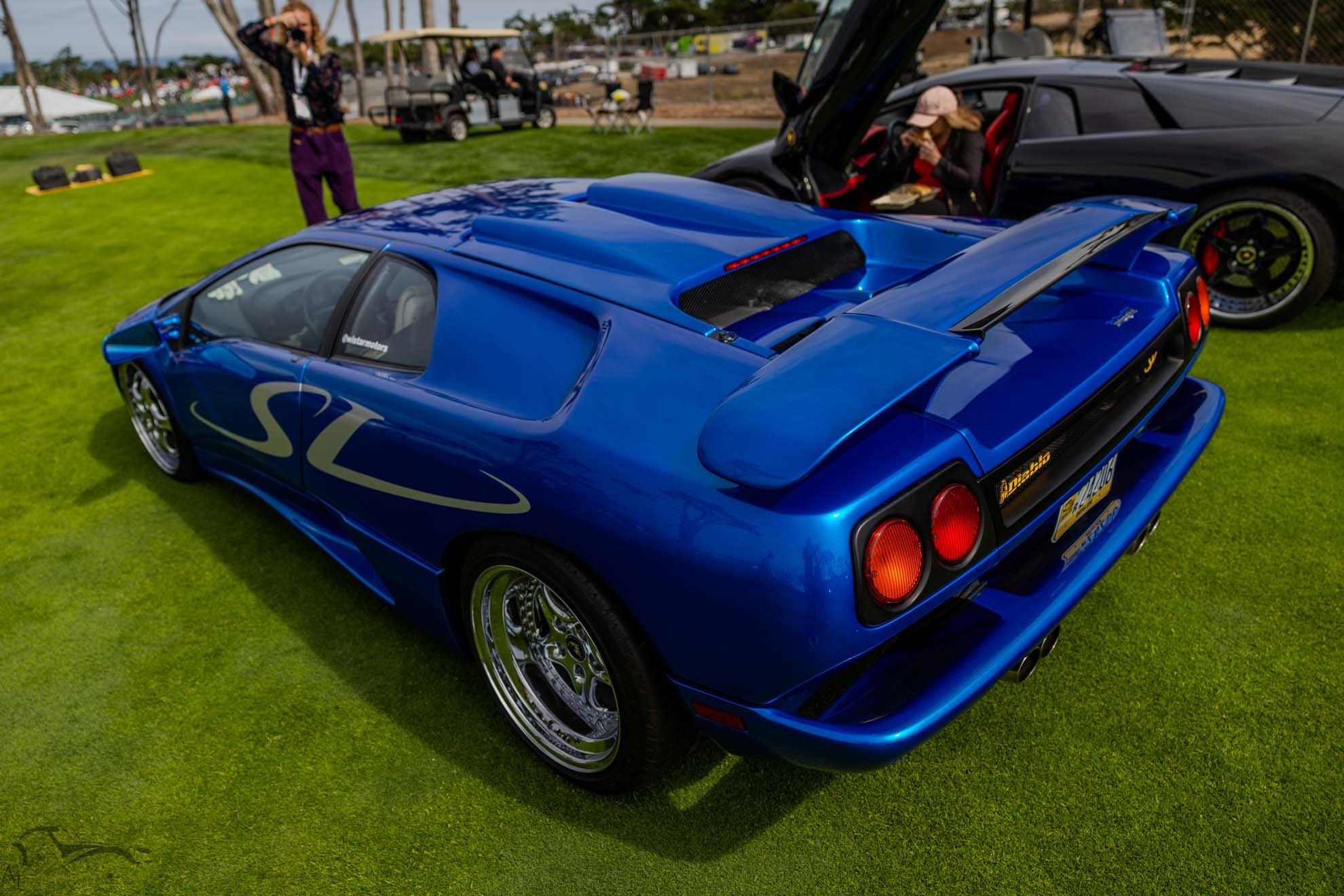
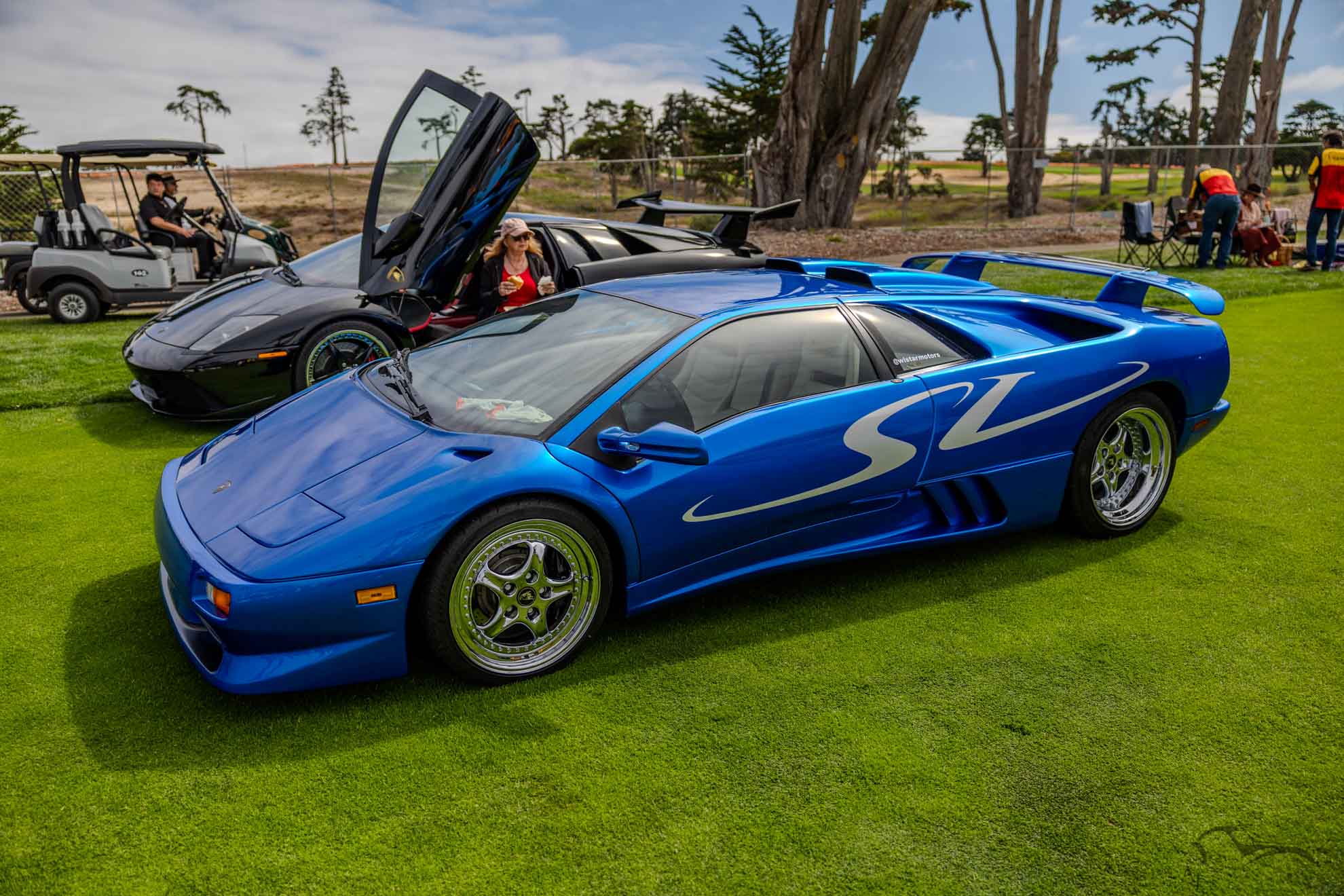
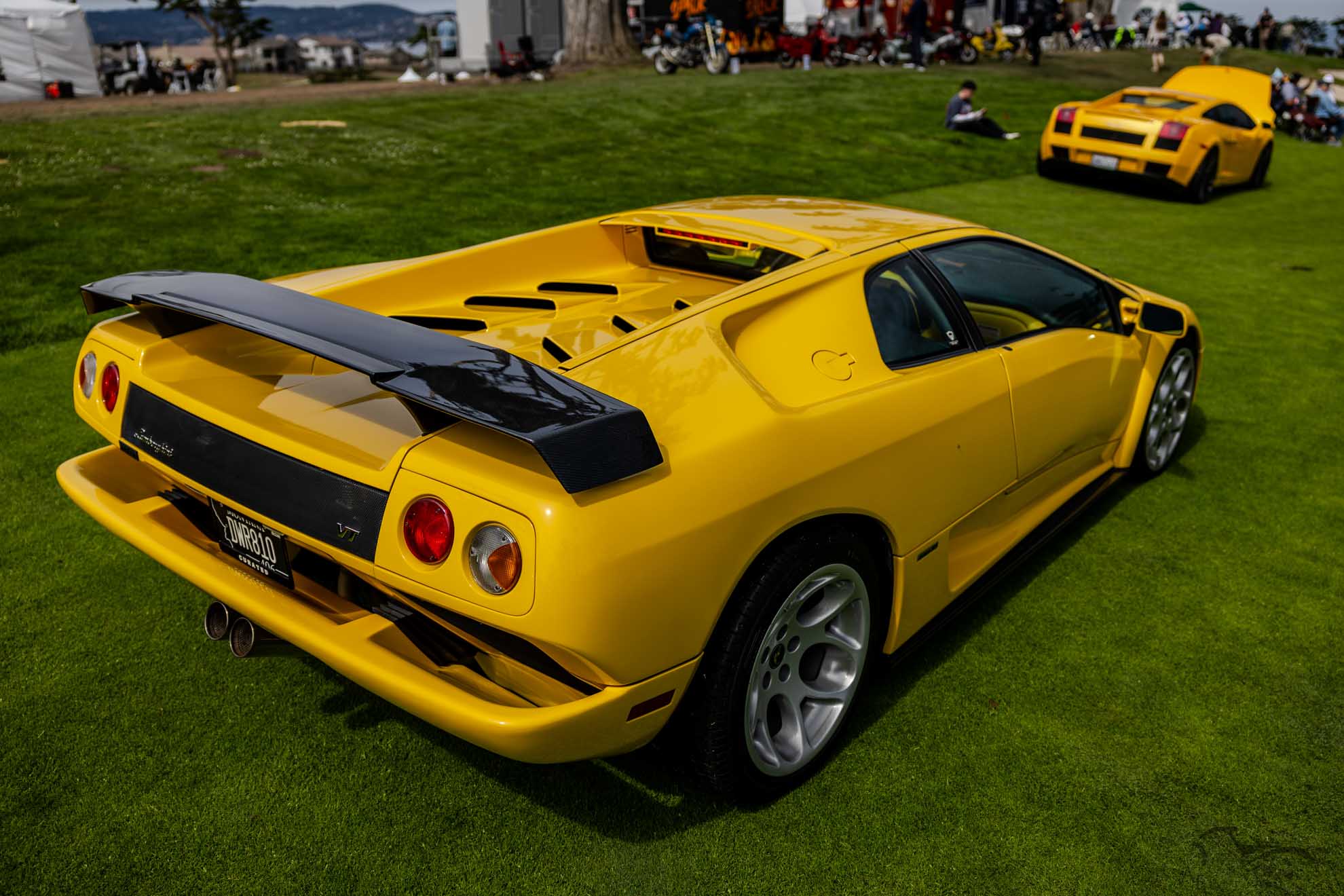
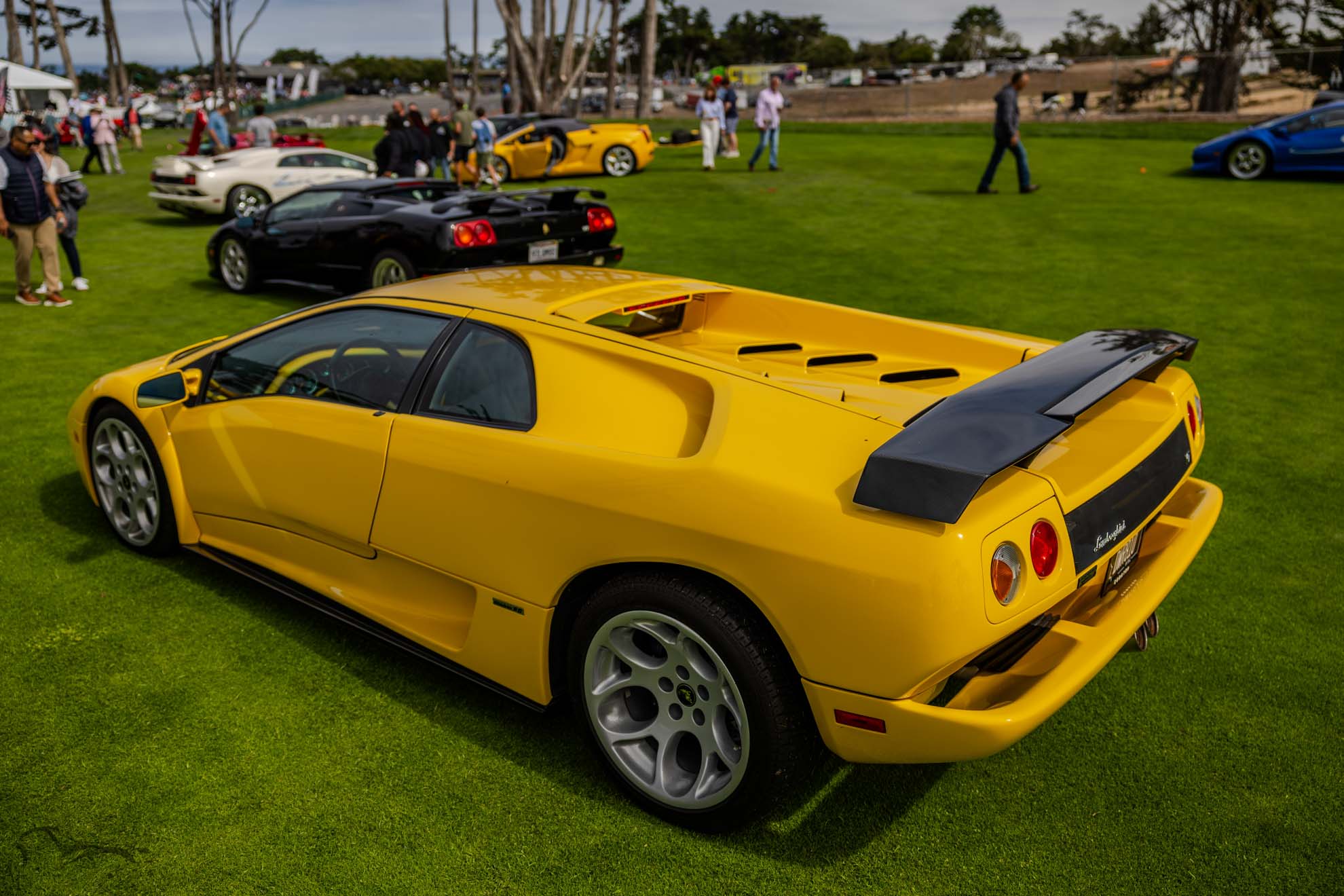
PHOTO NOTE — 0T9A2462.jpg / 0T9A2463.jpg — Yellow Lamborghini Diablo VT 6.0
The yellow Diablo 6.0 represented the final, heavily revised end of the model’s development. Introduced after Audi took control of Lamborghini, it received an improved cabin, altered bodywork and a 6.0-litre V12, while retaining all-wheel drive.
The 6.0 is often considered the best Diablo to drive, but some of the rawness had inevitably been removed. An early rear-wheel-drive car feels like the last product of old Lamborghini; the 6.0 feels like the first genuinely modern one. I would want the reliability and finish of the 6.0 with the simpler appearance of an early car, which of course is not how reality works.
Murciélago: the last manual V12 Lamborghini generation
PHOTO NOTE — 0T9A2456.jpg — Black Lamborghini Murciélago Roadster
The black Murciélago Roadster looked almost discreet after the Diablo display. Introduced in 2004, it retained Lamborghini’s V12 and scissor doors but used a removable soft roof officially intended only for low-speed emergency use.
Like the 550 Barchetta, it is a roadster designed on the assumption that the weather will cooperate. The Murciélago is larger and heavier than a Diablo, but also much more stable and usable. Early cars could still be ordered with a manual gearbox, making them increasingly desirable today.
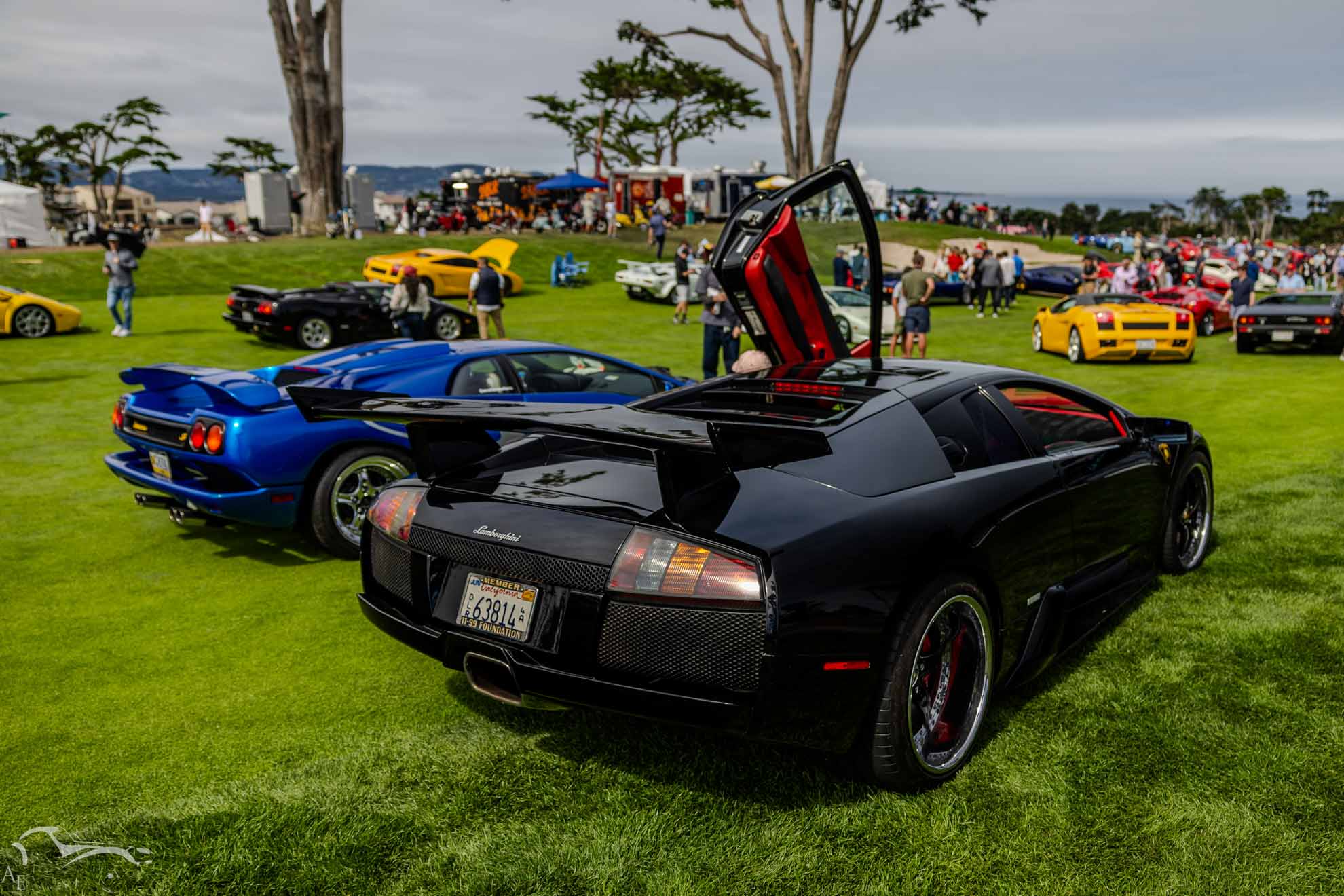
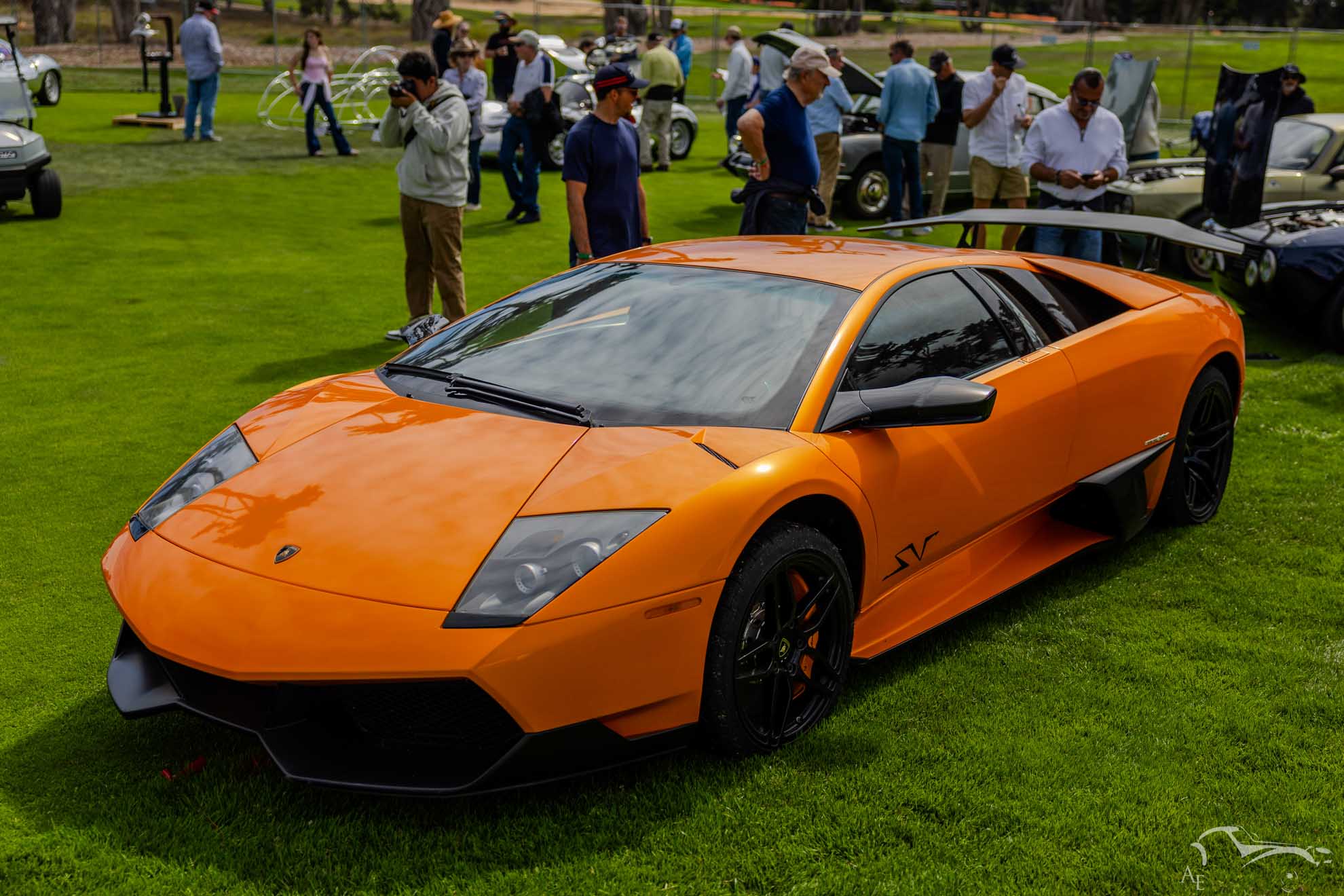
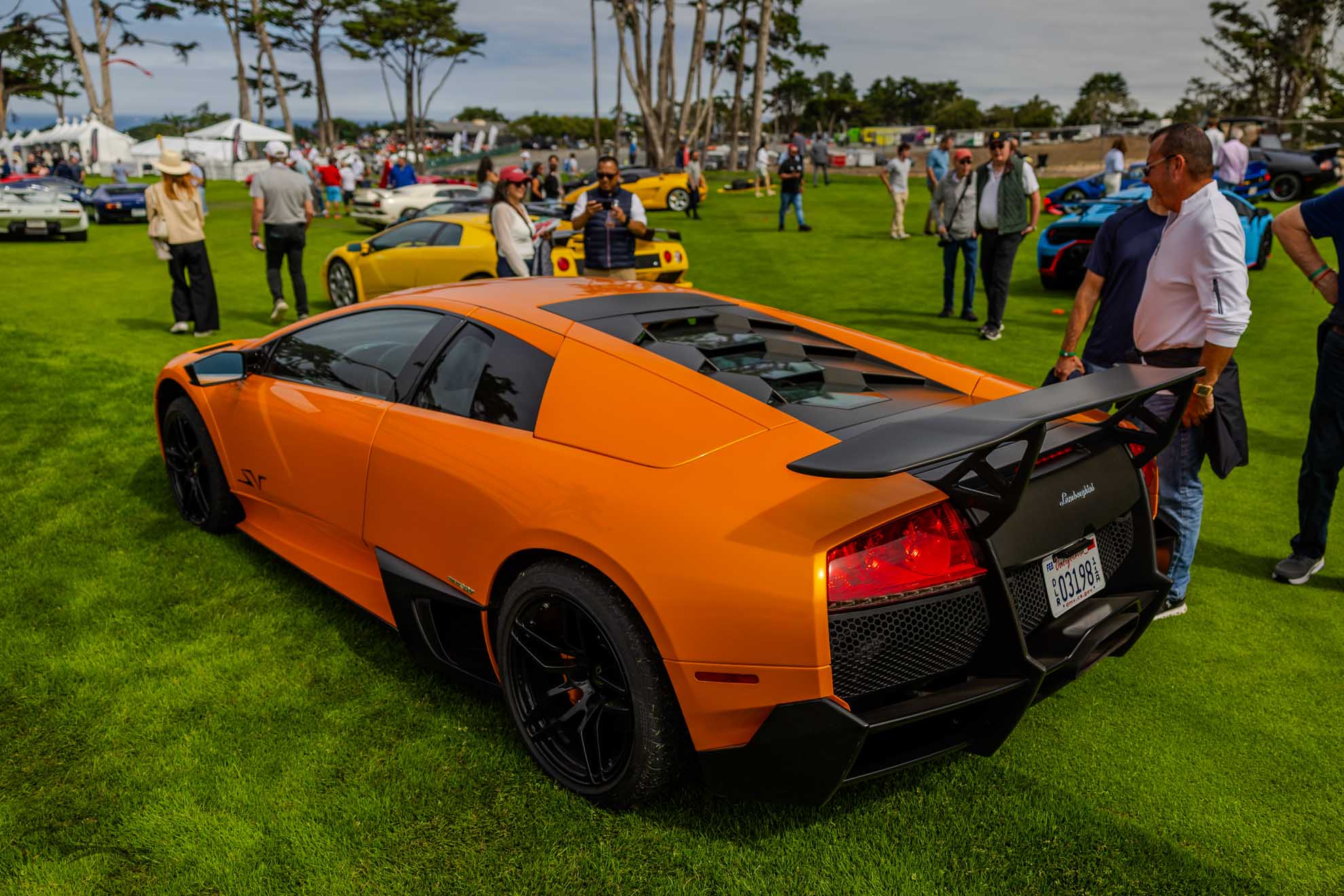
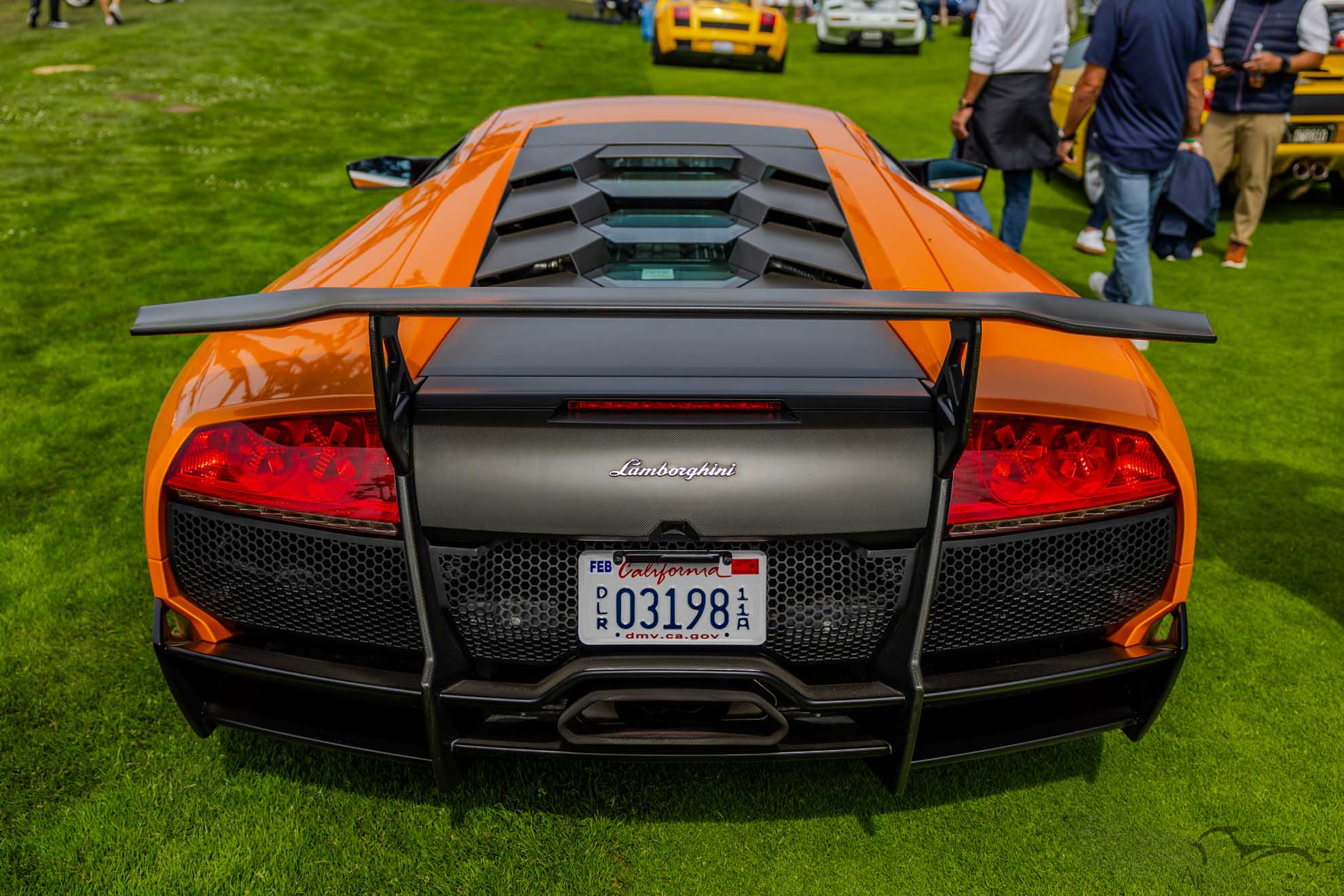
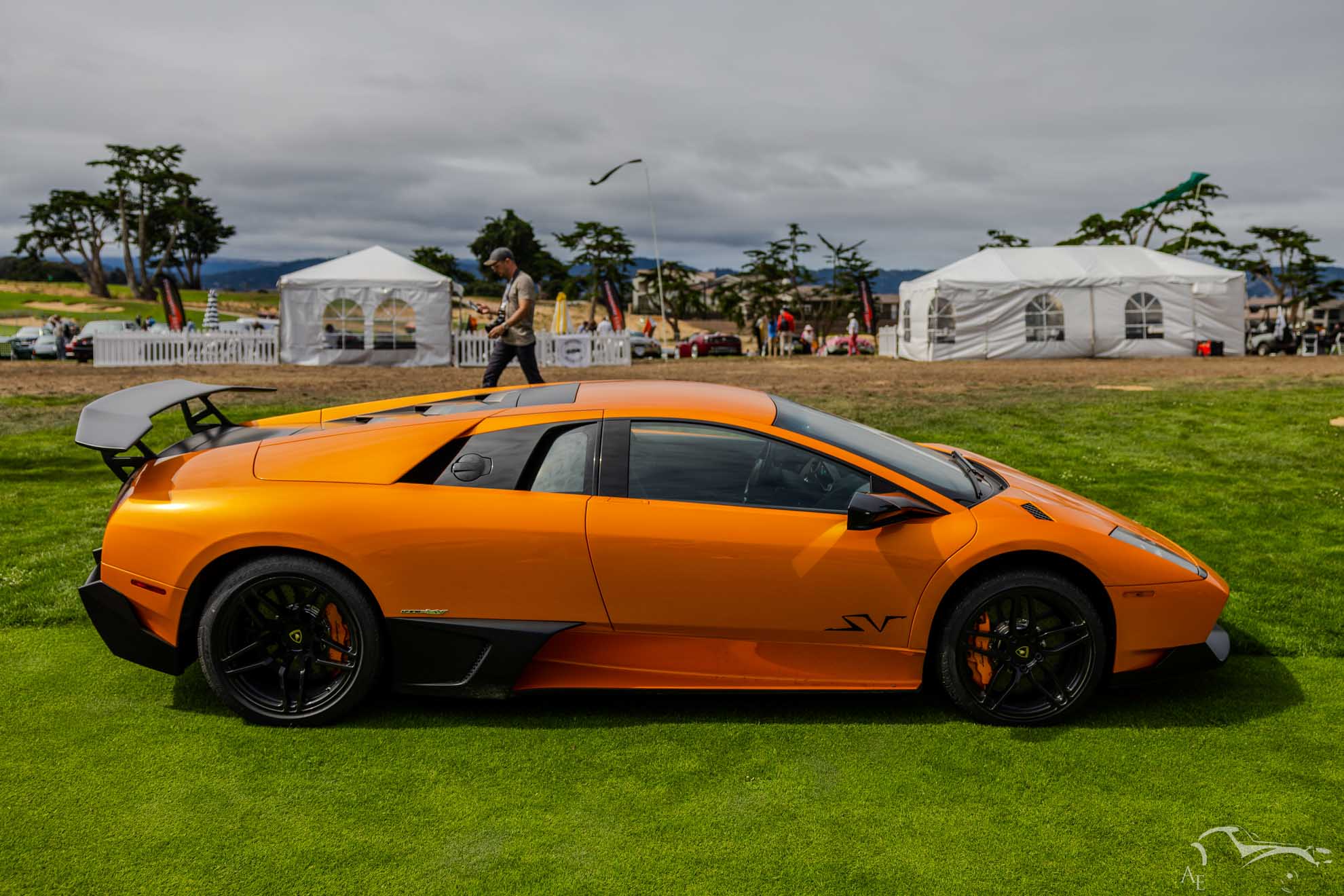
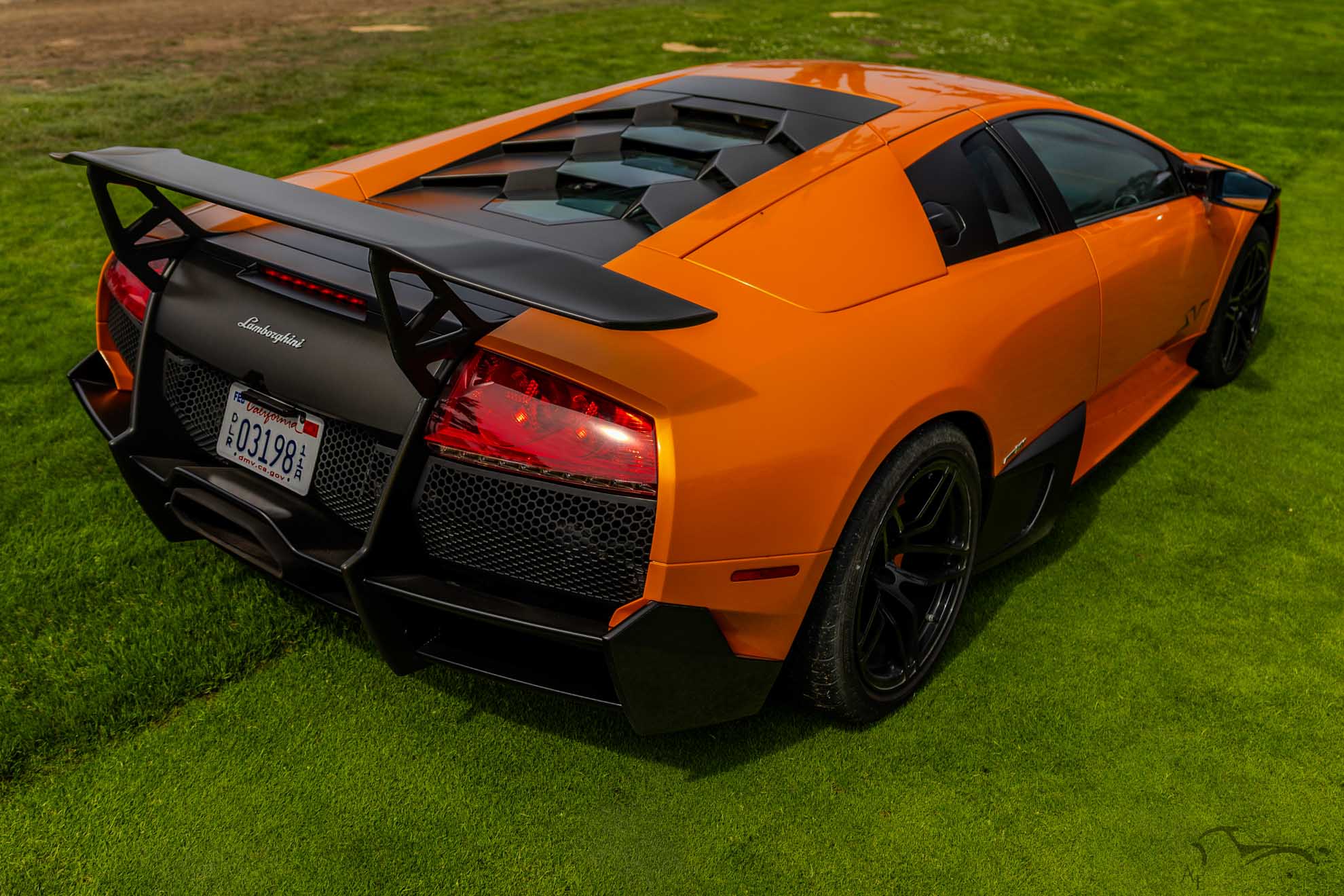
PHOTO NOTE — 0T9A2466.jpg / 0T9A2468.jpg / 0T9A2469.jpg / 0T9A2470.jpg — Orange Lamborghini Murciélago LP 670-4 SuperVeloce
The orange Murciélago LP 670-4 SuperVeloce was the ultimate factory evolution. Lamborghini extracted 670 horsepower from the 6.5-litre V12, removed roughly 100 kilograms and added a much more aggressive aerodynamic package. Official figures quoted 0–100 km/h in 3.2 seconds and a top speed up to 342 km/h depending on the rear wing.
Only a small number were produced before Murciélago production ended, making the SV one of the defining modern collector Lamborghinis. Orange with black details is not subtle, but an LP 670-4 SV should not be subtle.
I prefer the design without the largest optional rear wing, as it preserves more of the original Murciélago shape. Many people will disagree, because on a SuperVeloce visual restraint can sound like missing the entire point.
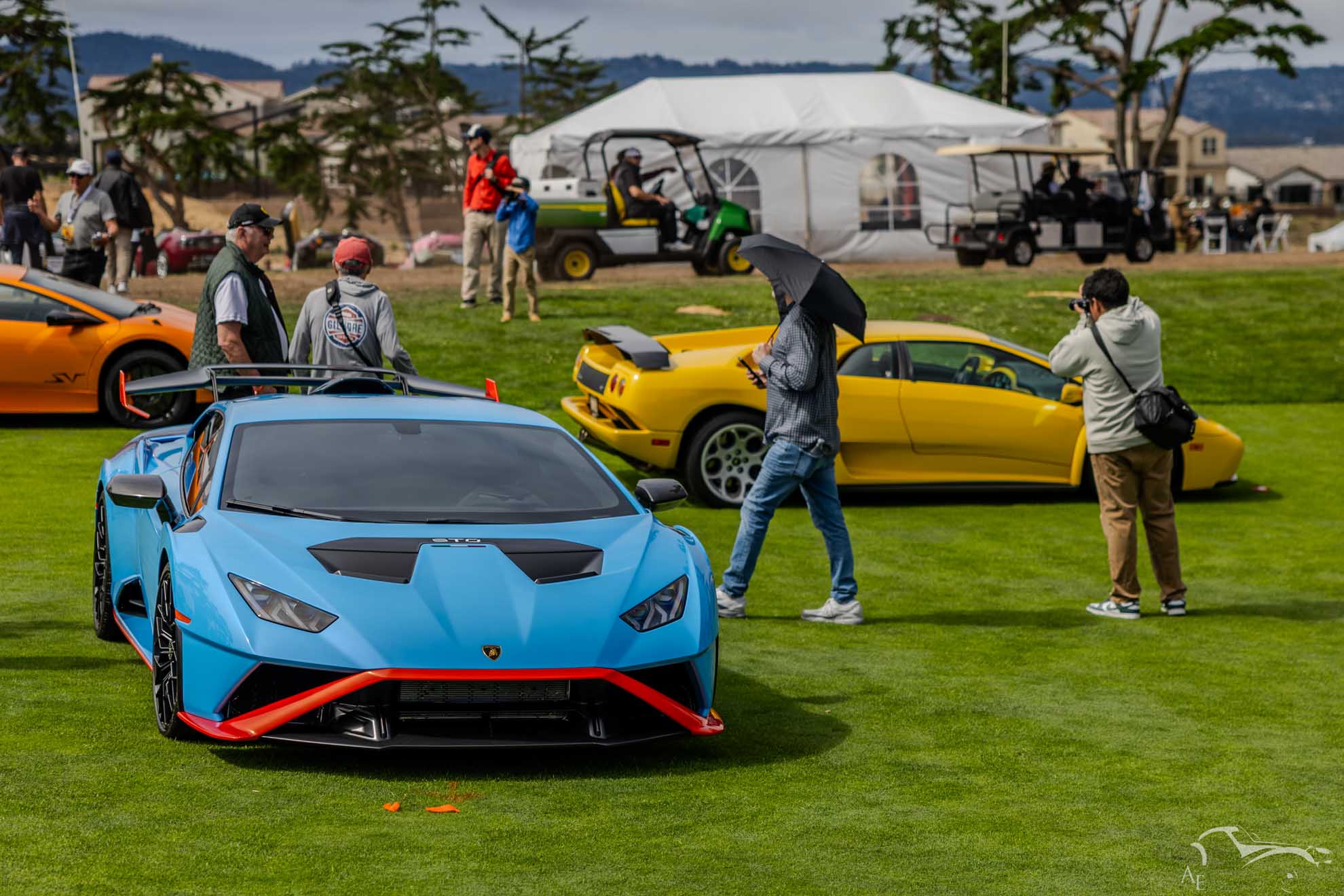
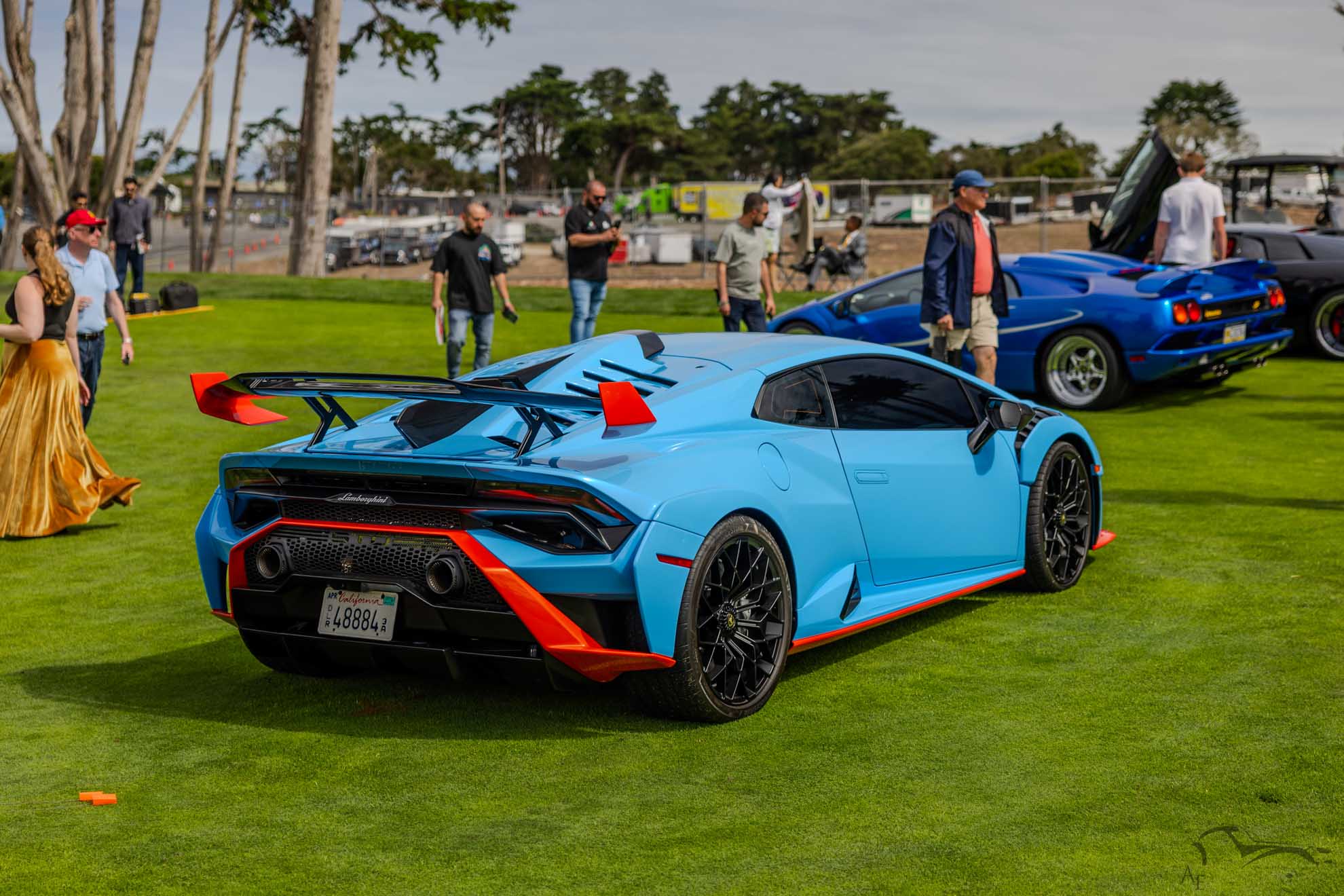
The light blue Huracán STO represented the modern naturally aspirated V10 branch. Developed with extensive influence from the Super Trofeo and GT3 racing programmes, it sends 640 horsepower to the rear wheels and uses aggressive aerodynamics, lightweight panels and a one-piece front “cofango”.
The STO is one of the most visually complicated Lamborghinis ever made. In this light blue specification, the shapes were easier to read than on cars wearing three contrasting colors. It is not elegant, but it is honest about its purpose.
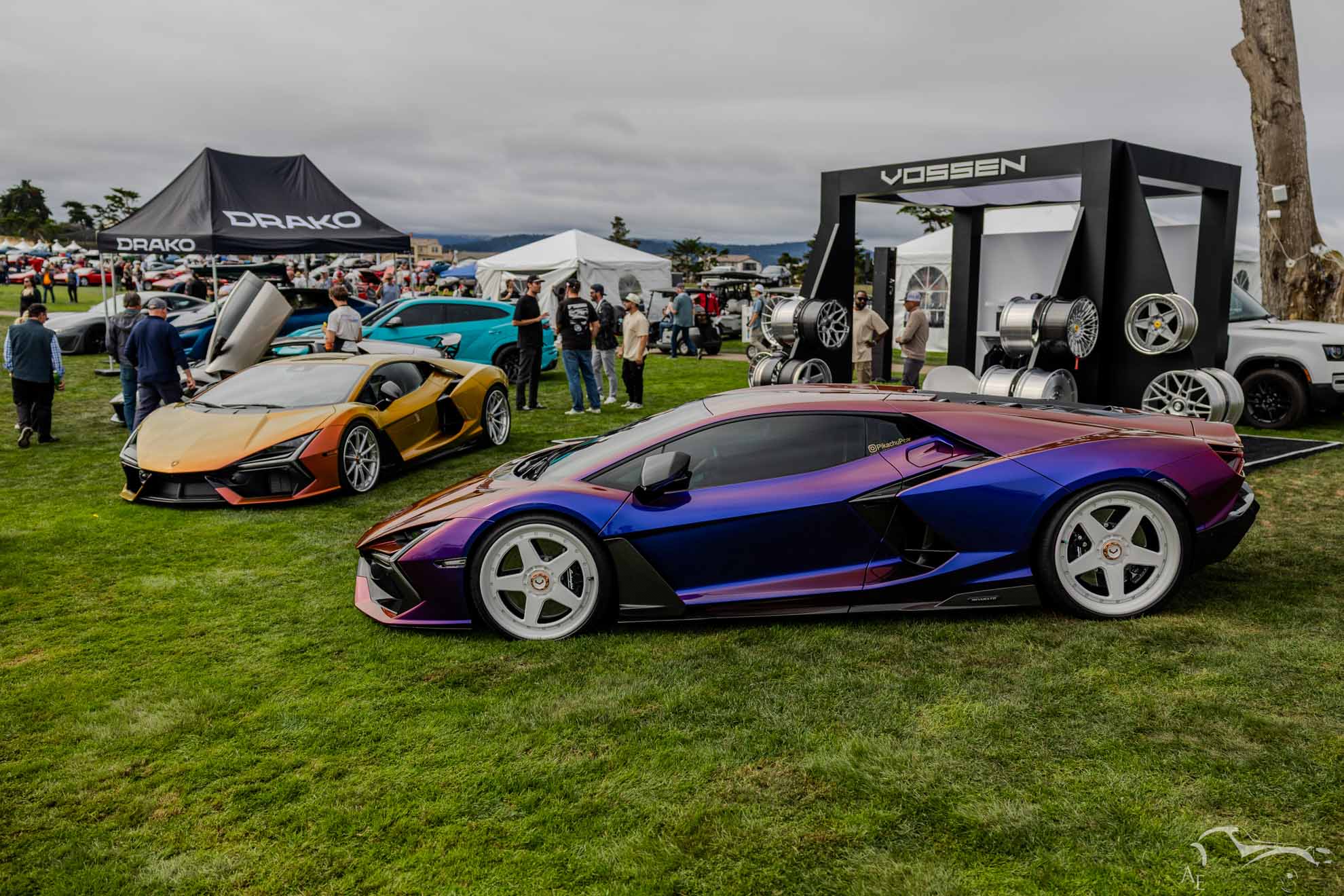
The iridescent violet-blue Revuelto brought the V12 story fully into the hybrid era. Its 6.5-litre naturally aspirated engine works with three electric motors and a new dual-clutch gearbox to produce a combined 1,015 CV.
The numbers are astonishing: 0–100 km/h in around 2.5 seconds and a top speed above 350 km/h. More important for Lamborghini identity, the company retained a naturally aspirated V12 rather than replacing it with a turbocharged engine.
The cost is complexity and mass. The benefit is that the V12 survives under modern emissions and performance requirements. I see the Revuelto as a compromise, but a very intelligent one. The alternative might not have been a lighter pure V12; it might have been no V12 at all.
Awards, atmosphere and why Concorso Italiano still matters
By mid-afternoon, the scale of the event had become clear. Concorso Italiano is not curated with the severity of Pebble Beach. A unique Cisitalia can sit within walking distance of a Fiat 850 Spider, a modern Ferrari SF90, a modified Pantera and an Alfa saloon. That mixture is both its strength and its weakness.
The advantage is variety. Italian automotive culture was never only Ferrari and Lamborghini, and the event gives equal emotional space to cars that sold in huge numbers and cars built almost one at a time. The disadvantage is that the field can feel overwhelming, and the quality or historical importance of individual entries varies considerably.
The official awards helped identify the cars that best represented the 40th anniversary edition. The Lawrence Auriana Collection’s 1947 Cisitalia Aerodinamica Coupé received Best of Show. Ethan Stark’s 1997 Lamborghini Diablo VT Roadster received the Valentino Balboni Award. Carl and Cindy Baker’s 1956 Pegaso Z103 Panoramica received Meguiar’s Best Finish. Phil White’s 1959 Maserati 3500 Vignale Prototype received the Chairman’s Award. Don Ferrari’s 2011 Ferrari 458 Italia received the Ferrari Club Best of Show, while Gary and Sue Choate’s 1973 Pantera L took the Pantera International Best of Show.
The Pegaso was among the cars I wish I had photographed more carefully. The Maserati prototype was in fact already in my files; it was a useful reminder that at a show this large, understanding what you photographed can take considerably longer than photographing it.
Concorso Italiano also continued to include a Global Exotics area, explaining the presence of cars such as the Aston Martin, Spyker, BMW and Ford seen in both this event and the Paddock. Purists may argue that a concours called “Italiano” should remain exclusively Italian. I understand the objection, but the separate category prevents the identity from being diluted too heavily and gives visitors a few unexpected contrasts.
What remained most memorable was not a single horsepower number or concours result. It was seeing the continuity. A 1925 Lancia Lambda sat at the same event as a 1,015-CV Revuelto. The Cisitalia showed how much could be achieved with modest Fiat-derived components and clever aerodynamics; the SF90 showed what happens when computing power, electric motors and a V8 are integrated into one system. The Fiat 850 Spider and Ferrari Enzo shared almost nothing mechanically, yet both were unmistakably products of an Italian belief that even an impractical car should create emotion before it moves.
My personal highlight was probably the Cisitalia 202 CMM Aerodinamica, because it was something I may not see again soon. The blue Miura SV was the car I would most like to drive away. The dark blue Mistral Spyder was perhaps the most elegant, while Fiorella and the custom Pantera were the most gloriously unreasonable.
Would I recommend Concorso Italiano during Monterey Car Week? Clearly yes. It is large enough to require several hours, relaxed enough that those hours remain enjoyable, and varied enough that everybody will find a different favorite. Just do not make my mistake of starting the morning at Laguna Seca and assuming that arriving at 10:30 AM leaves plenty of time. At Car Week, there is never plenty of time.