
Mechanics, engineers, strategists, and drivers must endure twice around the clock to win the 24 Hours of Le Mans. However, the most critical link between the car and the asphalt is the tire. As the only element connecting the vehicle to the road, the Le Mans Hypercar tires operate under extreme forces at Circuit de la Sarthe, where Hypercars reach speeds of 350 km/h on the Mulsanne Straight. Text: Luca W. © Images: Michelin ©
Le Mans Hypercar tires: Technical insights and performance
Limited to an allocation of 56 tires per car for the main race, teams and official supplier Michelin must balance maximum performance with strict durability constraints.
Last year, the winning #83 AF Corse Ferrari 499P completed a single tire stint of 586 km, accounting for 11% of the total race distance.
Stopping from 325 kph to 95 kph in just 250 meters generates 2.7g of deceleration, putting immense pressure on a contact patch no larger than two sheets of A4 paper. At the Indianapolis curve, each tire must cope with loads up to 1,400 kg under combined braking and aerodynamic forces.
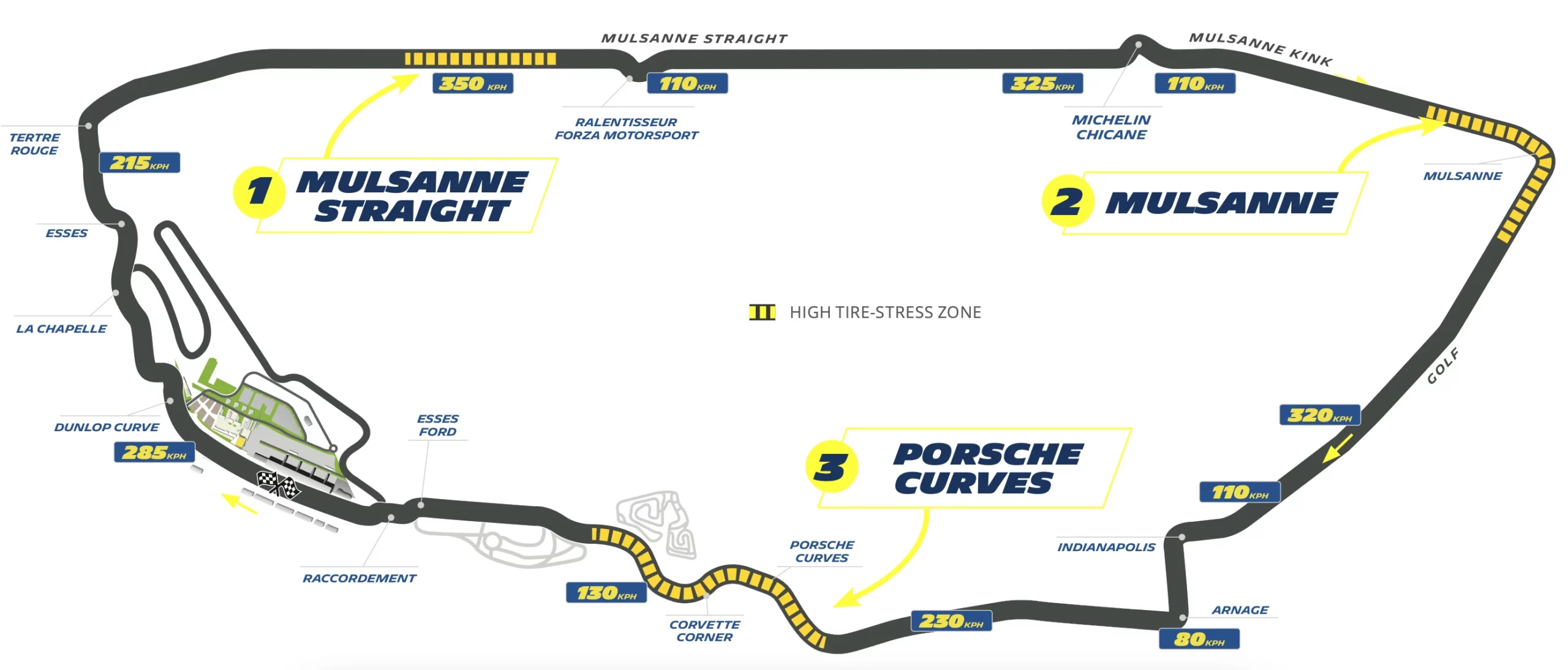
The Circuit de la Sarthe features 33 curves, with the Porsche Curves being the most demanding. Hypercars enter these corners at 250 kph, generating 3g of lateral acceleration while tire temperatures reach 120°C.
Strategic and regulatory context
Regulations ban pre-heating devices, forcing Michelin to develop Le Mans Hypercar tires compound that warm up rapidly without compromising long-term stint wear. To meet FIA and ACO sustainability goals, all Michelin Pilot Sport Endurance tires range consists of 50 percent renewable and recycled materials.
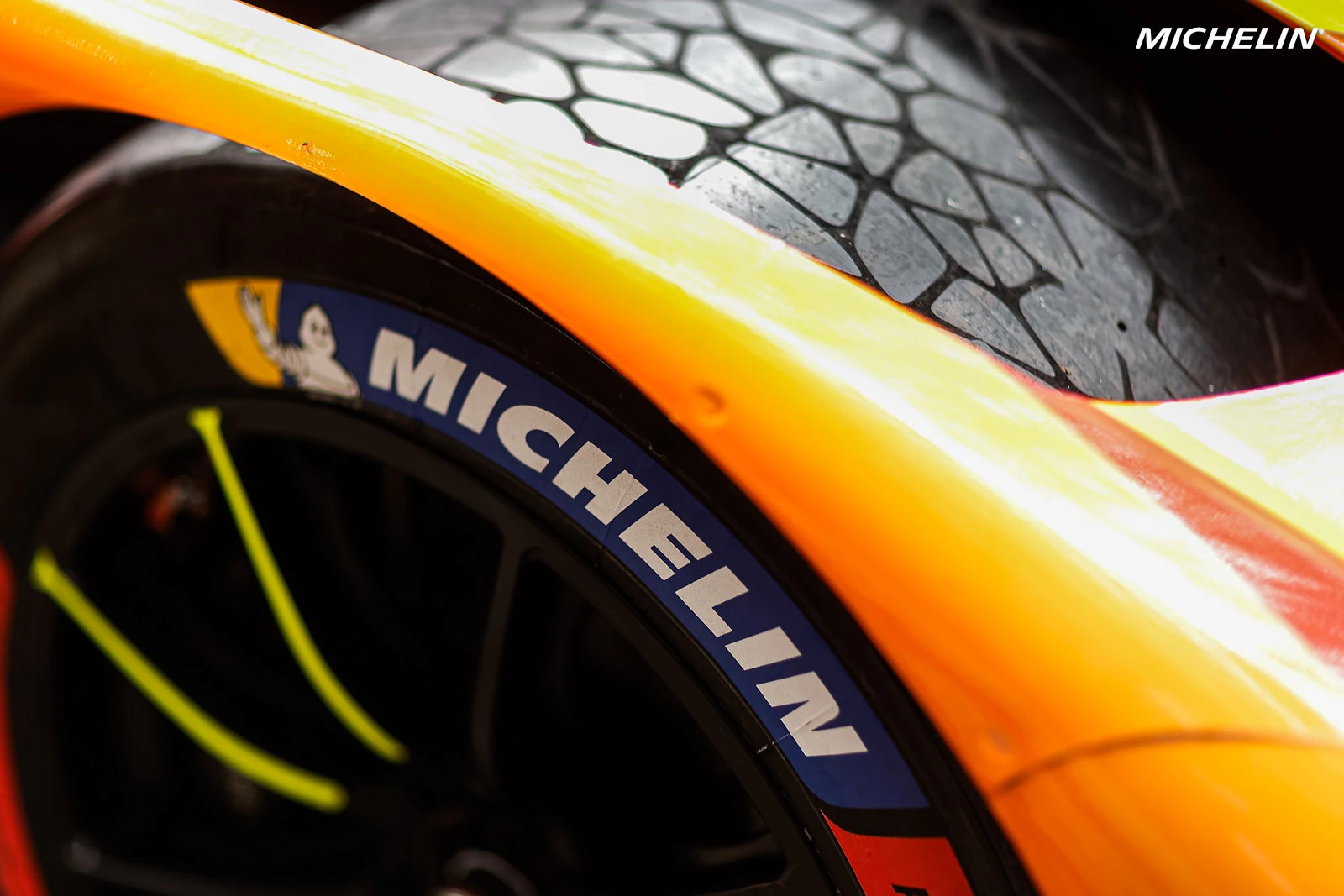
The 50% renewable tire is available in four specifications for the Hypercar category. The soft compound suits dry or slightly damp conditions with low temperatures, though it is not inherently the fastest option. The medium compound serves as the optimal and most versatile choice for standard dry conditions. The hard compound is reserved for high track temperatures and severe loads.
For wet conditions, the tires can evacuate 120 liters of water per second at 200 km/h, equating to 28,000 liters per lap.
| Compound | Sidewall Color | Condition |
| Soft | White | Cool (below 15°C) or damp |
| Medium | Yellow | Standard dry |
| Hard | Red | High heat (over 30°C) and load |
| Wet | Blue | Rain |
Slick tire dimensions are 29/71-18 for the front and 34/71-18 for the rear, requiring a nominal minimum pressure of 26.1 PSI at the front and 27.6 PSI at the rear.
The tire allocation rules are highly restricted to control costs and logistics. For the event, teams receive 24 tires for Free Practice and Qualifying, 12 tires for Hyperpole, and 56 tires for the main race.
Across the 18 Hypercar entries, Michelin supplies a total of 4,000 tires throughout the entire event.
Managing these tires is a decisive strategic factor over 24 hours. The interplay between compound selection, stint length, and sustainability highlights the engineering precision required to conquer Le Mans, where the margin between victory and defeat relies heavily on rubber meeting the track.
