



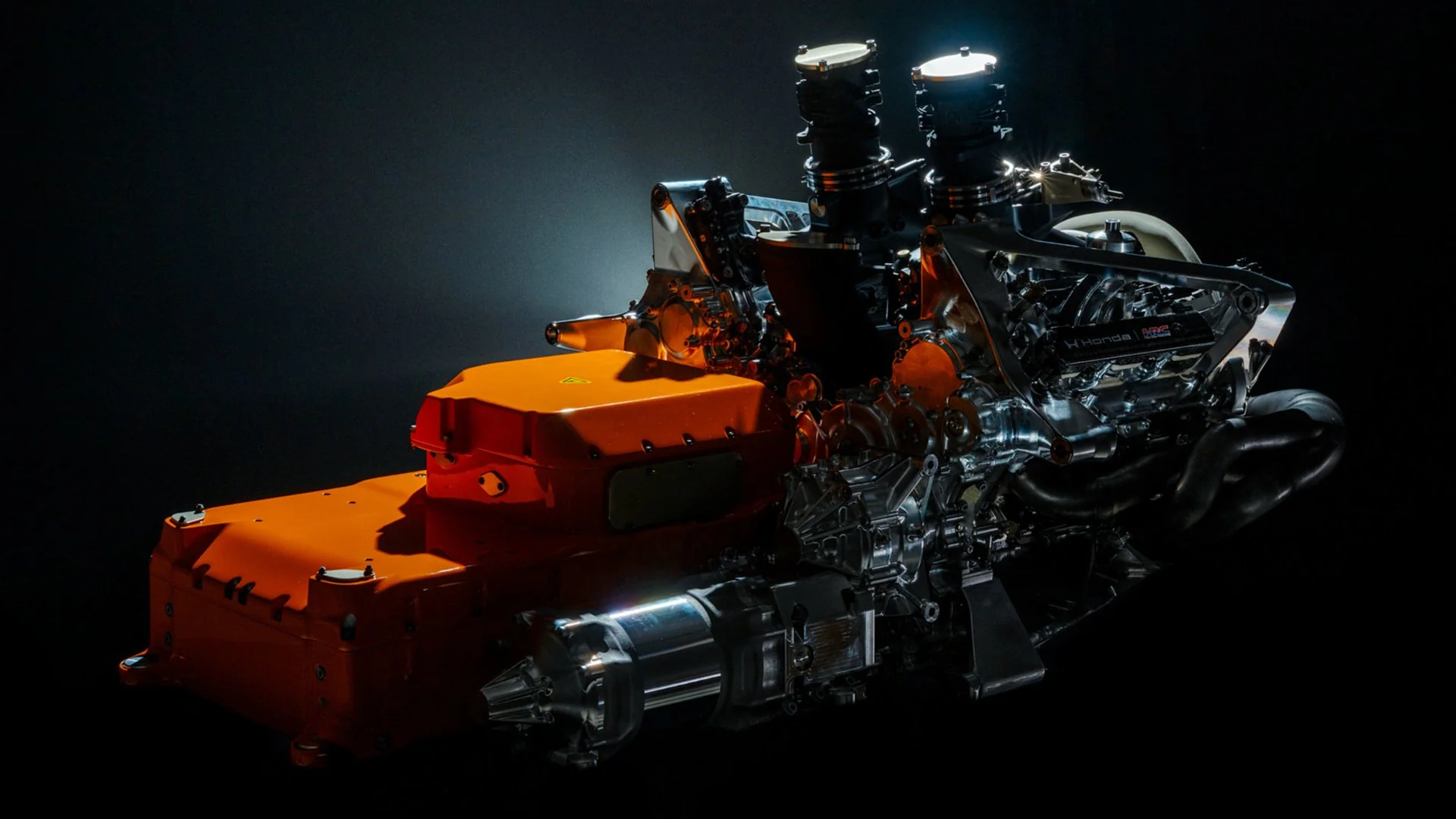
The 2026 power unit reset is the most consequential technical overhaul F1 has attempted in a generation. Four manufacturers are developing entirely new hybrid architectures simultaneously, with a radical 50/50 split between internal combustion and electrical power delivery. The risk of a performance gap emerging, and staying there, has never been greater. This is where ADUO comes in. Text: Luca W. © Image: HRC ©
The FIA knows this. Buried inside the 2026 PU technical regulations is a mechanism designed to prevent any manufacturer from falling so far behind that catching up becomes impossible, like in 2014. That mechanism is ADUO: the Additional Development and Upgrade Opportunities framework.
What is ADUO?
ADUO is a regulatory safety net embedded within the 2026-2030 power unit cycle. Its purpose is to preserve competitive integrity across a frozen-development formula by providing structured relief to manufacturers who fall below an acceptable performance threshold.
The mechanism is triggered when a power unit supplier demonstrates a deficit of between 2% and 4% or more against the benchmark, measured across thermal efficiency, MGU-K deployment, and overall power output, using FIA telemetry data as the objective reference.
Crucially, this isn’t assessed from race one. The FIA conducts its formal evaluation after the first six races. A defined checkpoint designed to produce a statistically meaningful dataset rather than react to early-season noise. Only once that deficit is confirmed does the struggling manufacturer unlock resources beyond what the standard engine freeze permits.
The catch-up mechanics
When a manufacturer qualifies for ADUO, the FIA unlocks additional resources proportional to the deficit, which can include:
- Increased dyno testing hours beyond the standard allocation
- Extra homologation upgrade tokens for ICE and hybrid components
- Relaxed development restrictions on performance-critical areas
The larger the gap, the more headroom granted. But here’s what most commentary glosses over: ADUO relief does not produce a mid-season hardware fix.
Power unit development lead times are measured in months, not weeks. Unlike an aerodynamic update, where a revised floor can move from CFD to trackside within a few race cycles, a redesigned ICE component requires materials validation, dyno sign-off, and FIA homologation. You cannot redesign a combustion chamber between race weekends.
In practice, the realistic impact of an ADUO award falls into one of two windows:
- The following season’s car: the most likely route, where a full development cycle applies to the next homologated specification
- The third ICE deployment: teams carry just three power units per season, so the final third of the year is the only plausible mid-campaign window, and only if timelines allow
- The Ferrari method: introduce a new engine in Spa, in the 2026 season
ADUO is a structural correction tool, not an emergency patch. The FIA monitors benchmarking data throughout the season to ensure relief targets genuine deficits, not opportunities to leapfrog competitors already within the accepted band.
As usual: fairness vs. innovation
Audi and Red Bull Powertrains (with Ford) are building PU programmes from a standing start. If either emerges from 2026 with a meaningful deficit against Ferrari or Mercedes, who carry decades of hybrid expertise, ADUO provides a structured path back. Given the earliest hardware response likely lands in the 2027 specification, the mechanism also removes the panic incentive: there is a regulated route to competitiveness, not a cliff edge.
Incumbent manufacturers see a philosophical tension. Ferrari and Mercedes invested years achieving their levels of thermal efficiency and MGU-K integration. Accelerating a rival’s development cycle edges toward the Balance of Performance debate that has long made F1 purists uneasy.
But the counterargument holds: a sport where one manufacturer dominates five locked years loses sponsors, teams, and audiences. ADUO is not a BoP system: it doesn’t artificially equalise performance. It simply ensures the floor cannot collapse and stay there.
What is ADUO’s bigger picture
The six-race assessment window, tiered development relief, and the hard constraint of three ICEs per season all point to a system built for the long game. ADUO won’t rescue a struggling manufacturer’s 2026 season. But it might define their 2027, and in a five-year freeze, that is everything.
Does a post-six-race correction window give newcomers like Audi enough of a safety net, or is the timeline still too slow to matter?